

New research unlocks the mystery of leaf size
- Written by: Ian Wright, Associate Professor in the Department of Biological Sciences, Macquarie University
Why is a banana leaf a million times bigger than a common heather leaf? Why are leaves generally much larger in tropical jungles than in temperate forests and deserts? The textbooks say it’s a balance between water availability and overheating.
But new research, published today in Science, has found it’s not that simple. Actually, in much of the world the key limiting factor for leaf size is night temperature and the risk of frost damage to leaves.
As a plant ecologist, I try to understand variation in plant traits (the physical, chemical and physiological properties of their tissues) and how this variation affects plant function in different ecosystems.
Read more: How we found out there are three trillion trees on Earth
For this study I worked with 16 colleagues from Australia, the UK, Canada, Argentina, the US, Estonia, Spain and China to analyse leaves from more than 7,600 species. We then teamed the data with new theory to create a model that can predict the maximum viable leaf size anywhere in the world, based on the dual risks of daytime overheating and night-time freezing.
These findings will be used to improve global vegetation models, which are used to predict how vegetation will change under climate change, and also to better understand past climates from leaf fossils.
 Conifers, which grow in very cold climates, grow thin needles less vulnerable to frost.
Peter Reich
Conifers, which grow in very cold climates, grow thin needles less vulnerable to frost.
Peter Reich
The world’s plant species vary enormously in the typical size of their leaves; from 1 square millimetre in desert species such as common eutaxia (Eutaxia microphylla), or in common heather (Calluna vulgaris) in Europe, to as much as 1 square metre in tropical species like Musa textilis, the Filipino banana tree.
But what is the physiological or ecological significance of all this variation in leaf size? How does it affect the way that plants “do business”, using leaves as protein-rich factories that trade water (transpiration) for carbon (photosynthesis), powered by energy from the sun?
More than a century ago, early plant ecologists such as Eugenius Warming argued that it was the high rainfall in the tropics that allowed large-leaved species to flourish there.
In the 1960s and ‘70s physicists and physiologists tackled the problem, showing that in mid-summer large leaves are more prone to overheating, requiring higher rates of “transpirational cooling” (a process akin to sweating) to avoid damage. This explained why many desert species have small leaves, and why species growing in cool, shaded understoreys (below the tree canopy) can have large leaves.
 Rainforest plants under the tree canopy can grow huge, complex leaves.
Ian Wright
Rainforest plants under the tree canopy can grow huge, complex leaves.
Ian Wright
But still there were missing pieces to this puzzle. For example, the tropics are both wet and hot, and these theories predicted disadvantages for large-leafed species in hot regions. And, in any case, overheating must surely be unlikely for leaves in many cooler parts of the world.
Our research aimed to find these missing pieces. By collecting samples from all continents, climate zones and plant types, our team found simple “rules” that appear to apply to all of the world’s plant species – rules that were not apparent from previous, more limited analyses.
We found the key factors are day and night temperatures, rainfall and solar radiation (largely determined by distance from the Equator and the amount of cloud cover). The interaction of these factors means that in hot and sunny regions that are also very dry, most species have small leaves, but in hot or sunny regions that receive high rainfall, many species have large leaves. Finally, in very cold regions (e.g. at high elevation, or at high northern latitudes), most species have small leaves.
 Understanding the mechanisms behind leaf size means leaf fossils – like these examples from the Eocene – can tell us more about climates in the past.
Peter Wilf/Supplied
Understanding the mechanisms behind leaf size means leaf fossils – like these examples from the Eocene – can tell us more about climates in the past.
Peter Wilf/Supplied
But the most surprising results emerged from teaming the new theory for leaf size, leaf temperature and water use with the global data analyses, to investigate what sets the maximum size of leaves possible at any point on the globe.
This showed that over much of the world it is not summertime overheating that limits leaf sizes, but the risk of frost damage at night during cold months. To understand why, we needed to look at leaf boundary layers.
Every object has a boundary layer of still air (people included). This is why, when you’re cold, the hair on your arms sticks up: your body is trying to increase the insulating boundary of still air.
Larger leaves have thicker boundary layers, which means it is both harder for them to lose heat under hot conditions, and harder to absorb heat from their surroundings. This makes them vulnerable to cold nights, where heat is lost as long-wave radiation to the night-time sky.
So our research confirmed that in very hot and very dry regions the risk of daytime overheating seems to be the dominant control on leaf size. It demonstrated for the first time the broad importance of night-time chilling, a phenomenon previously thought important just in alpine regions.
Still, in the warm wet tropics, it seems there are no temperature-related limits to leaf size, provided enough water is available for transpirational cooling. In those cases other explanations need to be considered, such as the structural costs and benefits of displaying a given leaf area as a few large leaves versus many more, smaller leaves.
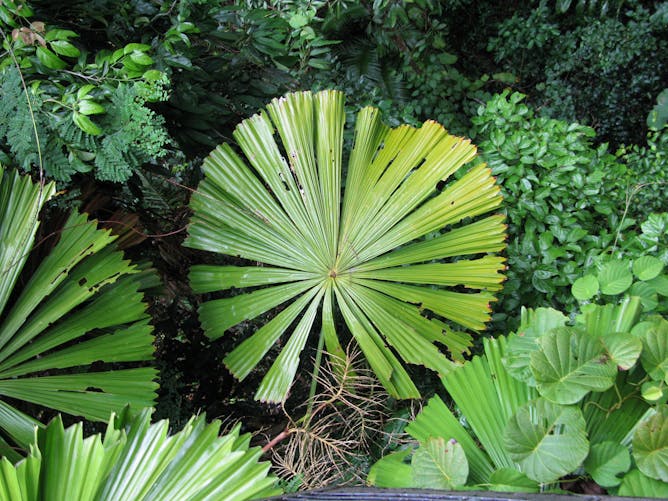 The view from a canopy crane at the Daintree in Queensland.
Peter Wilf
The view from a canopy crane at the Daintree in Queensland.
Peter Wilf
These findings have implications in several fields. Leaf temperature and water use play a key role in photosynthesis, the most fundamental plant physiological function. This knowledge has the potential to enrich “next-generation” vegetation models that are being used to predict regional-global shifts in plant nutrient, water and carbon use under climate change scenarios.
These models will aid the reconstruction of past climates from leaf macrofossils, and improve the ability of land managers and policymakers to predict the impact of a changing climate on the range limits to native plants, weeds and crops.
But our work is not done. Vegetation models still struggle to cope with and explain biodiversity. A key missing factor could be soil fertility, which varies both in space and time. Next, our team will work to incorporate interactions between soil properties and climate in their models.
Authors: Ian Wright, Associate Professor in the Department of Biological Sciences, Macquarie University
Read more http://theconversation.com/new-research-unlocks-the-mystery-of-leaf-size-83294


 Daily Bulletin


