

How I came to know that I am a closet climate denier
- Written by: Joy Murray, Senior Research Fellow in Integrated Sustainability Analysis, School of Physics, Faculty of Science, University of Sydney
This article is part of an ongoing series from the Post-Truth Initiative, a Strategic Research Excellence Initiative at the University of Sydney. The series examines today’s post-truth problem in public discourse: the thriving economy of lies, bullshit and propaganda that threatens rational discourse and policy.
The project brings together scholars of media and communications, government and international relations, physics, philosophy, linguistics, and medicine, and is affiliated with the Sydney Social Sciences and Humanities Advanced Research Centre (SSSHARC), the Sydney Environment Institute and the Sydney Democracy Network.
What we believe and how we act don’t always stack up. Recently, in considering what it means to live in a post-truth world, I had cause to examine my understanding of how the world works and my actions on sustainability.
I realised I was, in effect, almost as much a climate denier as those who profess to be. Here’s how.
1.1 A way of understanding how the world works
I take a cybernetic view of the world. For me this means a holistic systems perspective based on circularity and feedback with a biological/evolutionary slant.
As I understand it, we learn and change as we bump up against the milieu we inhabit, which changes as we bump into it.
Our ontogeny – our life history since conception – determines what we contribute to that milieu, and the life histories of others determine what they take from it.
1.2 Sustainability
Now to the messages that we – the Integrated Sustainability Analysis (ISA) group at the University of Sydney – strive to communicate to the world.
Using input-output analysis, we put numbers to trends in emissions. We communicate on environmental and social sustainability through books, journals and conferences, showing how complex supply chains snake around the world.
We suggest that once producers, consumers and global corporations know the damage that is being done they will take action to stop it. Meanwhile, we discuss the motivations of climate deniers and wonder what we can do to change things.
1.3 The big collision
This is where I bump into my understanding of the world. What messages do people take from what we contribute to the milieu? Are they changed by the sustainability messages we try to communicate?
Dan Kahan and colleagues from the Yale Law School suggest that perception of risk from climate change depends on our cultural worldview: we dismiss risk if accepting it would mean social upheaval. Survival within the group, they say, trumps lifestyle change.
This fits with my understanding of how our ontogeny determines our survival needs and how our perception of survival within the group influences our actions. It also fits with my view about how people learn – we pick up from the surrounding milieu what fits with our views and ignore the rest.
I nodded along with Kahan, aligning myself with those trying to tell others of the risk. Until I realised there were two problems in such a position.
Problem one
The first problem is that my behaviour is little different from that of Kahan’s subjects. I live in Australia, which has the fifth-highest gross national income per capita. We also have the highest per-capita emissions in the OECD.
While I minimise waste and do my recycling, it would take a lifestyle upheaval to drop my household emissions to the sustainable share suggested by people like Peter Singer. So, I behave as though the call to act on climate change in an equitable way does not apply to me.
I am not alone in understanding the issues, being concerned about the consequences, and yet failing to act. It’s known as the “knowledge, concern, action paradox”.
Julien Vincent, writing about investors who ostensibly support the Paris Agreement yet fail to act, refers to this as a “much subtler, but no less damaging, form of denial”. He cites a case of Santos investors, aware of the consequences, professing concern, yet choosing to vote against a resolution that would have committed the company to conduct a 2°C scenario analysis.
It would seem that knowing the truth and professing concern about climate change are the easy parts. They cost nothing and allow us to claim the kudos that accrues to taking up such a position.
However, knowing the truth and professing concern without taking action is somewhat disingenuous. At worst it is living a lie, akin to being a closet climate denier.
So, even when recognising this truth/action/denial dilemma, why don’t we act? George Marshall, in his book Don’t Even Think About It, provides an insight. He discusses our evolutionary origins, our perception of threats, including climate change, and our instincts to protect family and tribe.
This resonates with my take on cybernetics, which suggests I live the way I do because I need to survive in my physical, economic, social and cultural environment; and because in a different era it would have given my offspring the best chance of survival.
It doesn’t let me off the hook – I still need to take action to lower my emissions – but it reminds me I shouldn’t be so quick to judge. I’m as much a part of the system as anyone else.
Meanwhile, my cybernetic take on life says that whatever we put into the milieu matters. So even though very few of us living in high-income countries can reduce our emissions to an equitable share, whatever actions we take to reduce them contribute to the world of tomorrow, next week, next year. They change the milieu, which changes the possibilities for change.
Problem two
Putting myself outside the system leads to the second problem, which is contingent on the first and means that if I can’t change my own actions I can’t expect to change those of others.
For while I shout about climate change, hoping others will hear what I say and act on it, in so many ways I communicate that I’m not acting on it myself.
 Al Gore is a prime example of someone whose large carbon footprint has affected responses to his message.
Reuters
Al Gore is a prime example of someone whose large carbon footprint has affected responses to his message.
Reuters
A recent online survey showed that a researcher’s perceived carbon footprint affected her/his credibility and influenced the participants’ intentions to change their energy consumption.
If I know the figures, accept the science and yet continue to lead my rich nation lifestyle, I’m fair game as an excuse, conscious or not, for the deniers to continue their climate-indifferent lifestyles.
This doesn’t mean sharing our research is a waste of time. It provides valuable information about the social, economic and environmental effects of doing business; again, it changes the milieu. But it’s highly unlikely that people will read it and change what they do, which is a far more complex process.
Changing attitudes and action
Much research has been devoted to the question of how, and how not, to influence people’s responses to the threats posed by climate change.
Michael Mann is wary of scare campaigns as a motivating force. Bob Costanza and colleagues suggest that scare campaigns from scientists and activists alike are not the answer to weaning us off our addiction to an unsustainable lifestyle.
There’s research to suggest that enlisting the help of a trusted community member might be an effective alternative. Having an advocate present benefits of a low-carbon lifestyle, framed around community issues like energy security rather than climate change, has had some success.
Such an approach could help provide a way to take action for people who know about the science but whose political affiliations and values position them at the climate denial end of the spectrum, regardless of their knowledge.
However, it may not help those of us whose political affiliations and values are aligned with acting on climate change, yet still find it hard to act.
Probably more pertinent to our case is research showing that our actions on climate change are circumscribed not only by the political and cultural contexts that we inhabit but also by the infrastructure provided by them. That’s because this infrastructure forms the milieu that enfolds our lives.
So, where to from here?
If this is the case, then resolution to my first problem might require a significant change to the web of edifices that support my lifestyle. It would take a climate-friendly government with a narrative that normalises action on climate change to make it easy for me to survive in the group and live a low-carbon lifestyle.
Sweden provides an example of what this could look like. For many countries, though, a shift in the national narrative might seem impossible.
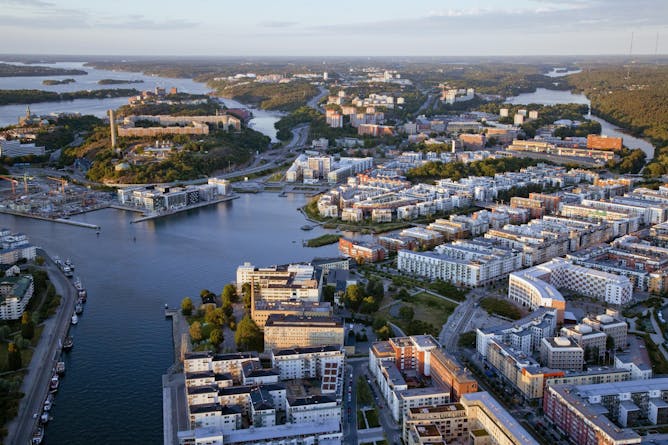 In Sweden, a rare example of a rich nation with low emissions, Hammarby in Stockholm is a model of environmentally friendly city development.
Ola Ericson/imagebank.sweden.se
In Sweden, a rare example of a rich nation with low emissions, Hammarby in Stockholm is a model of environmentally friendly city development.
Ola Ericson/imagebank.sweden.se
There are examples of dramatic change to a seemingly inviolable narrative, but they come with a “be careful what you wish for” label.
Recently, we’ve seen Bernie Sanders, Jeremy Corbyn, Nigel Farage and Donald Trump make spectacular changes to the political landscape. They illustrate the power of engaging at the community level, discussing local issues (albeit sometimes with the help of big data), portraying empathy and swearing commitment to local solutions.
These leaders have changed the discourse. A cybernetic take on the process might say that their acts of communication triggered a lifetime of connotations in their hearers. The hearers interpreted the message through the prism of their ontogeny, feeding back into the mix their personal understandings, amplifying the message and influencing others by their own communications.
This is a process that works for good or ill, depending where you stand. So a world leader with climate credentials and sufficient clout to make the low-carbon lifestyle message sound mainstream could change the world’s trajectory.
However, ranged against the wisdom of waiting for such a one is the ominous presence of big data companies with the capacity to help manipulate individuals as well as whole communities; uber-wealthy individuals and groups with the ability to influence leaders and world politics; and the top 10% of global income earners who are responsible for almost as much greenhouse gas emissions as the rest of us together.
All are acting out of their own survival instincts and are unlikely to succumb to any amount of persuasive argument from a climate-conscious leader.
So how else to change the milieu to support more of us in achieving a more sustainable lifestyle? Nobel prize-winning economist Elinor Ostrom’s view is that the planet’s salvation lies with communities everywhere bypassing governments and taking action themselves. In 2012 she wrote:
… evolutionary policymaking is already happening organically. In the absence of effective national and international legislation to curb greenhouse gases, a growing number of city leaders are acting to protect their citizens and economies.
Those mayors defying Trump’s exit from the Paris Agreement come to mind as examples.
Ostrom suggests that supporting distributed leadership is the answer. And, to bring us back to cybernetics, management cybernetics guru Stafford Beer did exactly that.
Beer took Ashby’s law of requisite variety and revolutionised the way business management operated. Ashby’s law tells us that only variety (or complexity) can control variety. That leaves 90% of the global population to bring together the system variety required to influence – Ashby says “control” – the very wealthy high-emissions minority.
So, I’m backing distributed leadership to overcome my own inability to cut my emissions further. Investing in the work of organisations that can act will be my proxy.
This may look like a slow haul to change the milieu so that action on climate change becomes normal life, but I’m counting on the snowballing power of amplification to make it happen sooner rather than later.
The complexity of the 90% will eventually trump that of the 10%, by which time my second problem should be irrelevant.
You can read other pieces in the post-truth series here.
The Democracy Futures series is a joint global initiative between The Conversation and the Sydney Democracy Network. The project aims to stimulate fresh thinking about the many challenges facing democracies in the 21st century.
Authors: Joy Murray, Senior Research Fellow in Integrated Sustainability Analysis, School of Physics, Faculty of Science, University of Sydney
Read more http://theconversation.com/how-i-came-to-know-that-i-am-a-closet-climate-denier-83039


 Daily Bulletin


