

Speed plus control in new computer chip: slowing down light to sound
- Written by: Moritz Merklein, PhD candidate in Brillouin optomechanics, University of Sydney
Light travels fast – sometimes a little too fast when it comes to data processing.
Published today, our paper describes a new memory chip design that allows us to temporarily slow down light to a manageable speed for better control of computer processing.
Light energy slows down to become sound, which allows more control.Light packets were successfully stored as high-pitch sound waves – about 1,000 times higher than ultrasound – in a wire on a microchip. Around 100-fold thinner than a human hair, the tiny wires were designed to guide light waves as well as high-frequency sound waves, known as hyper-sound.
It’s the first time this has been achieved.
The delay of the transferred information packet is caused by the large difference in speed of travel between light and sound. This is something we experience every time we try to determine how far a thunderstorm is away from us by counting the seconds between the lightning and the thunder.
Read more: Hold it right there: how (and why) to stop light in its tracks
Why we use light in computing
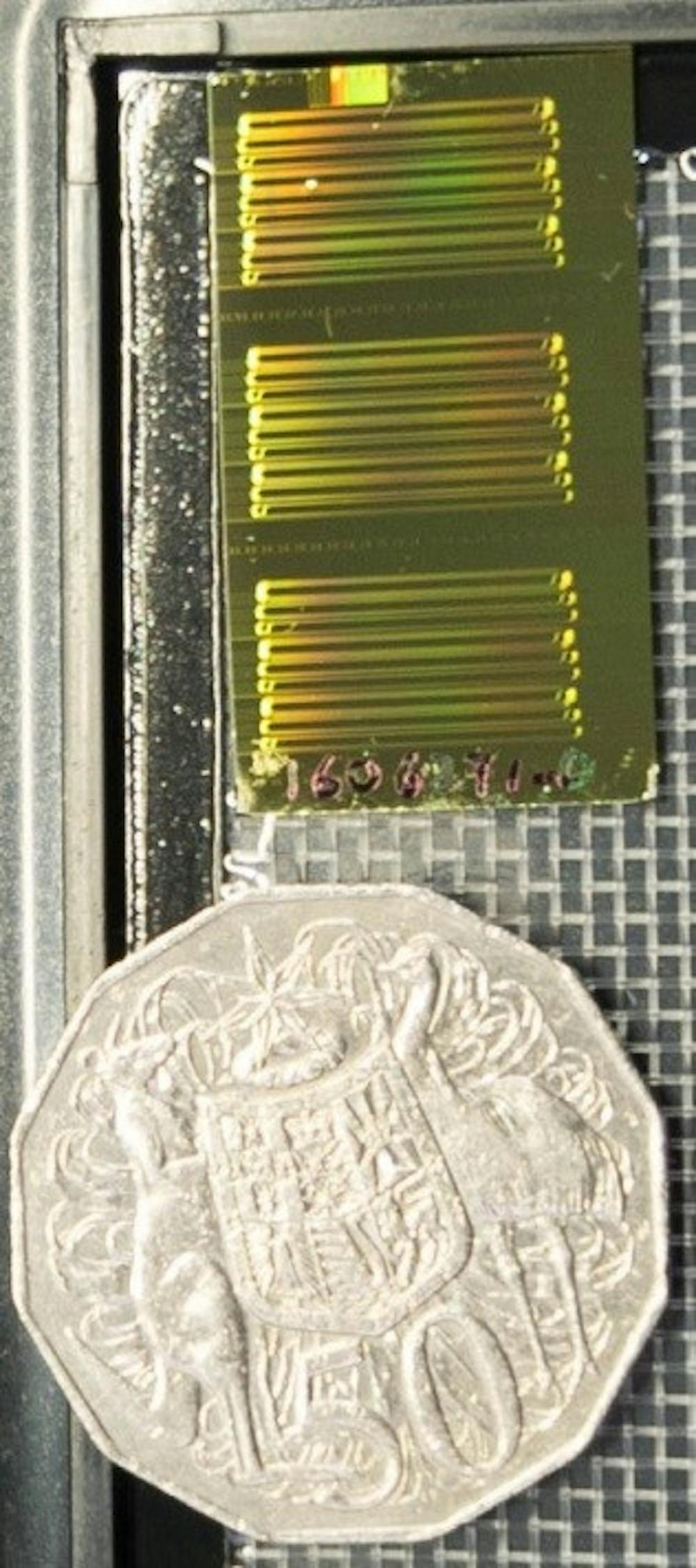 The new chip design, shown next to an Australian 50 cent piece.
University of Sydney, Author provided
The new chip design, shown next to an Australian 50 cent piece.
University of Sydney, Author provided
Today even small laptops use multiple processors, such as dual or quad cores. This is even more evident in high-performance machines, supercomputers or large data centres. Dividing computation between several processors is a way to improve performance, known in computer language as parallel computing.
This parallelisation, however, raises new issues: the different cores have to talk to each other and perform in sync, like a big orchestra. Here electronics starts to reach its limits. The connections between the processors suffer from losses and produce heat. This is the main reason why your laptop gets hot.
At industrial scales, the heat is becoming almost unmanageable. Just last month there was an announcement to build the world’s largest data centre inside the Arctic Circle, in order to deal with the heat problem of these centres.
Optical links between processors can help solve this problem: data encoded as light packets can provide large bandwidths, high speeds and do not produce heat.
A blessing and a curse
While the speed of light is of great advantage when sending data over the internet all around the globe, it is a real challenge to master on a small chip.
Light travels 300 metres in just a millionth of a second. To provide a connection between different processors, we need a way stop or delay the light at times when the receiving processor is still occupied. In other words, we need a buffer for light packets on a chip.
But buffering the optical data in common chip designs for electronic memory results in loss of speed and bandwidth.
Our new research shows all the characteristics of a light wave – that is, brightness, colour and phase – can be transferred to a hyper-sound wave, and by doing so can be buffered.
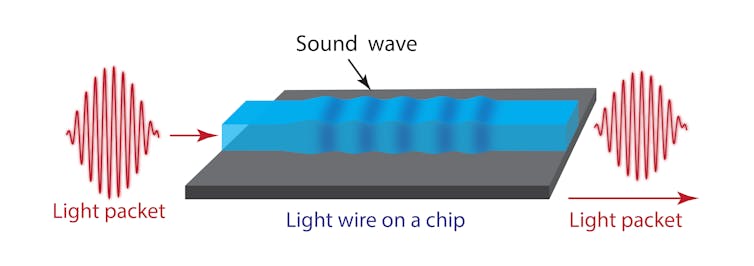 A light packet is converted to a sound wave as it moves through the chip, and then back to light as it exits.
University of Sydney, Author provided
A light packet is converted to a sound wave as it moves through the chip, and then back to light as it exits.
University of Sydney, Author provided
One reason for the large data rates achieved using light lies in its ability to carry data simultaneously at different wavelengths, or colours. Using multiple colours is like opening additional lanes on a crowded highway.
What we experience as different colour in the case of light is a different pitch for a sound wave. We show that different colours can be stored as different pitched sound waves, and importantly can be unambiguously identified afterwards.
Sound waves to store information
The basic operation principles of our new design – which features a phenomenon known as delay line memory – are the following:
- a processor encodes the freshly-calculated data on light packets, and sends it towards the next processor
- if this processor is still occupied, the light packet is transferred to a sound wave
- the sound wave travels a hundred thousand times slower towards the processor, giving it the required time to finish the computation
- the sound wave gets transferred back to a light packet, and can be further processed.
Read more: How scientists invent new colours
This process resembles the operation of the first computers built at the beginning of the 20th century. Here information was temporarily stored in sound waves that propagated in mercury tubes while the processors were occupied.
So as computer chips are reaching their performance limits, the old idea of a delay line-based memory using sound waves is celebrating a comeback. This time it’s not in bulky mercury tubes, but tiny light wires on a microchip that are capable of processing much more data.
Authors: Moritz Merklein, PhD candidate in Brillouin optomechanics, University of Sydney
Read more http://theconversation.com/speed-plus-control-in-new-computer-chip-slowing-down-light-to-sound-84129


 Daily Bulletin


