

'Identity politics' have not taken over university history courses
- Written by: Paul Sendziuk, Associate Professor in History, University of Adelaide
The recent report from the Institute of Public Affairs on history teaching in Australian universities is the latest salvo in the “history wars”. Left-liberal “elites” have been accused for decades of undermining the nation and its roots by indulging in fanciful or biased history teaching by focusing on “identity politics” instead of the “canon”. For conservative or right-wing critics, teaching the “canon” means telling the story of Western civilisation and its successful implantation in Australia.
A short history lesson
Australia’s history wars peaked around the turn of the century. They are usually understood as a phenomenon of broader “culture wars” identified with the Howard era. John Howard is often seen as launching the history wars, most famously in his 1996 statement that Australia’s historians were bent on peddling a miserable view of the past. The reality, he contended, was that there was much more cause for pride than shame.
The next few years saw much public contention about the reality or otherwise of the Stolen Generations, the design and content of the National Museum of Australia, the frontier wars in Tasmania, and the content of history curricula in schools.
Howard was not the sole combatant in the history wars, but he led the charge for many individuals and institutions. Keith Windschuttle, David Barnett, Quadrant and News Corp papers – especially The Australian and conservative commentator Andrew Bolt – were all behind him.
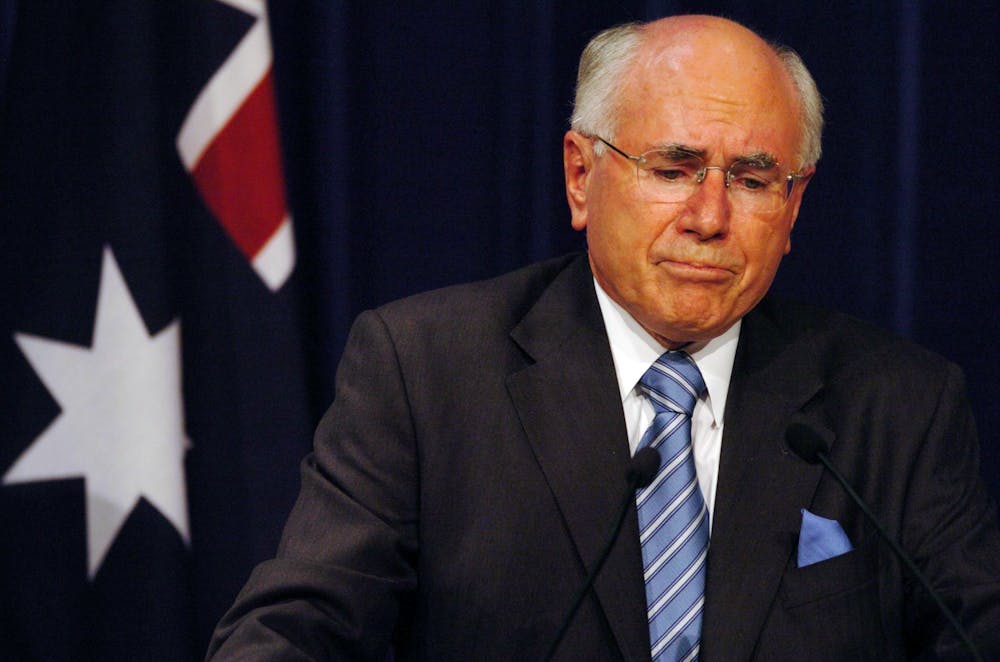 Former Prime Minister John Howard, shortly after admitting defeat in the 2007 election.
Dean Lewins/AAP
Former Prime Minister John Howard, shortly after admitting defeat in the 2007 election.
Dean Lewins/AAP
Much of the heat went out of the history wars when Howard lost the 2007 federal election, but never entirely. These arguments tend to resurface around Anzac Day, when contrary voices are condemned (witness the treatment of Scott Macintyre, Marilyn Lake and Yassmin Abdel-Magied), when the Prime Minister’s History Awards are handed out, when school curricula are discussed, and on many other occasions.
The most recent skirmishes have been around the appropriateness of January 26 as Australia Day, and statues of Cook and Macquarie.
Number of “identity politics” courses not an accurate indicator
The authors of the IPA report attribute the supposed flowering of “identity politics” courses to the politics of the historians who teach them. This ignores the fact that historians (and their Heads of School) are under constant pressure to maximise enrolments. Undergraduate enrolments are the primary driver of an academic unit’s resourcing. Academics and their managers are acutely aware of areas of student interest, and tend to respond to student demand rather than shaping it.
The authors of the report also ignore that history programs offer a mix of broad and narrow courses. Typically, larger and broader courses are offered at first-year level, and a greater number of specialised courses at upper-level. There is a clear pedagogical logic behind this curriculum structure, but it appears to have led the IPA astray.
Broader first-year courses – more closely aligned to what the IPA and The Australian would consider the “canon” – attract higher enrolments because there are fewer of them, and one or more are usually compulsory for a history major. More than 40% of the total history student cohort in any one semester at the University of Adelaide, for example, take the courses Empires in World History or Revolutions that Changed the World. These courses pay plenty of attention to the foundations of parliamentary democracy, and the changes brought about by clever inventions and “great ideas”. These fit within the foundations of Western civilisation.
Counting the number of courses based on “identity politics” is not a realistic way of identifying what most students are studying or how they are being taught about the past.
A different result
In early 2017, under instruction from the Heads of History and the Australian Historical Association, we conducted a comprehensive survey of the history discipline in Australian and New Zealand universities. We gathered data on every history course taught in the previous two years, including student enrolments. We accounted for the fact that courses are often taught on a biennial basis, which the IPA failed to do. Our data produced findings quite different from the conclusions reached by the IPA.
We counted and classified more than 1,220 different history courses taught in 2015 and 2016. They were categorised into 47 content areas, such as “Australian history”, “Early Modern European history”, “history of race” and so on.
The graph below shows which content areas were most commonly taught at undergraduate level.
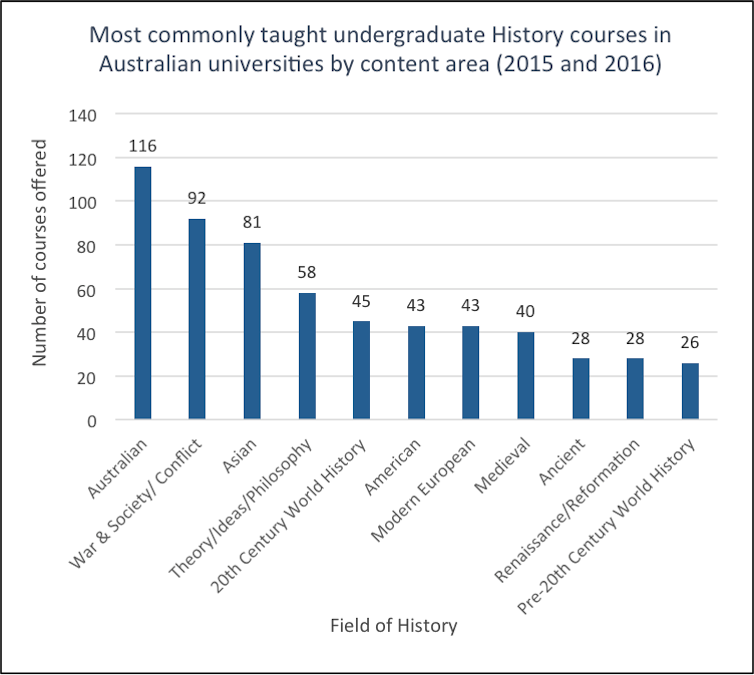 Most commonly taught undergraduate History courses in Australian universities by content area.
The next graph shows which types of courses were most commonly taken by Australian students.
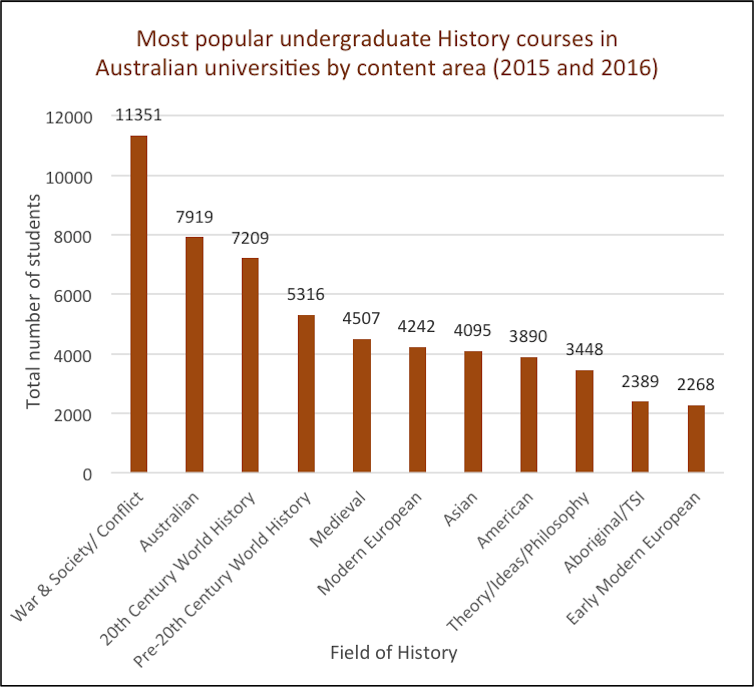 most popular undergraduate History courses in Australian universities by content area.
This shows the most commonly taught and most popular content areas align with the traditional historical “canon”. They consist of broad-scope courses, often centred on the nation state or traditional themes such as “war/conflict”, “the Renaissance”, or the “history of ideas”. Courses that focus primarily on histories of race, imperialism/post-colonialism, sexuality, and popular culture do not make the cut. Such topics might be studied as part of broader courses, and be the focus of one or two tutorials or lectures, but they are not the primary focus.
Only nine courses concerned primarily with the history of imperialism/post-colonialism were offered by Australian universities in 2015 and 2016, making this the 29th most commonly taught content area out of 47 possible areas. A total of 508 students were enrolled in these courses across the nation, making them the 29th most popular.
In terms of the number of course offerings, those in the history of sexuality ranked 33rd. Histories of popular culture ranked 26th, and history of race/ethnicity courses (excluding Aboriginal history) ranked 23rd.
In terms of total student enrolments, history of sexuality courses ranked 36th. History of popular culture courses ranked 25th, and history of race/ethnicity courses (excluding Aboriginal history) ranked 18th.
Besides differences in findings, the IPA assumes that specialised “identity politics” courses that focus on questions of race, gender, class, ethnicity, and sexuality are intrinsically less valuable than the study of the European Renaissance or Medieval periods. In a nation that is currently debating gay marriage, apparently unable to resolve Aboriginal disadvantage or counter the appalling rates of domestic violence against women, and in which nearly half of the population have a parent born overseas, we would suggest that such questions are vital.
It is little wonder that our students are interested in exploring these questions in different historical contexts, and that this interest might rival student enthusiasm for studying Renaissance art, the English Civil War or the French Revolution.
They know, as we do, that one of the primary purposes of studying history is to inform the present, and to enable us to apply insights gleaned from the past to debates about issues that affect us here and now.
Authors: Paul Sendziuk, Associate Professor in History, University of Adelaide
Read more http://theconversation.com/identity-politics-have-not-taken-over-university-history-courses-85972


 Daily Bulletin


