

This is what Australia's growing cities need to do to avoid running dry
- Written by: Ian Wright, Senior Lecturer in Environmental Science, Western Sydney University
The increasing thirst of Australia’s biggest cities routinely exceeds our capacity to rely on rainfall for drinking water. Australia is facing a fast-approaching “perfect storm” of growing urban populations and declining rainfall to supply storage reservoirs.
Despite these challenges, our capital cities’ rapid population growth is forecast to continue in coming decades. Sydney, for example, is expected to grow by 1.6 million people in 20 years, but is predicted to be overtaken by Melbourne as the nation’s largest city by then.
How is Australia going to ensure the swelling urban population has enough water? The last two decades provide some important clues.
Further reading: The lessons we need to learn to deal with the ‘creeping disaster’ of drought
The largest east coast centres (Melbourne, Canberra, Brisbane and Sydney) have all faced water supply challenges, but Perth and Adelaide have really been pushed to extreme levels. Current water storage levels in Australian capital cities range from 94.2% in Hobart and 69.7% in Melbourne through to 40.4% in Perth – the lowest of the capital cities. Only a year ago it was an alarming 28.5%.
Why are Perth’s water storages so low? Because of steep declines in rainfall and catchment runoff into the city’s dams.
The world is watching Perth and its water supply crisis. The long-term volume of water flowing into the Perth supply has plummeted from an annual average of 338 gigalitres (1911 to 1974) to less than 50 GL/year (2010-2016). During this 43-year “big dry”, the number of people served by the Perth water supply has increased steeply.
How has Perth managed to survive? Desalination and groundwater have come to the rescue. Perth relies less on catchment runoff and surface storages, and now has two giant desalination plants. It also has tapped into groundwater as a major source of domestic water.
Further reading: ‘Drought-proofing’ Perth: the long view of Western Australian water
Solutions have been costly
All water utilities across Australia struggle with increased population growth and extended periods of low rainfall. The Millennium Drought caused widespread problems for all Australian urban water supplies. The levels in major east coast storages shrivelled to the lowest levels in decades.
Melbourne’s water storages fell to a perilous low of 26% in June 2009. A large part of Adelaide’s water supply has relied on declining flows in the Murray River. The drought combined with extractions by upstream water users reduced the Murray to a trickle in 2006-07.
All of the mainland states have built huge desalination plants, but these come with huge price tags. The Melbourne plant cost about A$4 billion.
Operational costs are enormous, even if the plants sit idle. The Sydney plant’s costs are more than A$500,000 a day, although it has not supplied any water since 2012 as the city’s stored water supply remains higher than 60% of capacity.
Desalination also uses enormous quantities of electricity to extract fresh water from salt water. During his time as NSW premier, Bob Carr referred to desalination as “bottled electricity”. This is important to consider given the power crisis facing eastern Australia.
Urban growth affects water quality
The growth of the urban populations and other human activities is linked to water quality issues in urban water supplies. Melbourne’s water catchments are mostly “closed” – minimal private landholdings and human activity are permitted. In contrast, Sydney and Brisbane have more “open” catchments, which include private lands.
Three Brisbane storages (Wivenhoe, North Pine and Somerset) have water quality issues linked to agriculture and other human activity in the catchments. Sydney’s massive Warragamba Dam has a huge catchment that includes more than 110,000 people. The settlements are served by nine sewage treatment plants, most of which discharge treated sewage into drinking water catchment rivers.
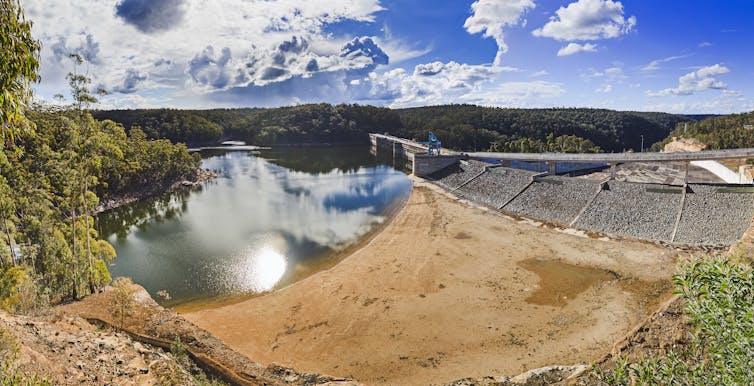 New South Wales’ hydroelectric Warragamba Dam.
Taras Vyshnya / Shutterstock
New South Wales’ hydroelectric Warragamba Dam.
Taras Vyshnya / Shutterstock
A recent audit of the Sydney catchments and storages reported that sewage treatment plant upgrades had improved water quality. The audit recommended that future upgrades improve sewage treatment for the growing urban population in the NSW Southern Highlands (Bowral, Mittagong and Moss Vale).
The case for water conservation and recycling
Perth and Adelaide are the two capitals under most water supply stress. They are an example for all Australian capitals to consider when planning future water supply challenges and solutions. Both Perth and Adelaide now heavily rely on recycled water and desalination.
Recycling waste water for use in urban water supplies is important for all urban centres, particularly Perth and Adelaide. The United Nations Food and Agriculture Organization points out that waste water has numerous public health risks, so risk management is essential for all recycled water schemes.
Further reading: Why we can get over the ‘yuck factor’ when it comes to recycled water
Perth and Adelaide are both using more groundwater than the other capital cities. Perth is extracting more groundwater from deep aquifers north of the city. Perth is also pumping treated waste water into shallower groundwater aquifers to replenish the supply.
No new large water supply dam has been built in Australia since the 1980s. The challenge of meeting future urban water demand is not likely to be solved by building new dams.
While desalination, groundwater and recycling are all growing in importance, our individual actions to conserve and use less water are key. For example, the consumption of water per person in Sydney has dropped from 500 litres a day in 1990 to less than 300 litres. Melbourne has a daily target of 155 litres per person.
There is plenty of room for improvement. According to United Nations data, Australia still has the second-highest daily water consumption per person. The US has the world’s highest at 575 litres a day. The UK is already exceeding Melbourne’s target with 149 litres per day. Tragically, in Mozambique, water is in such short supply that people there use a paltry four litres per day.
Authors: Ian Wright, Senior Lecturer in Environmental Science, Western Sydney University


 Daily Bulletin


