

At APEC, Donald Trump and Xi Jinping revealed different ideas of Asia's economic future
- Written by: Nick Bisley, Executive Director of La Trobe Asia and Professor of International Relations, La Trobe University
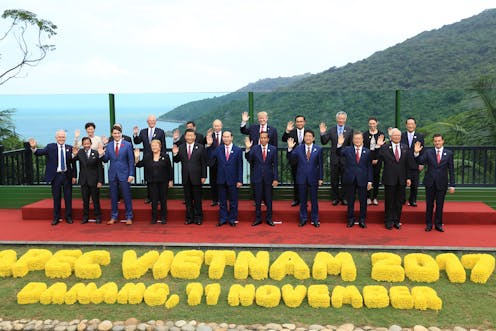
Donald Trump has just attended his first APEC leaders’ summit following bilateral state visits to Japan, South Korea, China and Vietnam. After the NATO summit and G20 earlier in the year, in which he displayed his inexperience and lack of affinity for multilateralism, many feared the worst.
But the comfortable rapport he established with leaders like Japanese Prime Minister Shinzo Abe, Chinese President Xi Jinping and South Korean President Moon Jae-in, as well as the less formal structures of APEC, meant there was no repeat of the northern hemisphere summer.
APEC was established in 1989 with the leaders’ summit added in 1994, with an ambition to drive economic co-operation and in particular trade liberalisation across the region. While it has been modestly successful in the unglamorous area of trade facilitation – involving largely regulatory streamlining to make the business of international trade smooth – as a co-operative framework it has not achieved any major outcomes.
So when looking at APEC, the real interest is not on the grouping’s economic policy process, but what occurs on the platform that the leaders’ summit provides, as its convening power remains impressive. What did we see in 2017?
Once again, APEC was a forum for discussing a non-APEC trade agreement. The TPP had regularly figured in previous meetings, and this time the 11 remaining members met to try to craft an agreement without the US. Canadian Prime Minister Justin Trudeau failed to attend one of the meetings, but it does appear that the 11 have salvaged some kind of a deal.
A string of meetings occurred on the sidelines. Of greatest interest was Trump’s conclave with Russian President Vladimir Putin, mostly focused on relationship-building, particularly important given the slate of new leaders in the club. New Zealand Prime Minister Jacinda Ardern, Moon, Hong Kong’s chief executive Carrie Lam and Taiwanese President Tsai Ing-wen were all making their debut.
Despite the evidently warm personal relationship that Trump has developed with Xi, the smiles and diplomatic tourism in Beijing are the pleasant facade of what has become a more overt competition for influence in the region. At the 2017 iteration of the meeting Gareth Evans famously described as “four adjectives in search of meaning”, this was plainly in sight.
At keynote speeches to the APEC CEO summit, Xi and Trump laid out their views on the region’s future. Trump’s speech was the second setpiece, following Rex Tillerson’s speech at CSIS in October, which outlined a belated US strategy to the region. The US aims to sustain a “free and open Indo-Pacific”, and Trump’s focus at APEC was on the economic dimension.
Continuing the themes raised in his UN General Assembly speech of September in which Trump declared he expected all countries to pursue their own interests first, he continued his walk away from core principles of its economic engagement of the region. In the past it had pursued large scale multilateral agreements, initially chasing a big free-trade agreement of the Asia Pacific, and more recently the TPP.
Trump said very plainly that there would be no more big agreements, and only bilateral deals based on strict and fairly narrow ideas of reciprocity. The other notable element was a direct statement that the US would no longer put up with predatory practices of other countries, such as IP theft, subsidies and not-enforced trade rules. While he did not name China as his main concern, he didn’t need to.
Trump’s effort to reconcile US rhetorical commitment to an open economic order in the region with his mercantilism stood in contrast to Xi’s approach. Xi painted a picture that seemed much more in keeping with the longer-run trends in Asia’s economic order.
Xi repeated the promise made at Davos that China was committed to economic openness. More specifically, he said China would seek to make economic globalisation more open, inclusive and balanced.
Interestingly, he said China would uphold regional multilateralism as the best means to advance the region’s common interests that were “interlocked”. He also presented the “Belt and Road Initiative” as an open mechanism that would help advance regional connectivity and even, somewhat surprisingly, described it in fairly economically liberal terms.
To be clear, Xi’s speech was a declaration of what China would do – whether it actually follows through is an open question. Nonetheless, Xi presented a China that would lead an open and inclusive economic order, in some ways as a defender of the status quo. Trump, in contrast, seemed to break with that tradition. Trump’s economic nationalism was on display, and he encouraged others to follow his lead.
Quite where this leaves the region is unclear. We still have to wait to see whether the two speeches of the “free and open Indo-Pacific” becomes an actual strategy. US policy remains hindered by a lack of resourcing in key branches of government.
Equally, we have to wait to see what China will actually do. But make no mistake, at APEC 2017, the region’s two biggest powers presented clearly different visions of the region’s economic future.
Authors: Nick Bisley, Executive Director of La Trobe Asia and Professor of International Relations, La Trobe University


 Daily Bulletin


