

Teaching kids 21st century skills early will help prepare them for their future
- Written by: Iram Siraj, Visiting Professor of Education, University of Wollongong
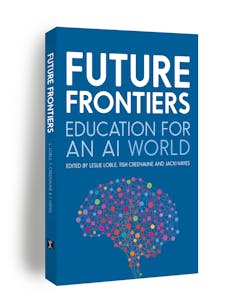
This is an edited extract written by Iram Siraj, from Future Frontiers: Education for an AI World, a New South Wales Department of Education publication.
It may be a truism that the future will be different, but human expectations have rarely been so high about the degree of imminent change. This century’s rapid development of artificial intelligence and digital systems has convinced us that almost every aspect of our children’s and grandchildren’s lives will be different to ours.
As these emerging technologies evolve, and are then quickly replaced by as yet unimaginable new ones, human society will need to become increasingly nimble and adaptable with lifelong learning as its modus operandi. In this digital age, the need for children to learn and memorise facts is diminishing. It is being replaced by the need to learn how to sieve and assess information critically for any kernel of “truth”.
 We don’t know exactly what kind of workforce today’s preschoolers will enter into in 18 years, but there is increasing demand for people skills.
Shutterstock
We don’t know exactly what kind of workforce today’s preschoolers will enter into in 18 years, but there is increasing demand for people skills.
Shutterstock
Today’s pre-schoolers will enter the workforce around 2035. Although we cannot contemplate exactly what their world will be then, we do know that children and adults will continue to need the basics of the 3Rs (reading, writing and arithmetic). They will also need a greater ability to learn how to learn, and to possess problem solving, critical thinking skills, and to be resilient in the face of fast-moving change.
Most discussions about “21st century skills” emphasise the need for schools to focus more on so-called “soft” skills and character traits (such as creative thinking and curiosity) in addition to cognitive skills such as problem-solving, critical analysis, the attainment of core subject knowledge, and strong early literacy and numeracy. Interestingly, early childhood education already includes a strong focus on these so-called “soft” skills. Early years learning has a stronger focus on whole-of-child development than school education.
Read more: Demand for people skills is growing faster than demand for STEM skills
There is a growing emphasis on integrated learning in early childhood education and care that creates a connection between the academic and the social. Developing children’s competencies in creativity, collaboration, self-regulation and problem solving can be undertaken through projects that harbour real-world knowledge. It can also be undertaken through problems that require young children (especially those age 3 to 5) to communicate and create knowing together. Here, the important task of the educator is to emphasise, and give attention to, the learning process rather than the learning outcomes.
Connected to this is the importance of educators emphasising interactions that support sustained shared thinking (SST). SST occurs when two or more individuals work together in an intellectual way to solve a problem, clarify a concept, evaluate an activity, extend a narrative, etc. It is still rare to see SST in early education settings, but research shows children are more successful learners and better motivated to learn where it is practised.
Future learners will need an excellent start in early learning if they are to cope with mid to late 21st century challenges. It is vital that early education curricula emphasise the process and the outcomes of both soft and hard skills to create the most competent learners and citizens. The family’s role is also essential in nurturing and enriching young children’s development. Any early childhood education and care system that ignores this reality will not be able to optimise children’s potential.
 Future learners will need an excellent start in early learning if they are to cope with mid to late 21st century challenges.
Author provided, Author provided (No reuse)
Future learners will need an excellent start in early learning if they are to cope with mid to late 21st century challenges.
Author provided, Author provided (No reuse)
Most early childhood education and care systems make less provision and funding for children under three because their care and education is very expensive. However, it is precisely these years when the family’s influence is the greatest. Future early childhood education and care systems should provide stronger support for local families with younger children. There is no reason some of this support cannot be offered through digital technologies, streamed directly into the home, which help parents learn about the power of early child rearing, and sensitive, responsive care and appropriate interactions. In such a system, early childhood education and care staff can offer more support to families living in challenging circumstances.
Evidence suggests intergenerational support, delivered through early childhood education and care centre-based provision, has more impact. Indeed, developing and nurturing intergenerational support allows staff to stimulate history learning-and-understanding skills through a creative use of simple oral histories. A clearer understanding of how others have handled and adapted to change in the recent past will help prepare children to deal with the challenges and changes they will inevitably face.
There is now growing evidence that high-quality training impacts children’s social and cognitive learning outcomes. Despite this, in terms of the wider education system, the early years generally contains the least qualified and worst paid. When early education provision is genuinely high quality, there can be lasting population change for good. But the government investment in knowledge, capital and labour must be commensurate.
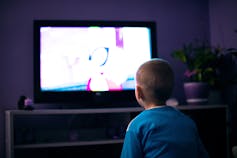 Too much screen time too young can be a barrier to learning essential people skills.
Shutterstock
Too much screen time too young can be a barrier to learning essential people skills.
Shutterstock
We are heading for an age that requires adaptable “knowledge workers” who can work collaboratively, independently and creatively. The solution does not lie in our youngest children spending long periods in screen time. Too much screen time at an early age deflects children from developing the essential human skills they need to function in complex social and economic work. Plus, we already know increased use of digital devices at an early age is associated with poorer outcomes.
Good ECEC teachers, and likewise parents, resist the temptation to use screen time for child entertainment and control. Rather, they show children how technology can serve our needs as tools that we turn to within our play and work.
Perhaps it is time to construct a new curriculum and to create a re-envisioned early childhood education and care system that includes a workforce of high quality, which is fit for purpose, well-rewarded and well-educated. Such a re-envisioned system may truly provide the foundational learning our children and grandchildren deserve. They, and all their fellow citizens, will need to sustain them and to face the challenges thrown at them by the brave new world we have entered.
Authors: Iram Siraj, Visiting Professor of Education, University of Wollongong


 Daily Bulletin


