

Explainer: how is the price of medicine decided in Australia?
- Written by: Rosalie Viney, Professor of Health Economics, University of Technology Sydney
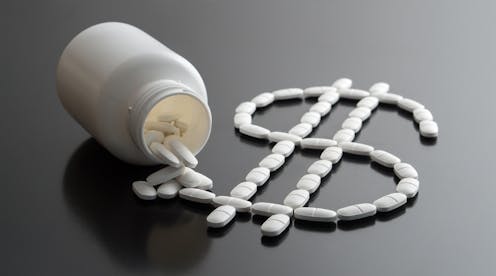
Every few months there are news stories about expensive medicines becoming affordable for Australian patients. Just as often, there are stories about medicines that aren’t approved for government subsidy. We read of the financial stress for families to access medicines not yet funded in Australia, compared with the relief for patients who now face a cost of only A$38.80 a month to access a newly funded medicine.
What we don’t see is why some medicines are so expensive in the first place. A quick look at the Pharmaceutical Benefits Scheme (PBS) shows the medicines that have been approved for subsidy range from less than a dollar to more than $800 per day.
What will the government pay for?
Medicines are recommended for funding if they’re safe and effective, and provide a health benefit compared with the existing treatments for the same condition, at an acceptable price. This means we may be willing to pay a higher price for a new medicine that provides better quality of life or improved survival, compared to existing medicines. But how much higher should that price be?
Read more - New drugs on the PBS: what they do and why we need them
The market for new medicines in Australia, as in many countries, is one where there is essentially one buyer (the government) and one seller (the company that has the patent on that new medicine) who negotiate the price.
Some medicines can be thought of as “me too” drugs – they are still under patent (so cheaper copies can’t enter the market), but they are similar to other medicines already on the PBS and produce similar outcomes. For these medicines, the price is determined by what Australia already pays for these outcomes.
Other medicines might be unique in terms of the way they act or the health gains they provide. In the past few years, we’ve seen examples of this in cystic fibrosis and melanoma.
For any new medicine, there will be years of research and development in terms of drug discovery, and many more years in terms of clinical testing and trials to demonstrate their safety and effectiveness. Pharmaceutical companies tell us for each new drug they bring to market, there will be many that fail along the way – and the cost of the research on these medicines needs to be recouped. This is exacerbated for medicines for rare conditions, where the overall patient numbers are small.
Read more - Explainer: what is the Community Pharmacy Agreement?
To have the incentive to develop new medicines and bring them to market, pharmaceutical companies rely on the protection provided by patents. While the patent life may be 20 years, it may also take some years to develop and present the evidence to support the safety, effectiveness and cost-effectiveness of the new medicine. A rational strategy for any company is to maximise the revenue from a medicine being listed on the PBS by seeking a high price at listing.
How is price decided?
The picture is complicated by the fact that pharmaceutical companies are large multinationals – and so the negotiations about the price of a new medicine are going on with other funders around the world.
Australia may be a relatively small market for a medicine, and so may not have a big impact on overall profit from the new medicine. But the price that is agreed in Australia can have ramifications for prices in other markets. If a low price is negotiated in one country, it might lead to other countries expecting the same price.
Read more - Time for costly medicine monopolies to go from TPP trade talks
When medicines come off patent, other manufacturers can enter the market, and competition should lead to the government paying lower prices. Until 2007, there was no effective mechanism for this to happen in Australia. “Generic” brands could enter the market and were sold at discounted prices to pharmacists, but the government continued to pay the price that was agreed when the medicine was first listed.
There has been a decade of progressive reforms to ensure prices for older drugs on the PBS are reduced. These have included mandated price reductions for multiple brand medicines, a mandatory price reduction when the first new brand of a medicine is listed, and a requirement for manufacturers to disclose the actual price at which they sell the brand to wholesalers or pharmacists, and for this price to then be the basis of the price the government pays in the future.
More recently, Australia has introduced a mandatory 5% price reduction for any medicine that has been on the PBS for more than five years, even if there’s only one brand. So the older a drug is, the lower the price the government pays.
Regardless of the asking price for a medicine being listed on the PBS, the government has to decide whether it represents good value for money. This involves balancing the needs of patients who will benefit with the opportunity costs (in other words, what other health care we could have paid for with these funds). There is not an unlimited budget for new medicines, and spending more on one drug will mean some other health care must be foregone.
Authors: Rosalie Viney, Professor of Health Economics, University of Technology Sydney
Read more http://theconversation.com/explainer-how-is-the-price-of-medicine-decided-in-australia-83633


 Daily Bulletin


