

What's the net cost of using renewables to hit Australia's climate target? Nothing
- Written by: Andrew Blakers, Professor of Engineering, Australian National University
Australia can meet its 2030 greenhouse emissions target at zero net cost, according to our analysis of a range of options for the National Electricity Market.
Our modelling shows that renewable energy can help hit Australia’s emissions reduction target of 26-28% below 2005 levels by 2030 effectively for free. This is because the cost of electricity from new-build wind and solar will be cheaper than replacing old fossil fuel generators with new ones.
Read more: Want energy storage? Here are 22,000 sites for pumped hydro across Australia
Currently, Australia is installing about 3 gigawatts (GW) per year of wind and solar photovoltaics (PV). This is fast enough to exceed 50% renewables in the electricity grid by 2030. It’s also fast enough to meet Australia’s entire carbon reduction target, as agreed at the 2015 Paris climate summit.
Encouragingly, the rapidly declining cost of wind and solar PV electricity means that the net cost of meeting the Paris target is roughly zero. This is because electricity from new-build wind and PV will be cheaper than from new-build coal generators; cheaper than existing gas generators; and indeed cheaper than the average wholesale price in the entire National Electricity Market, which is currently A$70-100 per megawatt-hour.
Cheapest option
Electricity from new-build wind in Australia currently costs around A$60 per MWh, while PV power costs about A$70 per MWh.
During the 2020s these prices are likely to fall still further – to below A$50 per MWh, judging by the lower-priced contracts being signed around the world, such as in Abu Dhabi, Mexico, India and Chile.
In our research, published today, we modelled the all-in cost of electricity under three different scenarios:
Renewables: replacement of enough old coal generators by renewables to meet Australia’s Paris climate target
Gas: premature retirement of most existing coal plant and replacement by new gas generators to meet the Paris target. Note that gas is uncompetitive at current prices, and this scenario would require a large increase in gas use, pushing up prices still further.
Status quo: replacement of retiring coal generators with supercritical coal. Note that this scenario fails to meet the Paris target by a wide margin, despite having a similar cost to the renewables scenario described above, even though our modelling uses a low coal power station price.
The chart below shows the all-in cost of electricity in the 2020s under each of the three scenarios, and for three different gas prices: lower, higher, or the same as the current A$8 per gigajoule. As you can see, electricity would cost roughly the same under the renewables scenario as it would under the status quo, regardless of what happens to gas prices.
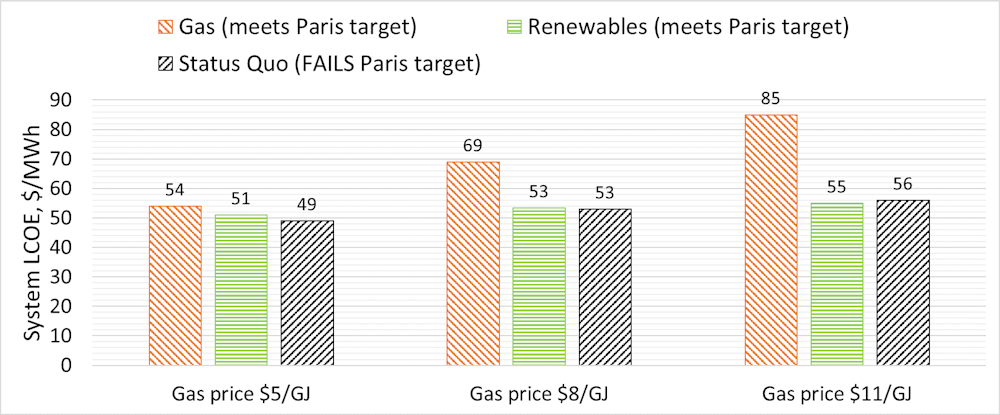 Levelised cost of electricity (A$ per MWh) for three scenarios and a range of gas prices.
Blakers et al.
Levelised cost of electricity (A$ per MWh) for three scenarios and a range of gas prices.
Blakers et al.
Balancing a renewable energy grid
The cost of renewables includes both the cost of energy and the cost of balancing the grid to maintain reliability. This balancing act involves using energy storage, stronger interstate high-voltage power lines, and the cost of renewable energy “spillage” on windy, sunny days when the energy stores are full.
The current cost of hourly balancing of the National Electricity Market (NEM) is low because the renewable energy fraction is small. It remains low (less than A$7 per MWh) until the renewable energy fraction rises above three-quarters.
The renewable energy fraction in 2020 will be about one-quarter, which leaves plenty of room for growth before balancing costs become significant.
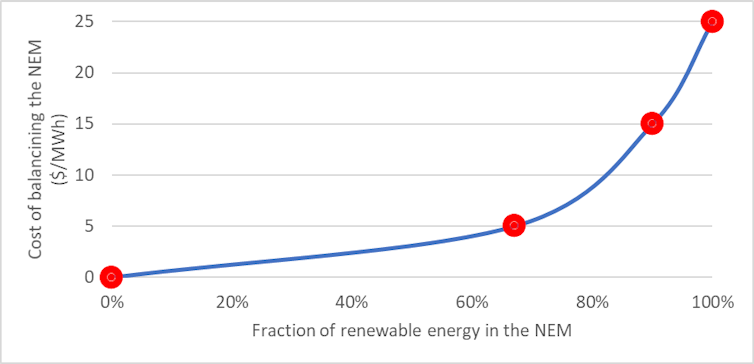 Cost of hourly balancing of the NEM (A$ per MWh) as a function of renewable energy fraction.
The proposed Snowy 2.0 pumped hydro project would have a power generation capacity of 2GW and energy storage of 350GWh. This could provide half of the new storage capacity required to balance the NEM up to a renewable energy fraction of two-thirds.
The new storage needed over and above Snowy 2.0 is 2GW of power with 12GWh of storage (enough to provide six hours of demand). This could come from a mix of pumped hydro, batteries and demand management.
Stability and reliability
Most of Australia’s fossil fuel generators will reach the end of their technical lifetimes within 20 years. In our “renewables” scenario detailed above, five coal-fired power stations would be retired early, by an average of five years. In contrast, meeting the Paris targets by substituting gas for coal requires 10 coal stations to close early, by an average of 11 years.
Under the renewables scenario, the grid will still be highly reliable. That’s because it will have a diverse mix of generators: PV (26GW), wind (24GW), coal (9GW), gas (5GW), pumped hydro storage (5GW) and existing hydro and bioenergy (8GW). Many of these assets can be used in ways that help to deliver other services that are vital for grid stability, such as spinning reserve and voltage management.
Read more: Will the National Energy Guarantee hit pause on renewables?
Because a renewable electricity system comprises thousands of small generators spread over a million square kilometres, sudden shocks to the electricity system from generator failure, such as occur regularly with ageing large coal generators, are unlikely.
Neither does cloudy or calm weather cause shocks, because weather is predictable and a given weather system can take several days to move over the Australian continent. Strengthened interstate interconnections (part of the cost of balancing) reduce the impact of transmission failure, which was the prime cause of the 2016 South Australian blackout.
Since 2015, Australia has tripled the annual deployment rate of new wind and PV generation capacity. Continuing at this rate until 2030 will let us meet our entire Paris carbon target in the electricity sector, all while replacing retiring coal generators, maintaining high grid stability, and stabilising electricity prices.
Authors: Andrew Blakers, Professor of Engineering, Australian National University


 Daily Bulletin


