

Despite what politicians and the media say, freedom of speech is alive and well on campus
- Written by: Lauren Bliss, Early Career Researcher in Screen Studies, University of Melbourne
Headlines that categorise international students as a problem for freedom of speech in Australian universities paint students with a broad brush, ignoring diversity in the student body. This stereotyping and reduction of cultural diversity can be seen in headlines like: “for Chinese students the state is an extension of family”.
More important is how these news stories overlook that these are students, not actors of a foreign state.
The classroom is not a political space
Pronoucements from politicians and the media on the need to preserve freedom of speech on campus ignores that the lecture theatre is a space for education, not politics. This is a crucial and obvious distinction.
Students are not speaking in a political context, such as in the media or halls of parliament, where they might have real power. Recent events that showed an angry, aggressive student provoked by a disagreement over lecture content at UTS, does not match my experience with engaged and curious students from a range of backgrounds.
Confronting conversations are not necessarily bad
It’s arguable that taboo topics and culturally sensitive issues are the lifeblood of the humanities, where I teach film and media studies. It’s common for troubled or tragic moments in history to come up in my classes, and for my classes to be primarily composed of students from mainland China and the East and South East Asian regions.
Classroom discussion often centres around sensitive topics of the Asian region, as much as they do on tricky topics in Australia. To date, I’ve yet to feel silenced or like I’m unable to encourage students to talk. This semester, in an open discussion on the 1989 Tiananmen Square protests, which remain heavily censored on Chinese social media platforms, one of my students expressed to the class with a sense of amusement:
We usually don’t talk about this.
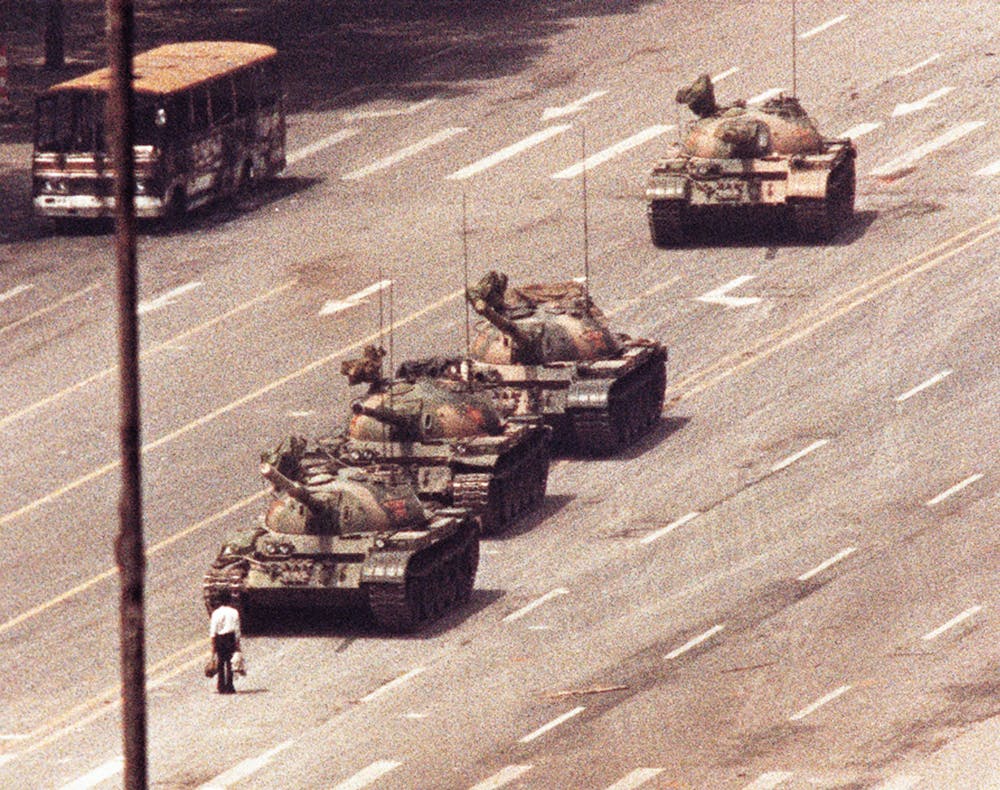 The protest at Tianenmen square in 1989, which resulted in this famous photo, is a taboo topic in Chinese history.
Reuters Pictures
The protest at Tianenmen square in 1989, which resulted in this famous photo, is a taboo topic in Chinese history.
Reuters Pictures
Of course, the discussion took place and students, local and international, freely shared their views to show a range of knowledge and opinions. Some knew very little about the actual events. Some knew quite a lot and openly critiqued the censorship. Some thought the protesters were there simply to overthrow the government, rather than challenge corruption. Some said they felt “sneaky” talking about the issue so openly in a Western classroom. Some disagreed with the value of public protest. Some found power in the humble “tank man” image. Others tuned out and looked at their smartphone or laptop.
I find these conversations can be moving, because I am aware it can be a powerful and life-changing moment for students to learn about ideas and issues that matter to them. In other contexts, it might not be possible to study the issues in-depth. These conversations, however, are also complex due to diverse and often conflicting cultural knowledge. This should not be seen as a problem in a political sense.
Learning how to argue effectively is just part of university
A tertiary education seeks to position students to see their views through an academic lens. The point is for students to research and analyse ideas, arguments and values as historical and theoretical, rather than as natural, objective or preconceived.
The roots of the modern humanities can, in part, be found in the work of 19th century German romantic philosophers. One such philosopher, Wilhelm Dilthey, was interested in distinguishing the value of the humanities from the dominant model of knowledge provided by the hard sciences. Dilthey’s work is still relevant for the humanities today, as he considered its value to be in the practice of arguments, which can be distinguished from scientific proof, as well as from opinion.
Arguments are not the same as opinions. Arguments have to be researched, rational, and critical, and take into account a range of varying perspectives. Opinions do not necessarily require research, rationality or acknowledgement of another point of view to be meaningful. An argument is just one perspective a student must defend as it presupposes that there are other points of view worth considering.
In other words, as Dilthey suggests, a successful argument will be reflexive and aim to interpret and understand through research and analysis, rather than explain and prove through experiment.
Positioning Chinese students as a threat
 Jaques Lacan was a French psychoanalyst and psychiatrist who has been called the most controversial psycho-analyst since Freud.
Wikimedia Commons/Nemomain, CC BY-SA
Jaques Lacan was a French psychoanalyst and psychiatrist who has been called the most controversial psycho-analyst since Freud.
Wikimedia Commons/Nemomain, CC BY-SA
One important theory for the humanities has been the concept of the “Other”, which originates in the work of psychoanalyst Jacques Lacan. The “Other” is a paradoxical concept, useful to explain both gender and racial discrimination. Hegemonic, or mainstream ideas and values, can be understood to rely on an “Other” to ensure their power. The “Other” is always an imaginary projection, where a person or thing is represented as causing a threat or a problem in order to justify their exclusion, control, containment or judgement. Simultaneously, this logic of the “threat” also justifies the need for the powerful to remain powerful.
Recent publications on the apparent political and cultural influence of students – especially Chinese students – reflect this logic. Just as they portray students as posing a threat, so too do they, paradoxically, triumph freedom of speech – ignoring or avoiding the fact freedom of speech means, in part, an ability to allow contradictory, opposing ideas to be freely expressed.
To my mind, there is no serious problem on campus, or within the humanities. The practice of argument remains unchanged from the tradition set out by thinkers like Dilthey. Students can freely argue their positions, but it will only be successful if it is well researched, rational, open to other perspectives, and understands itself as an “argument”.
In this sense, the only problem is in the rhetorical fallacies of journalists, politicians and intelligence officials in their generalisation and hyperbole, lack of concrete research or reference, and their politicisation of what it means to be a university student.
Authors: Lauren Bliss, Early Career Researcher in Screen Studies, University of Melbourne


 Daily Bulletin


