

What goes on inside a medically supervised injection facility?
- Written by: Marianne Jauncey, Conjoint Senior Lecturer, National Drug and Alcohol Research Centre, UNSW
The Victorian government recently announced a medically-supervised injecting centre for North Richmond, an inner-city area plagued by drug overdoses. While some may argue the establishment of such facilities normalises drug use, the centres offer an essential service to keep people who use drugs and the community safe.
A medically-supervised injecting centre is a physical space where it’s legal for people who inject drugs to come with pre-obtained substances and inject themselves. They key point is that rather than just being supplied with clean injecting equipment and then sent away to inject elsewhere (as is the case with needle syringe programs across Australia for the last 30 years), people are also provided with a safe space to inject.
How does the service work?
Stage 1
Walking in the front door, visitors probably feel they’re in the reception area of a typical health service. There are paintings on the wall, and someone smiling from behind a reception desk asking how they can help. A first time visitor will be taken aside to register with the service, which involves a conversation with one of our trained nursing or counselling staff, and a brief medical history being taken. Most of our clients have been injecting drugs for over a decade, and have complex histories, with mental health and childhood trauma both common features.
People are not required to leave either their full name or their real name, nor give us their Medicare details. Instead, they give us a password and we provide them with a unique number used for any subsequent visits. This option for anonymity is to encourage people who might be unsure about using our service.
Once registered, people are asked what drug they’re seeking to use, as well as what other drugs they’ve used recently. This gives staff a sense of what to expect in stage two, where supervised drug injection takes place. Testing of the drugs is not part of what an injecting centre traditionally does, due to the time and expense associated with it. The aim of an injecting centre is to physically accommodate the injection of drugs that would normally occur somewhere inherently more dangerous, and often public.
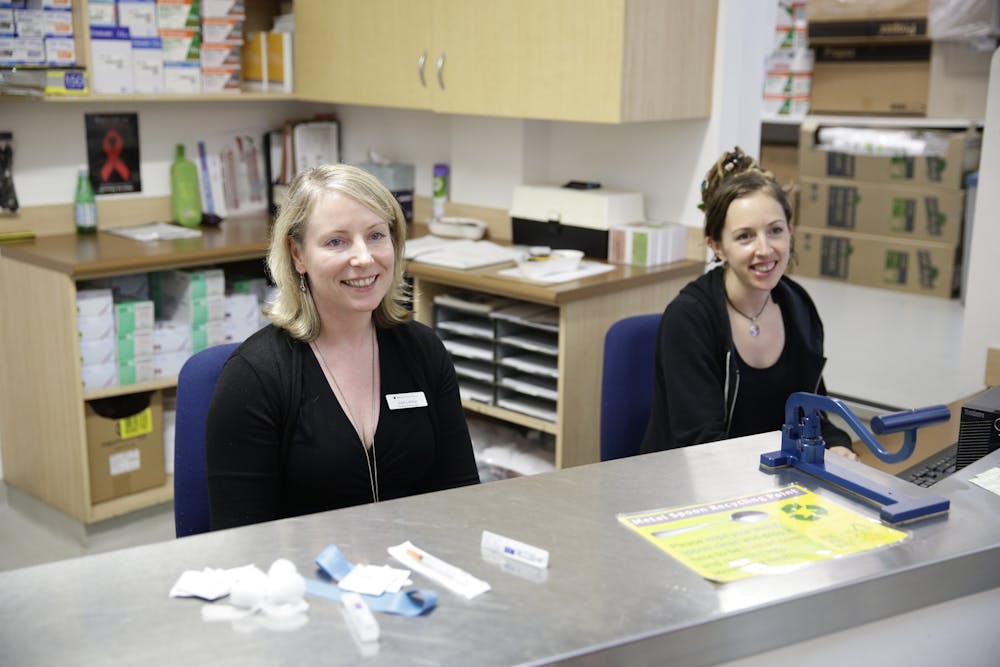 The reception is just like a typical health service.
Uniting Medically Supervised Injecting, Author provided
The reception is just like a typical health service.
Uniting Medically Supervised Injecting, Author provided
Stage 2
In stage two, staff provide clean injecting equipment. Typically this takes the form of small 1ml syringes, swabs to clean the skin, a tourniquet, water, filters and a spoon. Clients sit at one of eight stainless steel booths, then use this equipment to inject themselves. Staff are not legally able to inject a client, but their role as clinicians trained in harm reduction is to reduce the risks associated with that injection.
This may involve talking to someone about where and how they inject, encouraging them to wash their hands and use swabs, ensuring they don’t share any equipment, and other techniques aimed at ensuring they understand the risks of blood-borne virus transmission. Because there is no quality control for illicitly sourced drugs, part of the harm comes from simply not knowing what may or may not be in the mixture, so staff are always on the look-out for unexpected reactions.
This area can be really quite confronting. For health professionals working in the field of drugs, we have never been present for the actual injection of any drug. Why? Because this is illegal. So despite handing out injecting equipment to drug users over many years for the specific purpose of injecting drugs, we’ve never been able to provide additional care when it’s really needed. Instead, we’ve been forced to tell people to go elsewhere.
An injecting centre provides the setting and the possibility for a new type of connection with our clients. The power of suspending judgement for those who are the most judged and vilified in our society can be transformative.
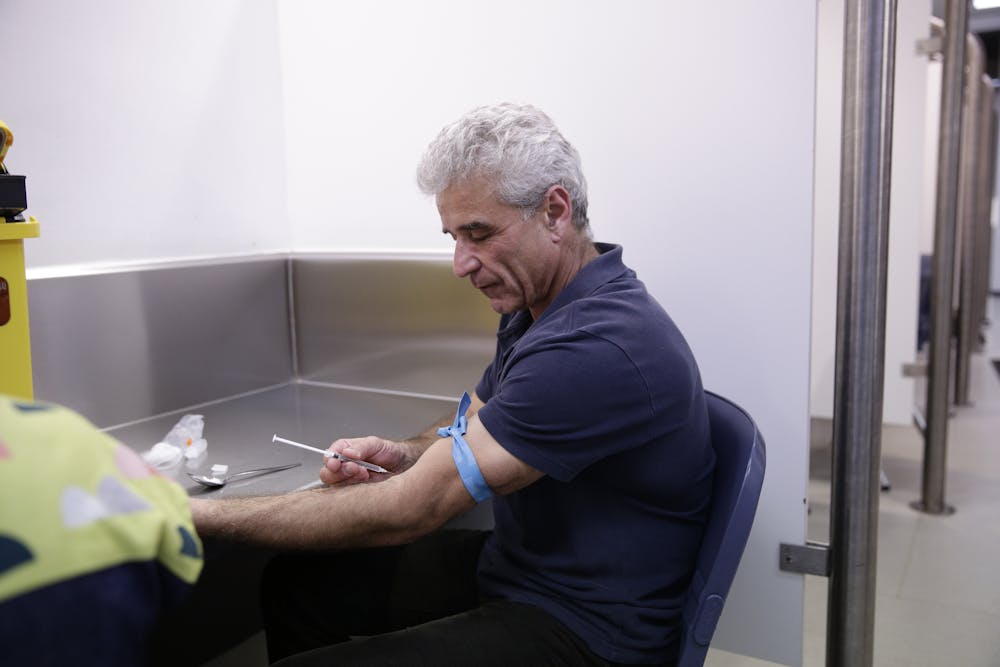 Most health professionals in the drug field have never been present for the injection of drugs.
Uniting Medically Supervised Injecting, Author provided
Most health professionals in the drug field have never been present for the injection of drugs.
Uniting Medically Supervised Injecting, Author provided
Read more: Why Australia needs drug consumption rooms
Stage 3
After the injection, clients safely dispose of their used equipment, and move to the next room, known as stage three. This is a more relaxed space, where we run all sorts of activities to engage people in conversations about their health and wellbeing. It may be a quiz, creative writing or art, or instructing people on appropriate overdose responses and showing them the recovery position and rescue breathing.
All staff have relevant experience and additional training to ensure they’re skilled in opening up conversations with the people they see. This therapeutic relationship is essential to make effective referrals into other treatment, care and support services.
Referrals may be for specialised treatment for addiction (from detoxification services and rehabilitation, to methadone and buprenorphine – slow-release oral opioids), or to relapse prevention and other types of counselling. It may be for a range of other medical services such as mental health treatment, dental services, hepatitis C treatment, or wound care.
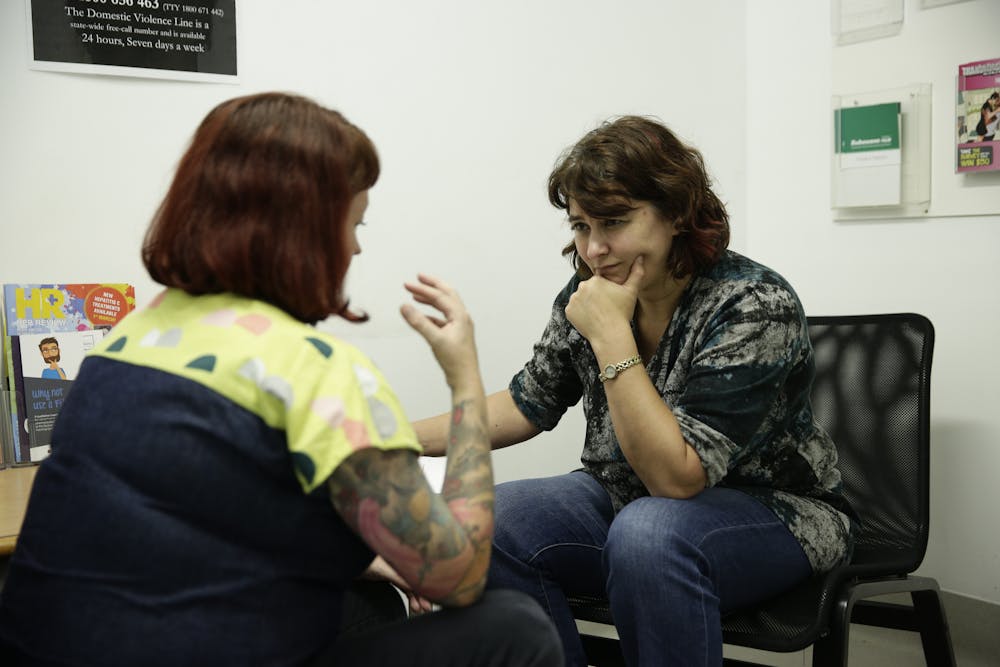 Clients are able to access counselling and referral services.
Uniting Medically Supervised Injecting, Author provided
Clients are able to access counselling and referral services.
Uniting Medically Supervised Injecting, Author provided
Preventing overdose
In all stages of the service, there is always a risk of overdose, and staff are trained to intervene immediately. Crucially, no one has ever died from a drug overdose in any such facility anywhere in the world (there are now more than 110 services internationally).
Whether it’s illicit heroin or pharmaceutical morphine, all opiate drugs switch off the part of the brain that reminds you to breathe. If no one intervenes in an opiate overdose, oxygen will be depleted and eventually the heart will stop, causing death. But if someone is present, recognises what is happening and intervenes appropriately, the person can be saved.
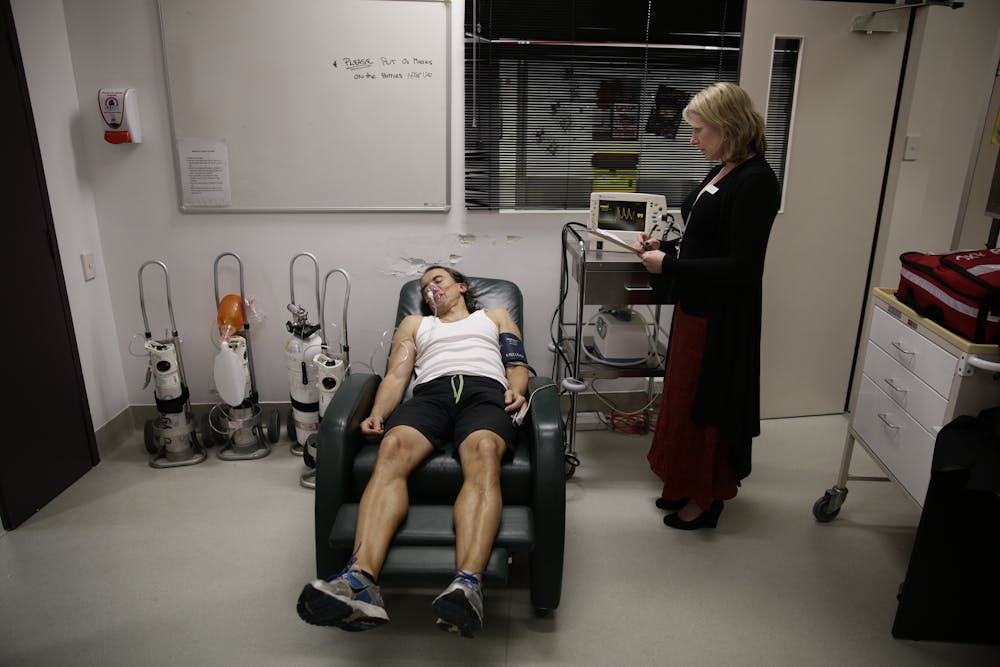 No one has ever died from a drug overdose in an injecting facility.
Uniting Medically Supervised Injecting, Author provided
No one has ever died from a drug overdose in an injecting facility.
Uniting Medically Supervised Injecting, Author provided
Our staff protect a person’s airway, provide supplemental oxygen, even artificially breathe for them via bag/valve/mask resuscitation. Nursing staff can also administer naloxone (narcan), which is an opiate antidote. This drug reverses the effect of any opiate drug, and the brain is reminded to breathe again.
Read more - Weekly Dose: Naloxone, how to save a life from opioid overdose
An injecting centre is very much a practical and evidence-based response, effective in areas with highly concentrated public drug use and overdose. It has been shown that an injecting centre does not create a honeypot for more drug use, rather it assists in addressing existing problems. They are well supported by police, as well as their local communities.
But it won’t make the problem vanish, nor get everyone instantly off drugs. Drug addiction is a chronic relapsing health problem that needs long-term commitment and encouragement in order to see change.
We need a wide range of affordable treatment and support services for people with problematic drug use, and treatment needs to be available and accessible to people when they need it. An injecting centre is only ever going to be one part of the larger jigsaw puzzle – but without it, people may die before they get the help they need.
Authors: Marianne Jauncey, Conjoint Senior Lecturer, National Drug and Alcohol Research Centre, UNSW
Read more http://theconversation.com/what-goes-on-inside-a-medically-supervised-injection-facility-87341


 Daily Bulletin


