

Indigenous cultural appropriation: what not to do
- Written by: Angelina Hurley, Lecturer in Indigenous Literacies, Victoria University
The words made me cringe at first with their echoes of an old, racist song made famous by Rolf Harris. “I am sick of buying my grandchildren woomeras that won’t throw a spear, boomerangs that won’t come back, and bullroarers that don’t roar,” said Bob Katter in a recent submission to parliament.
I don’t even know if boomerangs were ever meant to come back. Maybe it was coincidental when they did, but I’m pretty sure returning is not the boomerang’s primary purpose from a First Nations perspective.
Still, there was serious intent behind Katter’s submission on the production of fake Australian First Nations art. Today, up to 85% of art sold through tourism markets as First Nations souvenirs is fake and imported. Lost revenue from this major income stream has a harmful effect on everything from self-determination and cultural maintenance to families and communities.
In introducing a bill making it illegal to sell fake Indigenous art, Katter has re-ignited attention to artistic appropriation and rip-offs. But the stereotyping, disrespect and blatant theft of First Nations culture happens in many fields. The one that especially gets to me is hippy, New Age, non-Indigenous spiritualisation of our heritage.
For instance, WTF is a didjeridu massage? Yep, “didge therapy” is a thing. Apparently, paying to have someone blow a didjeridu over your body is reported to provide relief for a wide range of joint, muscular and skeletal-related pain as well as promote accelerated healing in various forms of bone trauma.
Seriously! On hearing about this practice, many of my mob have suggested a preferred area of the human body where such “therapists” might concentrate on shoving their didjeridus.
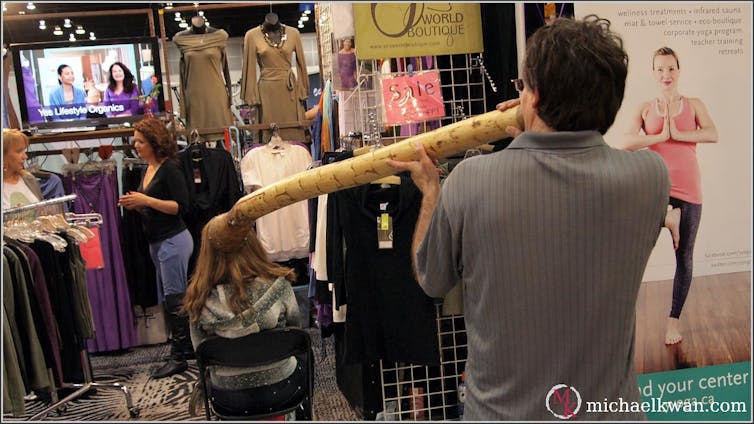 A didjeridu is applied to someone’s head in Vancouver, Canada.
Michael Kwan, CC BY-NC-ND
A didjeridu is applied to someone’s head in Vancouver, Canada.
Michael Kwan, CC BY-NC-ND
This appropriation shows a serious lack of understanding and respect of protocols. The need to find/discover one’s self via the culture and heritage of a different people is nonsensical to me. Here are some other areas of irritation and appropriation that would make us cry if we didn’t have such a deadly cathartic sense of humour.
Identity and connection
I know this is a very sensitive area of discussion because of the stolen generations, but don’t try to relate to me by announcing some new-found “distant” Ancestry.com connection or relation to a First Nations person.
For example: I know a First Nations person, I have an Aboriginal friend, my niece/nephew is married to an Aboriginal and/or Torres Strait Islander, my neighbours were Aboriginal and/or Torres Strait Islander people, or I dreamt my identity and I feel an affiliation/spirituality with First Nations culture … Big deal!
This doesn’t make you black because proximity is not a valid criterion. It’s commonly known that identifying as Aboriginal and/or Torres Strait Islander is complex and there’s much more involved. It’s a lived experience.
Language
Sis. Sista. Bro. Bala. Deadly. Gammon. Cuz. Oh it’s just torture to my ears. I’m not your sis. You’re not my bro. Do you really know when to use deadly and gammon/gammin? I’m not your cuz.
Seriously stop trying to use and steal colloquial Aboriginal and Torres Strait Islander language. It doesn’t sound cool, it sounds ridiculous. So in case you missed it … Take a look at ABC Black Comedy: Black White Woman Part 1.
The look
Just as proximity can’t identify you, the overindulgence in First Nations colour and adornment won’t bring you any closer to being donned with a traditional name, or get you acceptance into a nation/clan.
Appropriating First Nations tattoo designs, braided hair, overuse of spray tanning, collagen lips, red-black-and-yellow everything doesn’t make you blend in. You just stand out like a wanna be First Nations queen of the desert.
Knowledge and education
That’s right, someone told you a Dreamtime story somewhere, or you read it in a book written by a non-First Nations academic or writer, from a non-First Nations perspective … so you know more about my own culture, language and heritage than I do.
Oh yeah and you’ve driven your campervan around Australia engaging in Kumbaya campfire singalongs and numerous appropriated versions of the song Guri Ina Nami. Plus, you’ve been to the Northern Territory where the “real” black fullas are … Whatever!
Music
The yidaki (didjeridu) has got to be one of the most appropriated items of First Nations heritage and culture. Originating from Arnhem Land, its use is widespread and, apart from busking white women and men commercialising and making careers out of playing this instrument, a more recent offensive practice is its inclusion in the New Age healing and health industry.
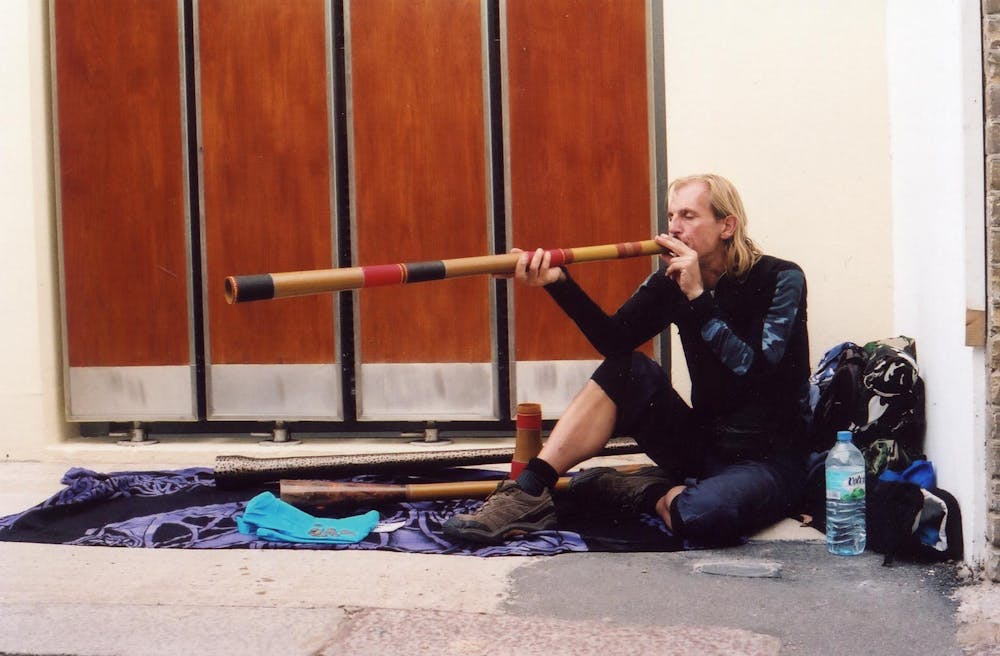 A didge player at Portobello Market in London.
Genial 23/flickr, CC BY-NC-ND
A didge player at Portobello Market in London.
Genial 23/flickr, CC BY-NC-ND
The exploitation of First Nations art, culture and heritage continues to be rife. Appropriation has become so commonplace that it has even infiltrated the practices of our own First Nations artists, e.g. copying another nation’s visual arts style and design and producing artefacts and materials that originate from that nation.
For whatever reason this is done – a disconnection from identity and culture, for financial and material gain – it saddens me and leaves me with a sense of loss that we can’t discern between cultural exchange and cultural appropriation, but that’s another story.
Tomorrow: Robert Phiddian considers appropriation and humour.
Authors: Angelina Hurley, Lecturer in Indigenous Literacies, Victoria University
Read more http://theconversation.com/indigenous-cultural-appropriation-what-not-to-do-86679


 Daily Bulletin


