

How 'brand you' came to be
- Written by: Gary Mortimer, Associate Professor, Queensland University of Technology
…a person’s name is, to that person, the sweetest and most important sound in any language.
Dale Carnegie’s line from his bestseller book ‘How to Win Friends and Influence People’ rings especially true in the retail sector.
From packets of Tim Tams and jars of Vegemite to luxury hand bags, today’s marketing is stamping our names on the things we buy, setting us out as unique individuals.
To get to this point, marketing has moved from a focus on the product itself to the consumer, who they are and finally, how they think.
The power of personalisation can been seen in Coke’s successful, ‘Share a Coke’ campaign. Soft drink manufacturers have been experiencing declining sales, but Coca-Cola was able to break the downward trend. By printing individual names on cans, the company saw a 2.5% increase in total sales and soft-drink volume went up by 0.4%.
Even luxury brands like Louis Vuitton and Mont Blanc have begun to personalise their products.
How we got to personalisation in marketing
The journey from mass production to personalisation has taken more than 100 years. Mass production was popularised between 1910 and 1920 by Henry Ford’s Ford Motor Company. He famously said:
Any customer can have a car painted any colour that he wants so long as it is black.
Mass production was tied to the production concept philosophy. This stated that consumers preferred products that were widely available and inexpensive. To achieve this, the focus was on uniformity, efficiency and mass distribution.
Today, even the most basic of household consumables (for example salt, bottled water, flour) would fail to succeed by employing this simple concept, as even these products have sought to differentiate in a crowded market. The production concept is now only ever used within the manufacturing sector.
From the 1930s, as new products flooded the marketplace, marketers turned their attention to communicating, not the low price and availability of their wares, but instead the quality and features. This is called the product concept. This held that consumers favoured products that offered different levels of quality, performance or features.
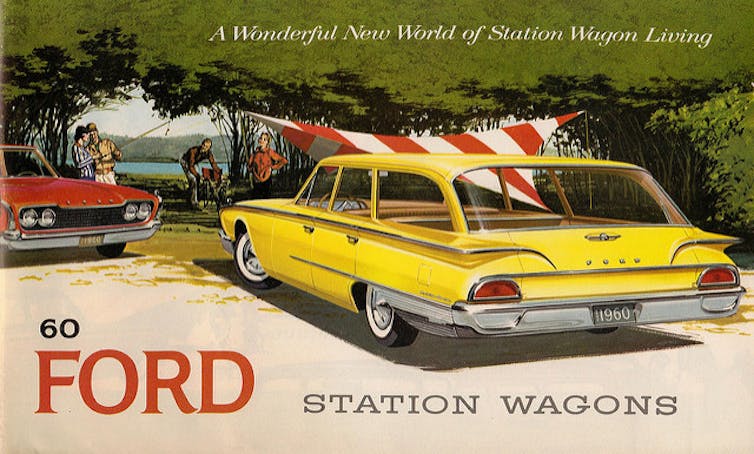 Vehicle manufacturer Ford has changed its marketing strategy from just making its products available and cheap.
JOHN LLOYD/Flickr, CC BY-SA
Vehicle manufacturer Ford has changed its marketing strategy from just making its products available and cheap.
JOHN LLOYD/Flickr, CC BY-SA
However, the risk of positioning your product based purely on its perceived quality and features, is that your competitor will simply replicate. Take any smartphone manufacturer, such as Apple, every 18 month or so, they need to release a new product, with higher quality and more features, to stay ahead of their competitors.
By the 1960s, marketing shifted to the selling concept, where the most successful marketing involved aggressive selling and promotions. This assumed that consumers will either not buy, or not buy enough, of the business’ products unless the business made a substantial effort to stimulate consumers’ interest. It focused on “creating a need”, rather than “fulfilling a need” for consumers.
Switch on to any home shopping television channel to see a good example of this in practice. See, you really didn’t realise you needed that piece of gym equipment with a free set of steak knives.
The simply named marketing concept challenged these earlier philosophies, holding that brands need to understand their target market in order to create and deliver value.
Customisation and personalisation
What’s emerging today is a move away from market segments with many consumers to markets of one. In other words, moving away from understanding the needs of a group of consumers (and creating standardised value) to creating unique value propositions for one customer through customisation and personalisation.
There is often confusion around these two terms, customisation and personalisation. In simple terms, customisation allows a consumer to make small changes to a product or service, from a discreet set of alternatives. This often happens in automotive manufacturing or consumer electronics, where a customer can customise their car, PC or notebook.
While customisation deals with small groups of consumers making choices from a set of alternatives, personalisation deals with just one, with unlimited alternatives.
Attachment theory explains why consumers desire personalised products. Like human relationships, sometimes consumers form an emotional bond with a brand. Once a strong bond is formed, consumers will become loyal and engage in positive “word-of-mouth” promotion of it. So, how do brands form bonds?
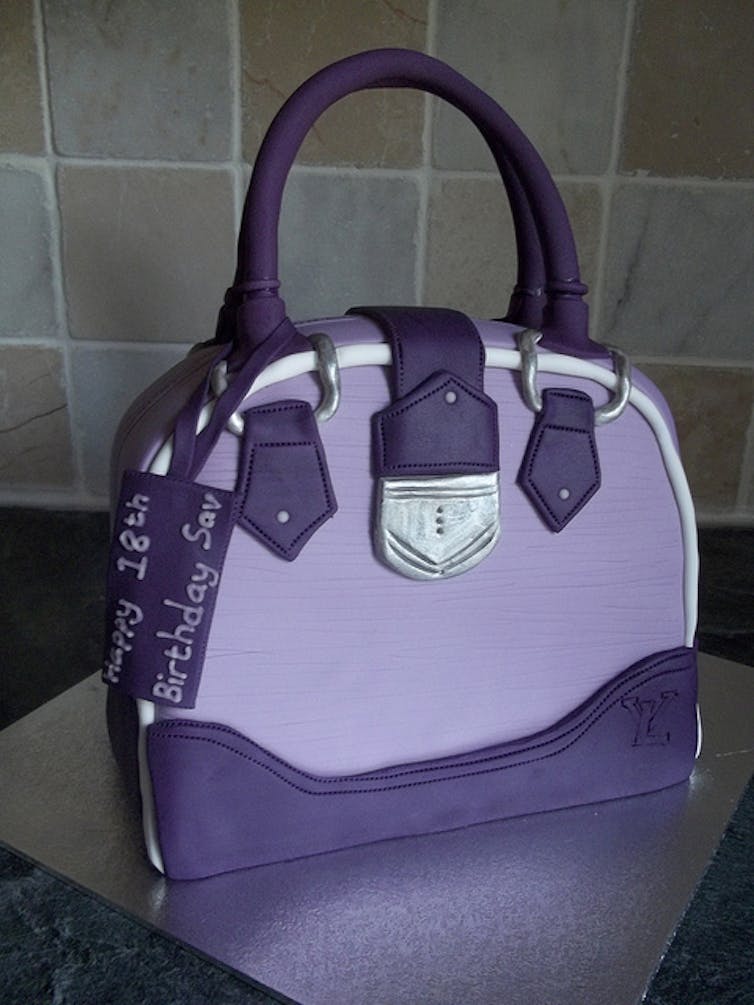 A Louis Vuitton handbag cake.
Dawn/Flickr, CC BY-NC-ND
A Louis Vuitton handbag cake.
Dawn/Flickr, CC BY-NC-ND
To increase this bond, brands need to get personal, and that personalisation needs to be relevant. Within a consumers’ brain lays their reticular activating system. This filters out irrelevant information, enabling consumers to attend to only important information.
Imagine being at a noisy party, with many conversations. It’s all white noise, until someone mentions a topic that is of particular interest to you. You then tune in, thanks to this part of your brain.
So brands use your name. Whether you see it or hear it, your name, is one of the easiest sounds for your reticular activating system to hone in on. A product with your name on it creates attachment, and then brands have you for life.
Authors: Gary Mortimer, Associate Professor, Queensland University of Technology
Read more http://theconversation.com/how-brand-you-came-to-be-87762


 Daily Bulletin


