

A new approach to regional higher education is essential to our economic future
- Written by: Adam Shoemaker, Vice Chancellor, Southern Cross University
The 30% of Australians who live outside a capital city are experiencing a period of rapid change. A new era of food and crop production prosperity is being driven by technological disruption and farm business consolidation. This is occurring alongside ballooning unemployment, poorer health outcomes, and social dislocation in regional communities. We need to find long-lasting solutions to this disparity.
Last financial year, agriculture was the largest contributor to Australia’s GDP growth and the fastest-growing sector in the nation. Meanwhile, in October 2017, youth unemployment in outback Queensland hit 59.2% at a time when employment rates in inner Brisbane for 15-24 year-olds were hovering at 6%. Youth unemployment sits around the 20% mark in many regional areas across Australia.
The challenges facing regional Australia will not be solved by a single new mine, a quick job-creation scheme, or a flurry of bus tickets to the city. Instead, we need sustainable solutions that give regional Australians the chance to leave welfare behind, transform their job prospects and contribute to society as skilled workers. The best first step would be to give regional Australians better access to tertiary education.
A problem for everyone
The majority of Australia’s 40 universities operate regional campuses. From Broome to Burnie to Bundaberg, 25 Australian universities have them. There are 68 regional campuses in total, located in every state and territory, with the exception of the ACT. Most of these campuses undertake research in areas like precision agriculture, organics, aquaculture, medicinal cannabis production, plant genetics and plant science. They’re building expertise relevant to our agriculture-driven economic prosperity. Yet the people living around those campuses don’t all benefit from them.
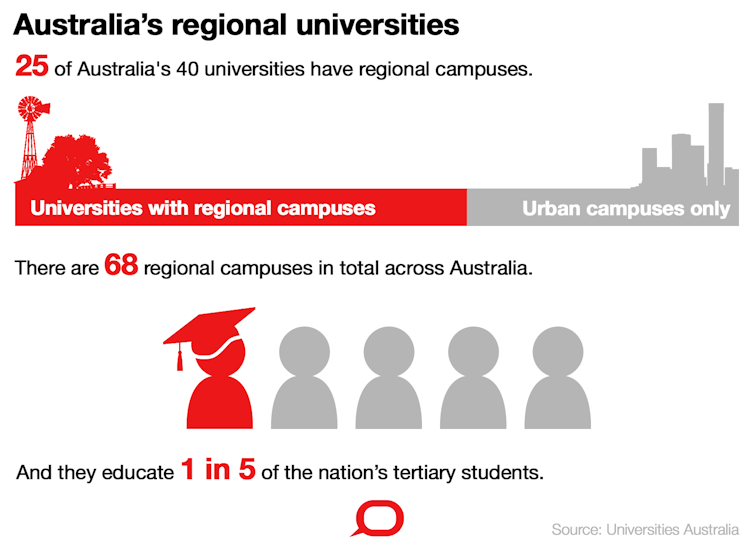 Australia’s regional campuses educate 20% of the nation’s tertiary students – more than 280,000 people. They could enrol many more, but proposed federal government policies would shut the door on many promising students. For example, proposals to make students pay for enabling places would act as a strong disincentive to take up study in the first place.
The goal of providing university access to 40% of the population has largely been met in metropolitan centres. But most regional areas are well below that participation target. Often, they are barely halfway there.
Since budget loadings, benefitting all regional campuses, were introduced in 2004, reviews have recommended extra funding for students enrolled at a regional university. This was proposed in recognition of the extra costs of delivering appropriate learning and teaching and the need to deliver career opportunities to regional people. These loadings were applied but have been successively wound back since that time.
Read more: Four barriers to higher education regional students face – and how to overcome them
The whittling away of regional loadings means such universities are at a substantial disadvantage. The current tertiary funding formula is too uniform. Students receive the same base level of funding for their degree in almost every case. This may suit a university with 50,000 students in a capital city. But it simply doesn’t cover the cost of many courses on much smaller campuses outside urban areas.
Regional universities also find it hard to attract international students, who provide important additional revenue to many metropolitan universities.
These factors mean it’s essential to prioritise the promise of economic sustainability and opportunity over the notion of higher education policy equality. Regional students merit more specific, targeted support across a range of degrees.
Australia’s regional campuses educate 20% of the nation’s tertiary students – more than 280,000 people. They could enrol many more, but proposed federal government policies would shut the door on many promising students. For example, proposals to make students pay for enabling places would act as a strong disincentive to take up study in the first place.
The goal of providing university access to 40% of the population has largely been met in metropolitan centres. But most regional areas are well below that participation target. Often, they are barely halfway there.
Since budget loadings, benefitting all regional campuses, were introduced in 2004, reviews have recommended extra funding for students enrolled at a regional university. This was proposed in recognition of the extra costs of delivering appropriate learning and teaching and the need to deliver career opportunities to regional people. These loadings were applied but have been successively wound back since that time.
Read more: Four barriers to higher education regional students face – and how to overcome them
The whittling away of regional loadings means such universities are at a substantial disadvantage. The current tertiary funding formula is too uniform. Students receive the same base level of funding for their degree in almost every case. This may suit a university with 50,000 students in a capital city. But it simply doesn’t cover the cost of many courses on much smaller campuses outside urban areas.
Regional universities also find it hard to attract international students, who provide important additional revenue to many metropolitan universities.
These factors mean it’s essential to prioritise the promise of economic sustainability and opportunity over the notion of higher education policy equality. Regional students merit more specific, targeted support across a range of degrees.
 Agriculture makes a significant contribution to Australia’s economy.
Shutterstock
A new regional deal
A new approach to regional higher education would address many of these problems. Based on our research at Southern Cross University, I’ve suggested such an approach to the current federal government review into regional, rural and remote education. It would include:
10,000 Commonwealth supported enabling places for regional Australians, distributed according to regional need and demand
$50 million per year for four years to help all 25 universities with regional campuses catch up
a new regional loading, in recognition of the higher costs of regional education delivery.
As the Regional Universities Network (the RUN group) has advocated, regional university campuses need a new policy approach. Only regional universities can provide education at a reasonable cost without forcing people to face the upheaval of moving hundreds of kilometres, leaving family members behind and competing in the unaffordable housing markets of Sydney and Melbourne.
Read more: Clever regional unis can form the backbone of a clever country
Local start-ups, local businesses, local health providers, and local arts performers all deserve a chance to thrive. A new funding approach will empower regional campuses to create more opportunities for the people they serve. It will help reduce inter-generational welfare dependence among a significant cohort of families, and bring additional income into communities. It will enable regional universities to educate more teachers, nurses, engineers and small business-people to work productively in their own backyards. Above all, it will translate that talent in the backyard to the front yard and then to the rest of the world.
Agriculture makes a significant contribution to Australia’s economy.
Shutterstock
A new regional deal
A new approach to regional higher education would address many of these problems. Based on our research at Southern Cross University, I’ve suggested such an approach to the current federal government review into regional, rural and remote education. It would include:
10,000 Commonwealth supported enabling places for regional Australians, distributed according to regional need and demand
$50 million per year for four years to help all 25 universities with regional campuses catch up
a new regional loading, in recognition of the higher costs of regional education delivery.
As the Regional Universities Network (the RUN group) has advocated, regional university campuses need a new policy approach. Only regional universities can provide education at a reasonable cost without forcing people to face the upheaval of moving hundreds of kilometres, leaving family members behind and competing in the unaffordable housing markets of Sydney and Melbourne.
Read more: Clever regional unis can form the backbone of a clever country
Local start-ups, local businesses, local health providers, and local arts performers all deserve a chance to thrive. A new funding approach will empower regional campuses to create more opportunities for the people they serve. It will help reduce inter-generational welfare dependence among a significant cohort of families, and bring additional income into communities. It will enable regional universities to educate more teachers, nurses, engineers and small business-people to work productively in their own backyards. Above all, it will translate that talent in the backyard to the front yard and then to the rest of the world.
Authors: Adam Shoemaker, Vice Chancellor, Southern Cross University


 Daily Bulletin


