

New foreign interference laws will compound risks to whistleblowers and journalists
- Written by: Keiran Hardy, Lecturer, School of Criminology and Criminal Justice and Member, Griffith Criminology Institute, Griffith University
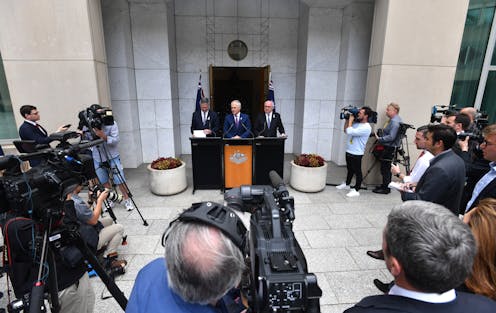
The Turnbull government has announced a crackdown on foreign interference in Australian politics and national security. Proposed laws include a ban on foreign political donations, new criminal offences, and a transparency register for those acting on behalf of foreign governments or organisations.
Prime Minister Malcolm Turnbull carefully emphasised that the proposals are not focused on China’s influence in Australia. But, as the Lowy Institute’s Euan Graham put it, there’s an “800-pound panda” in the room.
The proposed criminal offences will significantly expand the scope of existing laws against espionage and treason. This will make it easier to prosecute spies and other foreign nationals who seek undue influence over Australian business or politics.
However, the new laws pose risks to whistleblowers and journalists. They suggest the concept of “national security” is continually expanding.
Further reading: Ban on foreign political donations is both too broad and too narrow, and won’t fix our system
Espionage
The Criminal Code currently sets out an offence of espionage that is punishable by 25 years’ imprisonment.
The main offence applies where someone communicates or makes available information that concerns Australia’s security or defence. The person must intend to prejudice Australia’s security or defence, or advantage another country’s security or defence. Under the proposed changes, this offence will attract a maximum penalty of life imprisonment.
Where a person recklessly endangers Australia’s security or defence, this will be punishable by the current penalty.
The new espionage offences will apply to possessing or receiving information, in addition to communicating it. They will protect a broader range of information, including unclassified material.
Other new offences, punishable by 15 years’ imprisonment, will target preparation for espionage and the theft of trade secrets.
Foreign interference
Proposed offences for foreign interference will target conduct not ordinarily considered to be espionage or treason.
Currently, the federal offence of treason describes very rare and serious conduct, such as assassinating or capturing the Queen or prime minister.
These new offences will target covert, deceptive or undisclosed conduct that is directed, funded, supervised or undertaken on behalf of a foreign interest. The penalties will range between ten and 20 years’ imprisonment.
To constitute foreign interference, the conduct must be intended to:
serve the intelligence purposes of a foreign actor
harm Australia’s national security
influence the exercise or performance of a democratic or political right, or
influence a government or political process.
Other new offences will target the support or funding of foreign intelligence agencies. These will be similar to existing crimes for supporting or funding terrorist organisations.
Are the new offences needed?
The changes will make it easier to prosecute foreign nationals who intentionally interfere with Australia’s business, political or foreign policy interests.
Where such influence cannot strictly be described as impacting on security or defence, successful prosecution under the existing espionage or treason offences is very difficult.
The government’s other justifications are much weaker. The current espionage offences already extend beyond the communication of information to making, obtaining or copying sensitive records. The Crimes Act includes offences that are triggered when an Australian public official discloses official secrets or other information obtained in the course of their employment.
What are the risks?
The proposed offences will target some conduct that should clearly be a serious criminal offence, such as intentionally supporting a foreign intelligence agency.
However, the proposed laws go well beyond such clear cases to target a broad and vague range of conduct affecting Australian interests. This includes possessing unclassified information and any deceptive or undisclosed conduct that influences government processes.
Most importantly, the proposed changes pose risks to whistleblowers and Australian media organisations. These risks were compounded in 2014 by changes to national security legislation in response to the threat of foreign fighters.
Further reading: National security bills compound existing threats to media freedom
A journalist could face serious penalties under the proposed espionage offences for receiving information leaked by a government official or intelligence whistleblower, before they even decide to publish that information.
It seems the information need not even be classified for the penalties to apply, provided making the information available would benefit a foreign country or organisation.
The government needs to ensure that journalists publishing sensitive information in the public interest will not face criminal prosecution for espionage or other federal criminal offences. This should be done by drafting legal protections for journalists who act in a professional capacity in the public interest.
Assurances from Attorney-General George Brandis that journalists will not be prosecuted for doing their job are not enough.
The proposed laws should be viewed not only as a response to increasing Chinese influence in Australia, but also as symptomatic of a post-Snowden crackdown, in which all potentially embarrassing information about government is closely protected.
Similar debates about expanded espionage offences and press freedom have already taken place in the UK. These debates confirm that “national security” is no longer simply about physical threats like terrorism or traditional forms of spying.
Increasingly, the language of national security is invoked to protect a government’s broader interests – political, business and economic.
Authors: Keiran Hardy, Lecturer, School of Criminology and Criminal Justice and Member, Griffith Criminology Institute, Griffith University


 Daily Bulletin


