

Google's artificial intelligence finds two new exoplanets missed by human eyes
- Written by: Jake Clark, PhD Student, University of Southern Queensland
Two new exoplanets have been discovered thanks to NASA’s collaboration with Google’s artificial intelligence (AI). One of those in today’s announcement is an eighth planet – Kepler-90i – found orbiting the Sun-like star Kepler-90. This makes it the first system discovered with an equal number of planets to our own Solar system.
A mere road trip away, at 2,545 light-years from Earth, Kepler-90i orbits its host star every 14.4 Earth days, with a sizzling surface temperature similar to Venus of 426°C.
The new exoplanets are added to the growing list of known worlds found orbiting other stars.
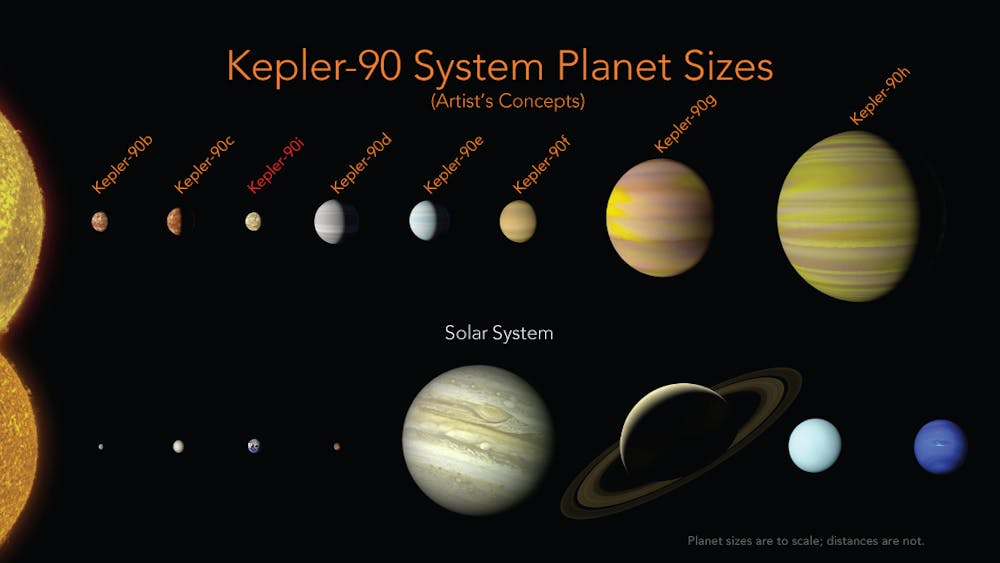 The Kepler-90 planets have a similar configuration to our solar system with small planets found orbiting close to their star, and the larger planets found farther away.
NASA/Ames Research Center/Wendy Stenzel
The Kepler-90 planets have a similar configuration to our solar system with small planets found orbiting close to their star, and the larger planets found farther away.
NASA/Ames Research Center/Wendy Stenzel
This new Solar system rival provides evidence that a similar process occurred within Kepler-90 that formed our very own planetary neighbourhood: small terrestrial worlds close to the host star, and larger gassy planets further away. But to say the system is a twin of our own Solar system is a stretch.
Read more: Exoplanet discovery by an amateur astronomer shows the power of citizen science
The entire Kepler-90 system of eight planets would easily fit within Earth’s orbit of the Sun. All eight planets, bar Kepler-90h, would be too hostile for life, lying outside the so-called habitable zone.
Evidence also suggests that planets within the Kepler-90 system started out farther apart, much like our own Solar system. Some form of migration occurred, dragging this system inwards, producing the orbits we see in Kepler-90 today.
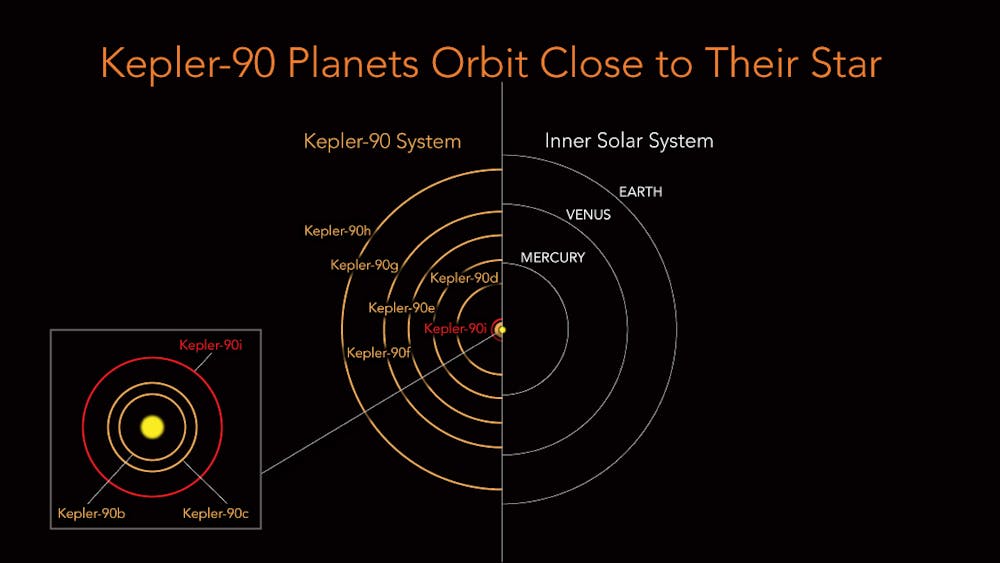 Kepler-90 is a Sun-like star, but all of its eight planets are scrunched into the equivalent distance of Earth to the Sun.
NASA/Ames Research Center/Wendy Stenzel
Kepler-90 is a Sun-like star, but all of its eight planets are scrunched into the equivalent distance of Earth to the Sun.
NASA/Ames Research Center/Wendy Stenzel
Google’s collaboration with NASA’s space telescope Kepler mission has now opened up new and exciting opportunities into AI helping with scientific discoveries.
So how exactly did Google’s AI discover these planets? And what sort of future discoveries can this technology provide?
Training AI for exoplanet discoveries
Traditionally, software developers program computers to perform a particular task, from playing your favourite cat video, to determining exoplanetary signals from space based telescopes such as NASA’s Kepler Mission.
These programs are executed to serve a single purpose. Using code intended for cat videos to hunt exoplanets in light curves would lead to some very interesting, yet false, results.
Googles’s AI is programmed rather differently, using machine learning. In machine learning, AI is trained through artificial neural networks – somewhat replicating our brain’s biological neural networks – to perform tasks like reading this article. It then learns from its mistakes, becoming more efficient at its particular task.
Google’s DeepMind AI, AlphaGo, was trained previously to play Go, an extremely complex yet elegant Chinese board game. Last year, AlphaGo defeated Lee Sedol, the world’s best Go player, by four games to one. It simply trained itself by watching thousands of previously played games, then competing against itself.
In our exoplantary case, AI was trained to identify transiting exoplanets, sifting through 15,000 signals from the Kepler exoplanet catalogue. It learned what was and wasn’t a signal caused by an exoplanet eclipsing its host star. These 15,000 signals were previously vetted by NASA scientists prior to the AI’s training, guiding it to a 96% efficiency of detecting known exoplanets.
Researchers then directed their AI network to search in multiplanetary systems for weaker signals. This research culminated in today’s announcement of both Kepler-90i and another Earth-sized exoplanet, Kepler-80g, in a separate planetary system.
Hunting for more exoplanets using AI
Google’s AI has analysed only 10% of the 150,000 stars NASA’s Kepler Mission has been eyeing off across the Milky Way galaxy.
How AI helps in the hunt for other exoplanets.There’s potential then for sifting through Kepler’s entire catalogue and finding other exoplanetary worlds that have either been skimmed by scientist or haven’t been checked yet, due to Kepler’s rich data set. And that’s exactly what Google’s researchers are planning to do.
Machine learning neural networks have been assisting astronomers for a few years now. But the potential for AI to assist in exoplanetary discoveries will only increase within the next decade.
Beyond Kepler
The Kepler mission has been running since 2009, with observations slowly coming to an end. Within the next 12 months, all of its on-board fuel will be fully depleted, ending what has been, one of the greatest scientific endeavours in modern times.
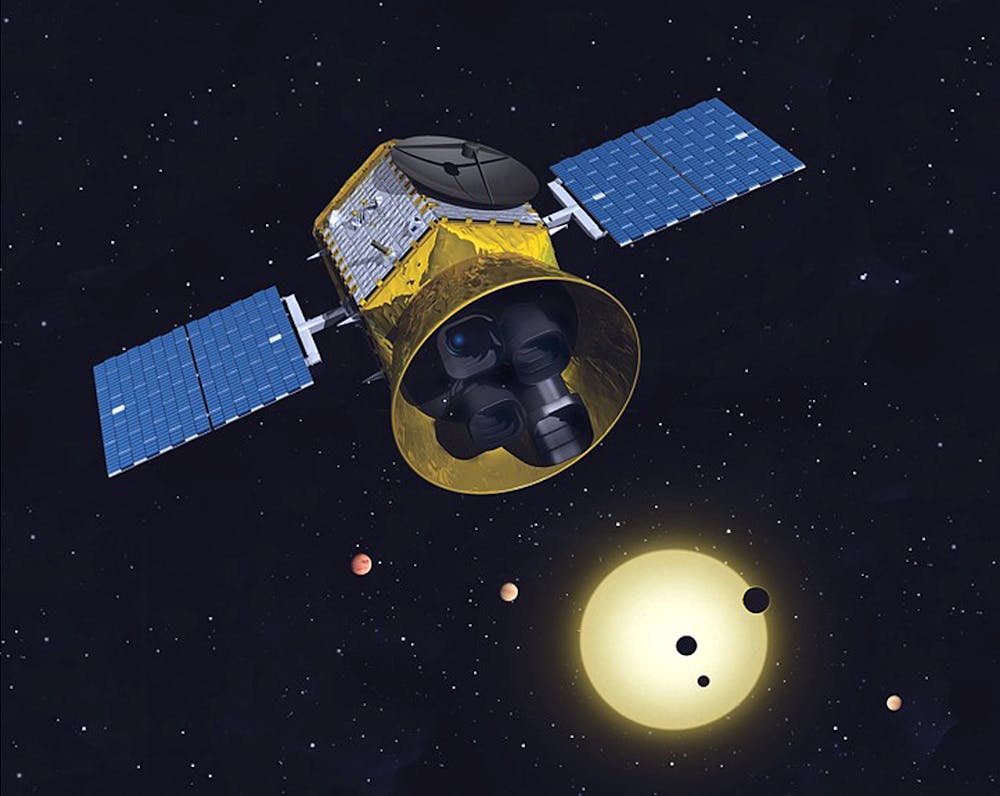 NASA’s new TESS mission will inundate astronomers with 20,000 exoplanetary candidates in the next two years.
Chet Beals/MIT Lincoln Lab
NASA’s new TESS mission will inundate astronomers with 20,000 exoplanetary candidates in the next two years.
Chet Beals/MIT Lincoln Lab
Kepler’s successor, the Transiting Exoplanet Survey Satellite (TESS) will be launching this coming March.
Read more: A machine astronomer could help us find the unknowns in the universe
TESS is predicted to find 20,000 exoplanet candidates during its two-year mission. To put that into perspective, in the past 25 years, we’ve managed to discover just over 3,500.
This unprecedented inundation of exoplanetary data needs to either be confirmed by other transiting observations or other methods such as ground-based radial velocity measurements.
There just isn’t enough people-power to sift through all of this data. That’s why these machine learning networks are needed, so they can aid astronomers in sifting through big data sets, ultimately assisting in more exoplanetary discoveries. Which begs the question, who exactly gets credit for such a discovery?
Authors: Jake Clark, PhD Student, University of Southern Queensland


 Daily Bulletin


