

Why a first strike option on North Korea is a very bad idea
- Written by: Andrew O'Neil, Dean and Professor of Political Science, Griffith University
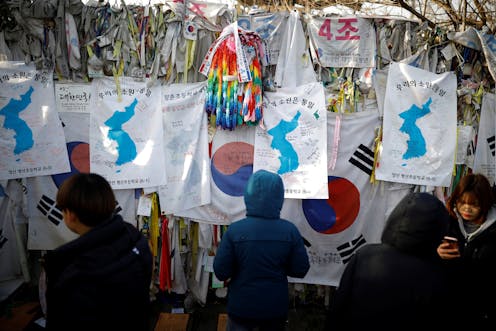
The prospect of South Korean and North Korean athletes marching together under a “unification” flag at this month’s Pyeongchang Winter Olympics signifies a brief respite in tensions rather than being a genuine thawing on the Korean peninsula.
After an initial surge of optimism in response to Pyongyang’s decision to accept Seoul’s offer to march as one Korea, reality has started to bite with the mechanics of implementing the deal.
While welcoming the Pyeongchang initiative, many South Koreans have pushed back against the decision to merge both countries’ women’s ice hockey teams, calling out the sexist nature of the decision (not a single woman was involved in determining the merger).
Meanwhile, citing “insulting” behaviour on the part of South Korean media, the North Koreans have cancelled a joint cultural performance with South Korea, scheduled for next week.
Understandably, the Pyeongchang “thaw” has attracted major headlines. But it obscures the significant possibility that we will witness major conflict on the Korean peninsula in 2018.
The South Korean government has worked hard to engage North Korea in structured dialogue in an effort to defuse the nuclear-armed state’s continued military threats. But there is nonetheless a growing risk that the Trump administration will authorise limited military strikes against the North’s weapons of mass destruction, conceivably within the next few months.
Read more: The Winter Olympics and the two Koreas: how sport diplomacy could save the world
Despite extracting a commitment from the US that any military action against North Korea is contingent on first gaining South Korea’s endorsement, there is justifiable concern among South Koreans that the Trump administration will act unilaterally if US intelligence assesses Pyongyang is about to deploy an operational nuclear-armed intercontinental ballistic missile (ICBM) force.
Given the extent to which we have underestimated the sheer pace of North Korea’s nuclear and missile development over the past decade, this intelligence assessment might happen sooner than we think. Donald Trump would then face a difficult problem: how to avoid being the president who allowed North Korea to achieve the capability to hit the US homeland with nuclear weapons.
Since coming to power, the Trump administration has been deliberating over whether to carry out preventive strikes to degrade Pyongyang’s ability to sprint to the finish line of acquiring a deployable ICBM that can hit the continental US with a nuclear payload.
An increasingly popular assumption is that the price of living with a nuclear-armed North Korea that can destroy prime targets on the US mainland is higher than risking a second Korean War. And this is not just the musings of a few hardheads in the Pentagon: a growing number of Americans believe some form of military action against North Korea is justified if sanctions and diplomacy fail to achieve denuclearisation.
Most worrying of all, a belief seems to be gathering pace that the US can somehow launch “surgical” military strikes while containing a larger conflict, because Kim Jong-un will not respond for fear of triggering an overwhelming retaliatory response.
There are two basic flaws underlying what one expert has termed “the myth of the limited strike”. The first, and most obvious, is that it’s highly unlikely Kim Jong-un will believe the Trump administration’s assurances that “surgical” strikes are not the opening phase of an all-out US assault aimed at overthrowing the regime.
When the US goes to war, it tends to go full throttle – in recent times, this has translated into regime change (think of Afghanistan, Iraq, and Libya). Why would the leadership in Pyongyang assess that this time around would be any different?
The second major flaw in the argument is that what is portrayed as limited in Washington, and among some armchair strategists supporting this course, will inevitably be seen in Pyongyang as a major assault on North Korean territory and its prized strategic assets.
Even in the scenario that Kim Jong-un actually believed the Trump administration did not intend to implement regime change, as Van Jackson notes, his position as North Korean supreme leader would be untenable domestically if he did not respond with force.
Read more: Five assumptions we make about North Korea – and why they're wrong
Pyongyang would have a compelling incentive to retaliate early with any nuclear reserve that survived a US first strike. In this scenario, the North Korean leadership would confront a stark choice of either using these weapons of mass destruction to maximum effect or risk losing them in follow-on US precision munition strikes.
As I have argued elsewhere, like all new nuclear powers, North Korea will place a premium on permissive command and control systems that allow authorities to use nuclear weapons whenever they want. This will be reflected in a hair-trigger launch posture if it perceives an imminent threat.
Whichever way you cut it, a US first strike against North Korea would almost certainly trigger major war on the Korean peninsula, with a high risk of escalation to full-scale nuclear conflict. While the appalling humanitarian consequences of this don’t need to be spelt out, the strategic illogic of the arguments advocating a first strike must be continually reinforced.
Authors: Andrew O'Neil, Dean and Professor of Political Science, Griffith University
Read more http://theconversation.com/why-a-first-strike-option-on-north-korea-is-a-very-bad-idea-90229


 Daily Bulletin


