

Trump and Turnbull have little cause for satisfaction over progress in Afghanistan
- Written by: Tony Walker, Adjunct Professor, School of Communications, La Trobe University
When Malcolm Turnbull sits down in the White House later this month for the Australian prime minister’s first substantive discussion with Donald Trump on American soil, Afghanistan will almost certainly be part of the conversation.
Whatever is said – and agreed – about that conflict, neither the Americans nor the Australians have much cause for satisfaction over progress in efforts to stabilise that country.
As 2017 gave way to a new year, the news from Afghanistan for the NATO-led effort to counter the Taliban, and other militant groups, was mostly bad.
Terrorist attacks in Kabul and other cities, which killed more than 100 people and wounded dozens in the first weeks of 2018, underscored the lack of progress in establishing a stable environment. Afghanis are losing confidence in the ability of US-backed Afghan security forces to hold insurgents at bay.
This lessening certainty in an Afghan administration, propped up by America and its allies, including Australia, has serious implications for the future of the country and the conduct of what is now America’s longest war.
The Afghan conflict has cost the American taxpayer getting on for a trillion dollars – or a lot more, according to some estimates – with no end in sight. More than 2,000 Americans have been killed.
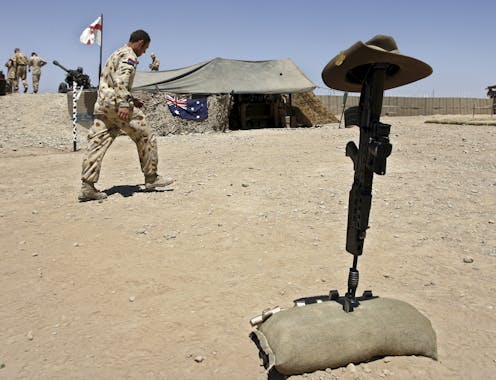
Australia has spent an estimated A$8 billion on its Afghan engagement, including civil and military assistance. Forty-one service personnel have been killed, and 261 wounded.
All this makes it notable that Trump, in his State of the Union address, devoted just 40 words to the Afghan conflict, in contrast to other foreign and security policy preoccupations, inclduing America’s campaign against Islamic State (IS).
This is what he said about a war that has outstripped by half a decade America’s previous longest war, in Vietnam:
As of a few months ago, our warriors in Afghanistan have their new rules of engagement. Along with their heroic Afghan partners, our military is no longer undermined by artificial timelines, and we no longer tell our enemies our plans.
That was it. It was as if Washington had resolved not to talk about a war that shows no sign of an endpoint, although it could be observed Taliban advances are creating what might prove to be an inflection moment.
Whether this will lead to a more concerted push to engage the Taliban in a regional settlement remains moot. However, it is hard to envisage an end to the Afghan nightmare without some sort of Taliban involvement, unpalatable though that may seem.
Robert Malley, newly appointed head of the International Crisis Group, sharply criticised US Afghanistan strategy in an assessment of 2018 trouble spots. He wrote:
The strategy faces serious obstacles. While hitting the Taliban harder might bring tactical gains, it is unlikely to change the war’s course or the incentives of a locally rooted and potent insurgency … Battlefield losses in the past have not impacted Taliban leaders’ willingness to negotiate.
And then this:
As the battlefield tempo increases, the Trump administration should keep lines of communication to the insurgency open and explore the contours of a settlement with Afghanistan’s neighbors and other regional powers, however slim prospects currently appear. US allies in Afghanistan should push for a greater diplomatic political component to the US strategy. As it stands, that strategy sets the stage for more violence while closing avenues for de-escalation. Afghan civilians will pay the price.
All this has been further complicated by growing IS and al-Qaeda involvement in the conflict, with those entities seeking alternative battlefields to Iraq and Syria.
Suspicions Iran and Russia are providing some level of support to the Taliban are adding to concerns. America’s estrangement from Pakistan – Trump has taken Islamabad to task for not doing more to combat the Taliban – is compounding an already fraught environment.
To say that Afghanistan in 2018 is a witch’s brew would be an understatement.
What seems clear is that the Trump administration and its allies are conducting something of a holding operation in the hope that a protracted war plays itself out. This strategy might be placed in the faint hope category, given Afghanistan’s history of resisting foreign involvement going back to the armies of Alexander the Great.
Trump might have escalated the conflict by freeing up local American commanders to fight more aggressively, but it is not clear this is paying dividends, given the level of violence that is manifesting itself.
Under this administration, America dropped three times the number of bombs – 4,361 – on insurgent targets in 2017 compared with the previous year.
American sensitivity about progress – or lack thereof – in the war was exposed recently when the its own ombudsman, the Special Inspector General for Afghanistan Reconstruction (SIGAR), reported it had been ordered not to report details of how much territory was under the control of the Afghan government or insurgents.
Information released to CNN by US forces in Afghanistan indicates that 56% of districts were under government control or influence in October. A further 30% is contested, with the balance under the influence of militant groups, including the Taliban.
These figures indicate a significant slippage since 2015, when the government controlled about 72% of the country, and insurgents 7%.
On top of territory yielded to the insurgency, more than 7,000 members of the Afghan security forces were killed last year. This is an attrition rate that would be demoralising in any circumstances.
In an assessment for Foreign Affairs, former commander of US forces in Afghanistan, Stanley McChrystal, observed that Taliban “presence and influence are likely at their highest levels since the group lost power in 2001”.
Last August, Trump announced a revamped strategy in Afghanistan, which included a commitment of additional forces. Numbers were not specified at the time, but are in the order of 4,000, taking the American involvement to 16,000.
This compares with 100,000 at the time of Barack Obama’s “surge” in 2009, which was intended to deal a killer blow to the Taliban. This has not materialised. As noted, the Afghan government has been losing ground since the US wound back its commitment in 2011.
Read more: Trump changes his mind on Afghanistan, but will upping the ante win the war?
In his August address, Trump said this about American strategy:
From now on, victory will have a clear definition: attacking our enemies, obliterating ISIS, crushing al-Qaeda, preventing the Taliban from taking over Afghanistan, and stopping mass terror attacks against America before they emerge.
This prompted the following observation from analyst Max Boot of the Council on Foreign Relations:
The Trump administration has concluded that it can live with a situation that even US generals describe as a ‘stalemate’, because the cost of victory – sending hundreds of thousands of additional troops – is too high for the United States to pay and might be impossible to achieve in any case, given that the Taliban continue to enjoy outside support, not only from Pakistan but also from Iran and Russia. In short, a war that started 16 years ago will continue indefinitely with no victory in sight, because from Washington’s perspective there is simply no viable alternative.
In response to the Trump speech, including the president’s unwillingness to set a timeline for an end to America’s involvement, Malcolm Turnbull observed the “coalition commitment to Afghanistan … would be very long-term”.
This might be regarded as an understatement on the eve of Turnbull’s visit to Washington, where the subject of Australian troop levels in a training capacity in Afghanistan will almost certainly arise.
Authors: Tony Walker, Adjunct Professor, School of Communications, La Trobe University


 Daily Bulletin


