

Does a sugar tax cause alcohol sales to spike? The research doesn't give a decisive answer
- Written by: Robin Room, Professor, Centre for Alcohol Policy Research, La Trobe University
Consuming sugar-sweetened drinks is associated with a range of health issues including weight gain and obesity. These are risk factors for diabetes, heart disease, high blood pressure, strokes and certain cancers.
Taxing these drinks is an effective means of reducing their consumption and related health issues – as well as generating revenue for the government.
A recent study in the Journal of Epidemiology and Community set out to test whether a sugar tax might impact on other behaviours affecting public health, along with whether such a tax would prompt people to choose no- or low-calorie drinks.
The researchers ended up finding an association between higher soft-drink prices and higher demand for some alcoholic beverages in terms of family food and drink purchases.
Read more: Clearing up confusion between correlation and causation
They did not find that a sugar tax, let alone higher soft drink prices, caused people to drink more lager, as news reports suggest. In fact, the study provided no direct evidence a sugar tax will lead alcohol sales to increase.
How was the study conducted?
In this study, researchers from the London School of Hygiene & Tropical Medicine estimated elasticity of demand on non-alcoholic and alcoholic drinks in the UK, based on households’ response to price differences in sugary drinks.
They used existing consumer survey expenditure data collected between 2012 and 2013 from nearly 32,000 households.
Households recorded their individual groceries and drinks they had purchased and brought home using scanned bar codes (or manually entered them if there was no bar code). The researchers tracked how much the household spent, where they purchased, the day of purchase and volume of beverage purchased.
They didn’t track consumption, or drinks which were bought and consumed elsewhere (for instance, in a bar or at a tuckshop), just the purchase of these products.
The researchers then compared how much one family bought and brought home of each beverage type when faced with a particular set of prices, against how much another family bought of each beverage type with a different set of prices.
What were the results?
The results were mixed, with variations between beverage types and income groups. There were several key outcomes.
In families where the price paid for high sugar-sweetened beverages such as Coke and Red Bull was higher, there were greater purchases of lager (such as Stella Artois, Beck’s or Corona), but less purchasing of spirits.
Where the price paid for medium sugar-sweetened drinks (including Fanta, Sprite and Powerade) was higher, there were fewer purchases of beer, lager and wines, but more of spirits.
Read more: Sugar tax is not nanny state, it's sound public policy
Higher prices for diet or low sugar-sweetened drinks were associated with higher purchases of all alcoholic beverages except spirits, for which purchases were less.
Taking into account also relationships with other categories of drinks, the study concludes that a price increase for medium sugar-sweetened drinks would have the most significant positive impact from a public health perspective, given the drinks’ impact on dietary sugar and energy intake.
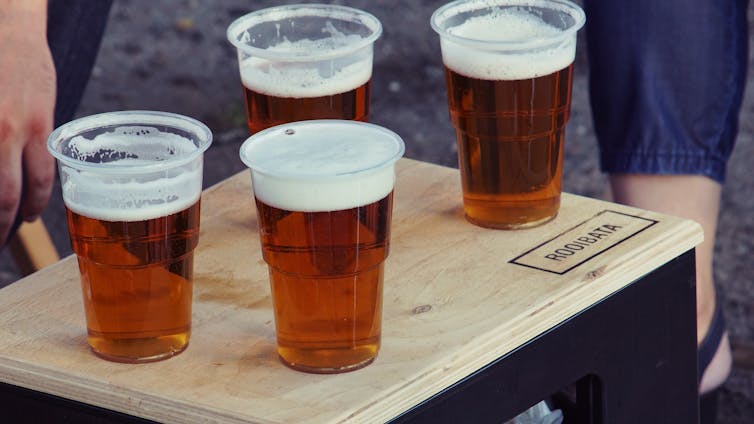 The amount of alcohol bought and drank outside of the home wasn’t taken into account in the study.
Photo by Julia Nastogadka on Unsplash
The amount of alcohol bought and drank outside of the home wasn’t taken into account in the study.
Photo by Julia Nastogadka on Unsplash
How we should read the results
In principle, elasticity is about what happens over time when there is a change – such as a new tax – which results in a higher price.
But the study was not actually measuring the effects of change in price over time. Rather, it correlated how much one family bought of each beverage type when faced with a particular set of prices against how much another family bought of each beverage type with a different set of prices.
But because the study isn’t actually measuring and correlating the change that elasticities would measure – a new tax and the change in consumption over time – it offers no direct evidence of what would happen in case of a change like a new tax, and should not be interpreted as having done so.
It is commonplace in economics to estimate elasticities this way, as a kind of modelling of what might happen with an actual price change, so it is not wrong for the authors to follow this common procedure. We just need to be careful how we interpret the results.
The study results indicate that an increase in the price of sugar-sweetened drinks potentially has both positive and negative impacts, from a public health perspective, on the consumption of alcoholic beverages. It suggests more nuanced price options across different ranges of beverages should be considered rather than a single tax only on high-sugar-sweetened beverages.
What else should we take into account?
The study’s measure of the amount of alcoholic beverages purchased was the number of bottles/containers of alcohol purchased – not the total units of pure alcohol (standard drinks) purchased. The demand for alcohol may not be accurately measured given different alcoholic beverages have different alcohol strengths and are in different sizes of containers.
And while the study looked at relationships between prices of sugar-sweetened drinks and consumption of other non-alcoholic and alcoholic drinks, the impact on other sugary products was not taken into account. For instance, previous studies suggest higher prices of sugar-sweetened drinks may have people substituting their sugar intake through things like sweets.
Read more: A sugary drinks tax could recoup some of the costs of obesity while preventing it
The paper’s unspoken contribution: counting the calories in alcoholic drinks
The paper takes for granted that the calories in alcohol drinks count when thinking about avoiding obesity. But alcohol is often overlooked when we are thinking about calories and obesity.
And it is not easy for consumers to take the calories in alcohol drinks into account. Unlike for every other packaged food or drink sold in Australia, the caloric content does not have to be listed on the label of alcoholic beverages. So one important contribution of the article is to underline that, aside from being intoxicating, alcoholic beverages are also high in calories.
As the paper points out, a bottle of lager beer contains slightly more calories than a can of Coca-Cola. This means arguments for discouraging obesity with a tax on drinks might well be directed at alcohol content as well as sugar content.
Authors: Robin Room, Professor, Centre for Alcohol Policy Research, La Trobe University


 Daily Bulletin


