

How we can put a stop to the revolving door between homelessness and imprisonment
- Written by: Sophie Russell, Research Associate, UNSW
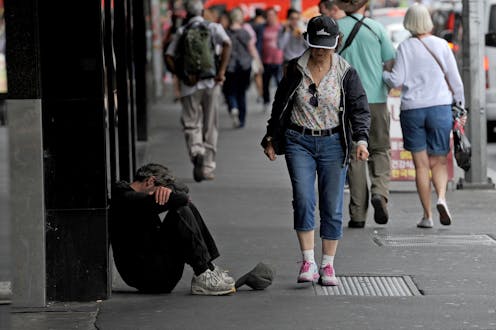
Homeless people are over-represented in Australia’s prisons, and previously incarcerated people are over-represented among the homeless. Experiencing homelessness increases the risk of criminal justice system involvement, and experiencing imprisonment increases the likelihood of homelessness.
Data from the Australia Institute of Health and Welfare and the New South Wales Justice Health Survey highlight both the over-representation of homeless people inside prisons and the absence of accommodation services for them on their release.
Over the past five years in NSW, the increasing prisoner population has been the subject of much policy and budget attention. There has been a considerable expansion of the state’s prisons, and an unprecedented investment in programs intended to reduce re-offending.
However, services that respond to unstable accommodation and homelessness for those who have spent time in prison have remained largely on the outskirts of discussions about reducing prisoner numbers and government investment.
The numbers game
18,284 people were released from NSW prisons in 2016-17.
The number of people attempting to access homelessness services from custody in NSW has almost doubled over the last six years, from 1,121 in 2011-12 compared to 2,176 in 2016-17.
The NSW prisoner population has increased by 33% over this period. Quite aside from this, there also appears to be a growth in homelessness among prisoners, and an absence of pathways out of the criminal justice system for those at risk of homelessness.
Demand for homelessness services across the board in NSW is growing. These services supported 74,216 people in 2016-17, compared to 52,105 in 2011-12. However, despite this increase in the provision of services, the homelessness sector is not funded or able to meet demand.
37.2% of people who required accommodation support in NSW did not receive it in 2016-17. This includes 12,280 people who were homeless and needing crisis or emergency accommodation.
An unclear picture
These numbers paint a stark picture of the absence of services available for those who request it, and detail an increase in requests for support from people leaving prison. But it cannot adequately capture the situation for people who did not, or could not, request support.
Although the number of people requesting assistance from inside prison has grown, it is impossible for many people in prison to access support from community agencies on the outside.
Limited access to phone calls or information, and reliance on program staff within the prisons to facilitate requests, frequently mean that people inside prison are not able to request accommodation assistance.
The over-representation of people in prison with mental health and cognitive disabilities further complicates access to services, as do the numbers of people in prison from highly disadvantaged and inadequately resourced communities.
There is some limited short-term accommodation support in place for people on parole, who generally have conditions that require some form of address on release. But for the majority of people released from remand, or after a short sentence, or for people coming out with no parole period, there is no clear accommodation pathway out of prison.
Almost 10% of the NSW prisoner population was homeless prior to incarceration. And when looking beyond primary homelessness and into secondary homelessness (people who move from one temporary site of accommodation to another), almost one-quarter of the prisoner population lived in unstable housing prior to their incarceration.
In NSW, 24.6% of people in prison either have no fixed address, or have moved twice or more in the six months prior to entering prison.
This picture is much worse for women. 27.7% of women in prison in NSW were in primary or secondary homeless prior to incarceration.
The large majority of women in prison (85%) have been the victim of domestic/family violence. Women exiting prison frequently return to living environments where they are at risk of violence, because there are no appropriate and affordable housing options.
Over half (51.3%) of those released from prison in NSW return within two years. There are thousands of people released from prison into homelessness in the community each year. But across the state, there are only 58 beds available specifically for people who are homeless immediately on release from prison.
Why stable housing is key
Having a safe and stable place to live is key to breaking entrenched cycles of poverty and criminal justice system involvement. And people who do not have stable accommodation following release from custody are more likely to re-offend and end up back in prison.
Building pathways outside of the criminal justice system that incorporate housing is critical for both the promotion of community safety, and for the people inside our prisons who are too often trapped for in cycles of homelessness and incarceration.
This article was co-authored by Dr Mindy Sotiri, Program Director (Advocacy, Research and Policy) for the Community Restorative Centre.
Authors: Sophie Russell, Research Associate, UNSW


 Daily Bulletin


