

Why New Zealand should not explore for more natural gas reserves
- Written by: Ralph Sims, Professor, School of Engineering and Advanced Technology, Massey University
New Zealand’s new coalition government has committed to introducing zero-carbon legislation that would set the country on a course to be carbon neutral by 2050.
At the same time, it is not ruling out new permits for coal mining, offshore oil drilling and fracking during a transition away from fossil fuels.
Natural gas is often touted as a “bridging fuel” to cut the use of coal for heat and power while moving towards a low-carbon economy. Also, this week’s report by the crown research institute Scion shows that New Zealand could build a renewable low-carbon transport fuels industry by switching to biofuels instead of natural gas. Developing new gas resources in New Zealand is a shortsighted strategy that could lead to stranded assets.
Read more: 2050 climate targets: nations are playing the long game in fighting global warming
Carbon budget
Carbon dioxide (CO₂) is a long-lived greenhouse gas. Each molecule released into the atmosphere from burning fossil fuels remains there for hundreds of years. Analysis by the Intergovernmental Panel on Climate Change shows that once we reach a total of 2,900 billion tonnes of carbon dioxide (Gt CO₂) in the atmosphere, the planet will likely exceed the internationally agreed target to keep warming below two degrees above pre-industrial levels.
More than 1,900 Gt CO₂ have already been emitted since the late 19th century. We are currently adding around 33 Gt CO₂ from fossil fuel combustion and 5 Gt CO₂ from deforestation every year. The atmospheric concentration of CO₂ has now surged to more than 403 parts per million, the highest in millions of years. The planet is already around one degree warmer than the average pre-industrial temperature.
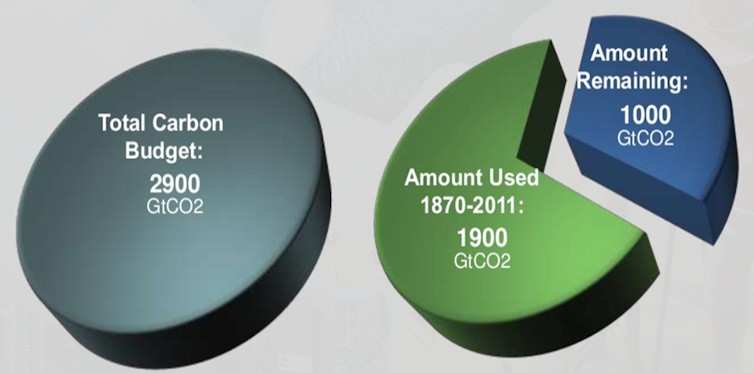 This graphic shows that we have already used up around two-thirds of the total carbon budget to avoid exceeding a two-degree average temperature rise (with a 66% chance).
IPCC, Working Group 1, 2013, CC BY-ND
This graphic shows that we have already used up around two-thirds of the total carbon budget to avoid exceeding a two-degree average temperature rise (with a 66% chance).
IPCC, Working Group 1, 2013, CC BY-ND
The remaining carbon budget, with a 66% chance of staying below the two-degree target, is now at about 800 Gt CO₂. At the current business-as-usual rate of fossil fuel combustion and deforestation, the total budget will be exceeded within 20 to 25 years.
Read more: Fossil fuel emissions hit record high after unexpected growth: Global Carbon Budget 2017
By then, we will have used up around two-fifths of the known global reserves of coal, oil and natural gas. The remaining three-fifths will need to stay in the ground.
Gas as a transition fuel
Natural gas is described as a “transition fuel” that cuts the use of coal. This argument, and the case for providing greater energy security, is being used to justify exploration for deep sea oil and gas in New Zealand waters.
Displacing coal by burning conventional natural gas does indeed produce lower emissions, while providing the same heat or electricity services. A coal-fired power station produces around 900-1100 g CO₂/kWh generated; a gas-fired plant produces around 450-500 g CO₂/kWh. By way of comparison, a geothermal plant varies with the field but can emit up to 50 g CO₂/kWh and emissions from other renewable energy plants vary widely with the circumstances but tend to be much lower.
However, on a life-cycle basis, any carbon dioxide reduction benefits would be partially negated by leakage of methane (CH₄), the main component of natural gas. Leakage is inevitable during the extraction, distribution and use of natural gas. It is difficult to determine the level of leakage, but it is more certain that emissions from coal or gas plants are significantly higher than from a renewable energy plant of similar generation output.
Natural gas has the potential to extend the time before the carbon budget is used up, assuming it displaces coal that would then be left in the ground. But the use of gas cannot deliver the deep cuts in emissions that will be required to stay below two degrees.
Energy security and fossil fuel subsidies
Many nations, including New Zealand, aim to improve their energy security by shifting to more indigenous fossil fuel resources to reduce their dependence on imports and widely fluctuating prices. Exploring for more gas to meet local demands at contracted prices may make good political sense in the short term, but it exacerbates climate change.
Fossil fuel exploration, production and consumption is widely subsidised by many governments. The International Energy Agency estimated the value of consumer subsidies in 2016 was over US$260 billion.
Conversely, divestment away from fossil fuel companies is growing worldwide. For example, New York City is not only intending to divest US$5 billion of its holdings in fossil fuel assets, but also plans to sue the major oil companies over their contribution to climate change.
New Zealand’s economy without more gas
In New Zealand, natural gas is used to generate electricity and heat for industries, to produce methanol (mainly for export) and other petrochemical products such as urea. It also supplies around 277,000 domestic and commercial consumers in the North Island.
Currently around 1,200,000 tonnes per year (t/yr) of coal are consumed in New Zealand, mainly for heat and electricity, emitting around 2.6 Mt CO₂/yr. If all existing coal plants and heating systems were converted to gas, around 1.3 Mt CO₂/yr of emissions would be avoided. This would contribute a little towards the 20 Mt CO₂-eq/yr of emissions reductions needed to meet New Zealand’s current 2030 target under the Paris Agreement.
However, given the Government’s target to reach net-zero emissions by mid-century, gas will ultimately need to be entirely phased out together with coal and oil products. Therefore, the overall aims for New Zealand should be to:
use our existing reserves of natural gas wisely in order to gain maximum long-term economic benefits by maximising the return on investments already made, as well as reducing our annual CO₂ emissions by displacing coal and minimising methane leakage
invest significantly in research and development in sustainable energy, including low-carbon and economically viable alternatives for the current uses of existing gas supplies
clarify and quantify any fossil fuel producer and consumer subsidies and remove them in the near future
avoid the temptation to explore and develop new gas resources even if they appear to deliver short-term economic benefits; and
invest in renewable energy technologies, including biofuels, as long as they are produced from crop and forest residues and purpose-grown forests on marginal land, as identified in the Scion report.
Authors: Ralph Sims, Professor, School of Engineering and Advanced Technology, Massey University
Read more http://theconversation.com/why-new-zealand-should-not-explore-for-more-natural-gas-reserves-91544


 Daily Bulletin


