

How birth interventions affect babies' health in the short and long term
- Written by: Hannah Dahlen, Professor of Midwifery, Western Sydney University
Medical and surgical intervention during birth continues to rise in much of the world. Nearly one in three women who give birth in Australia have a caesarean section and around 50% have their labour induced and/or augmented (sped up with synthetic hormones).
Our new research, published today in the journal Birth, found babies born via medical or surgical intervention were at increased risk of health problems. These include short-term concerns such as jaundice and feeding problems, and longer-term illnesses such as diabetes, respiratory infections and eczema.
Intervention will sometimes be required in childbirth, but should only occur when medically necessary.
Read more: Birth intervention – and harm – more likely in private hospitals
What did we find?
Our international team, based in five countries, analysed data from nearly 500,000 healthy, low-risk women who gave birth in New South Wales between 2000 and 2013, and their children. We looked at their children’s health in the first 28 days and up to five years of age.
We then compared the health outcomes of children whose mothers went into labour spontaneously and gave birth vaginally, with those who were born via medical or surgical intervention.
Medical intervention is when labour is induced using synthetic hormones that start labour and/or augment labour by producing stronger contractions.
Surgical intervention includes caesarean section and instrumental delivery using forceps or vacuum. This is where metal tongs or a plastic suction cap are placed around or on the baby’s head to enable it to be pulled through the vagina.
Read more: From barber surgeons to car mechanics: the technologies of vaginal birth
We found:
Babies who experienced an instrumental birth (forceps or vacuum) following induction or augmentation had the highest risk of jaundice and feeding problems needing treatment in the first 28 days
Babies born by caesarean section had higher rates of being cold and needing treatment in the hospital for this compared to babies born via vaginal birth
Children born by emergency caesarean section had the highest rates of metabolic disorders (such as diabetes and obesity) by five years of age
Rates of respiratory infections, such as pneumonia and bronchitis, metabolic disorders, and eczema were higher among children who experienced any form of birth intervention than those born vaginally.
Our study adds to the growing scientific evidence that children born by spontaneous vaginal birth have fewer short- and long-term health problems.
The findings hold even when you take into account the reason that might pre-empt the intervention, such as induction or caesarean section because the mother has diabetes or high blood pressure. We removed all women with such risk factors from the study.
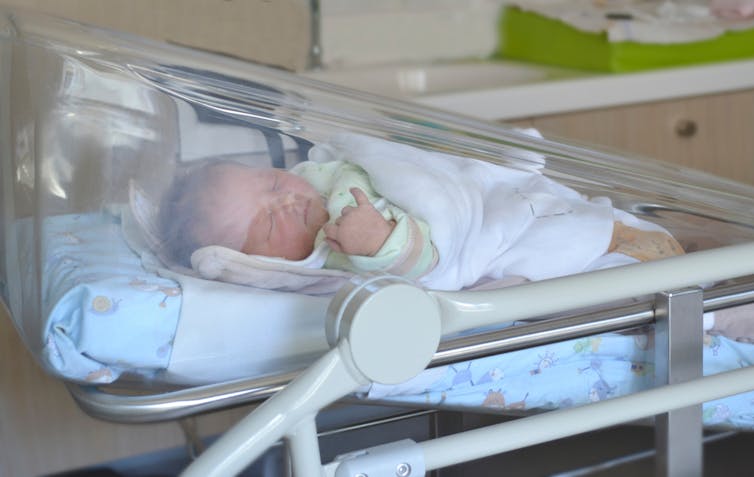 Rates of infections are higher among babies who experienced any intervention.
kipgodi/Shutterstock
Rates of infections are higher among babies who experienced any intervention.
kipgodi/Shutterstock
Why the increased risk?
This study showed an association between common forms of medical and surgical intervention and certain health outcomes for the child. It didn’t find one thing caused the other. But there are some obvious reasons for some of the links.
Forceps and vacuum birth, for instance, can cause bleeding and bruising in the baby’s scalp. These blood cells break down, releasing bilirubin that causes the skin to look yellow, which signals jaundice.
Babies born by caesarean section are more likely to be cold because the operating theatre is cold. Despite recommendations for the baby to be placed on the mother’s chest as soon as possible, this doesn’t always happen.
Read more: Women need more freedom during labour, not a medicalised birth script to follow
Reasons for the increased risk of longer-term problems are much less clear, but there are a couple of interesting hypotheses.
The first key theory is based on epigenentics: that life events affect how genes function and are passed on to the next generation.
Labor and birth exert a positive form of stress on the fetus, which impacts on the genes responsible for fighting off bugs, weight regulation and suppressing tumours. Too little stress (no labour and elective caesarean section) or too much stress (induced/augmented labour and instrumental birth) could impact the expression of these genes.
The second key theory is the extended hygiene hypothesis. This suggests that vaginal birth provides an important opportunity to pass gut bacteria from mother to baby to produce a healthy microbiome and protect us from illness.
If we have an unhealthy microbiome, we may be more vulnerable to infections, allergies, diabetes and obesity.
Read more: Gut instinct: how the way you're born and fed affect your immune system
How to reduce unnecessary birth intervention
Recently released guidelines from the World Health Organisation (WHO) recommend ways to reduce unnecessary intervention by encouraging evidence-based clinical care. Among the recommendations are three that can be applied in Australia:
Women should have continuity of care, where they see the same health practitioner throughout pregnancy, during the birth, and in the postnatal period. This reduces the risk of unnecessary interventions.
Don’t intervene too early. Women progress much slower in labour than we previously thought. For 70 years, clinicians believed the cervix should dilate by 1 cm per hour. If the cervix was slower to dilate, intervention was initiated because labour was thought to have slowed. We now know labour progresses more slowly.
Don’t use continuous electronic monitoring (CTG) to monitor the baby, unless there are significant risk factors. Instead, listen in regularly with a small, hand-held monitor. Continuous monitoring increases intervention rates for low-risk women and healthy babies without improving outcomes for babies.
Introducing a more evidence-based approach to care during labour and birth can increase the rates of spontaneous vaginal birth and reduce unnecessary intervention.
 Child birth guidelines should be evidence based to avoid unnecessary intervention.
GOLFX/Shutterstock
Child birth guidelines should be evidence based to avoid unnecessary intervention.
GOLFX/Shutterstock
When intervention is necessary
A certain level of intervention during childbirth improves outcomes for women and babies. But the World Health Organisation recommends the caesarean rate should be under 15%.
Babies may need to be induced when they are small and not growing well, or if they are overdue (beyond 41-42 weeks).
Caesareans may be necessary before labour even starts, such as when the placenta is lying across the cervix (placenta praevia), or when labour is in progress, if the baby gets distressed.
If you need to have your labour induced or augmented, or require an instrumental birth or a caesarean section due to complications, there are some things to help modify the long-term effect on your child. Seek uninterrupted skin-to-skin contact after the birth and exclusively breastfeed, if you can.
It is important for women and their partners to have all the information about both short- and long-term effects of intervention to make truly informed decisions about care during pregnancy and birth.
Authors: Hannah Dahlen, Professor of Midwifery, Western Sydney University


 Daily Bulletin


