

Further strikes on Syria unlikely
- Written by: Mehmet Ozalp, Associate Professor in Islamic Studies, Director of The Centre for Islamic Studies and Civilisation and Executive Member of Public and Contextual Theology, Charles Sturt University
A head-spinning series of events in the past few weeks have taken us from the United States pulling out of Syria, to analysts predicting the beginning of a third world war.
What has really happened in Syria, what are the ramifications of the joint strike from the US, France and Britain, and what can we expect from the key players?
Certainly, the mess in Syria and heightened tensions in the Middle East make us all fear an impending world war, especially when both the Russian and US presidents engage in a round of chest-thumping. Despite this, there is no certainty that a world war will be triggered from the Syrian conflict.
The latest chemical attack, allegedly perpetrated by the Syrian government, followed by the US, British, French retaliation, is really about aligning an unpredictable Trump with the Syria policy of the state and military establishment in Washington.
Why the strikes?
A world power like the US is seldom reactive. It often uses events as key moments to implement new policies or shift policies. An apparent correlation of events with policy implementation justifies the policy in the eyes of internal constituents and the wider international community.
Since the beginning of the Syrian conflict in 2011, Russia has followed an open and consistent policy: declare Syrian President Bashar al-Assad’s regime the legitimate government of Syria, always support his regime to ensure it doesn’t collapse, and morally justify its involvement as a struggle against terrorism. The unspoken policy is to build up a challenge to Western dominance over not only the Middle East, but geopolitical world order.
Yet, the US, and by extension Western policy on Syria, was tentative, unclear and seemed to change course over the seven-year conflict.
Under Barack Obama’s administration, the US consistently stayed out of direct involvement in the Syrian conflict. Busy with the Iraq exit, Obama missed the window of diplomatic opportunity in the crucial early months of the Syrian uprising in 2011. When violence started, Obama elected to provide limited military support to opposition groups, hoping they could muster enough power to dismantle Assad.
The Obama administration shifted its policy after a chemical attack in Eastern Ghouta in 2013 prompted it to push for a United Nations resolution demanding the destruction of chemical stockpiles. This in turn gave impetus to peace talks in Geneva. Apparently, the stockpiles were not destroyed, as we have seen more chemical attacks.
Read more: Explainer: the war in Syria and the possibility of removing Assad
Obama admitted his strategy failed, as the “US was muscled out of Syria” by an increasingly bold Russian President Vladimir Putin. His support allowed Assad to gain the upper hand in Syria with the fall of Aleppo in December 2016. Efforts to make progress in the Geneva talks were continually stalled. The parties failed to make any meaningful progress even as late as 2017.
In the early months of his presidency, the expectation was that Trump would change the US policy on Syria. It was uncertain what trajectory it would take, and when it would come to pass.
Not much happened until yet another chemical-gas attack by Assad in April 2017. The US responded with a massive missile attack, taking out 20% of Assad’s air force. The result was that the Trump administration committed to a more active involvement in Syria and the complete dismantling of the Islamic State presence in the country, but not necessarily the removal of Assad.
It is now apparent there was a fundamental difference between Trump and the key people in his administration in their understanding of the US’ Syria policy.
For Trump, it was always about eliminating IS. On April 3, he announced that the US’ primary mission in Syria was “getting rid of ISIS”. Since this had now been completed, he could bring the troops home.
Yet, in December 2017, Defence Secretary James Mattis said the US would continue its presence in Syria as a “stabilising force” beyond IS.
In January 2018, former Secretary of State Rex Tillerson confirmed the US would stay in Syria beyond IS, adding that the continued US presence aimed to prevent Iranian and Assad forces regaining territory “liberated with help from the United States”.
So, Trump’s withdrawal intentions, or rather the public announcement, came as a surprise to his own administration as well as the international community. In response, the US special envoy for the global coalition against IS, Brett McGurk, said:
We are in Syria to fight ISIS. That is our mission, and our mission isn’t over, and we are going to complete that mission.
Other officials from the US administration and military made conflicting statements.
Trump’s withdrawal announcement opened the ground for other players to assert their plans. On April 4, Russia, Iran and Turkey held a summit in Turkey, at which Putin announced:
We have agreed to expand the entire range of our trilateral cooperation in Syria.
The trio’s plan included an intensified Turkish operation in northern Syria. Turkish President Recep Tayyip Erdogan vowed “to clear all terror groups from Syrian border, including the YPG,” the Kurdish military force that was backed by the US in its bid to eradicate IS from Syria.
It seemed Syria would be left to Russia, Iran, Turkey and Assad. Until, of course, the most recent chemical attack in Douma, a suburb near Damascus, on April 7. The attack was blamed on the Assad government even though it vehemently denied it, and there were allegations of rebel involvement.
Importantly, the chemical attack conveniently served the faction in the US administration advocating for a greater involvement in Syria. Their arguments pushed Trump towards retaliation. In a matter of days, Trump went from vowing withdrawal from Syria to saying they have a “big price to pay”.
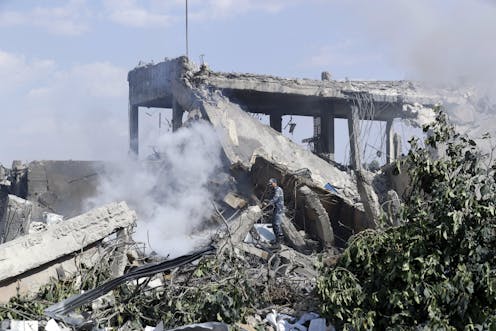
A military response in the form of a missile attack was inevitable, and so it took place on April 13, when the US and its allies, Britain and France, made “precision missile strikes against the Syrian government”. The six-day delay was really to gain international support for the attack so that it did not appear to be a showdown between Russia and the US.
Where to from here?
The most recent events in Syria were really about aligning Trump’s understanding of Syrian policy with that of the state and military establishment. The policy is to stay in Syria beyond IS, preventing its revival and preventing Iranian and Assad forces from regaining territory.
It is unlikely there will be any other military strikes by the US and its allies anytime soon. There are two possible wild cards though – Trump’s unpredictability and a possible Russian retaliation.
Elements within the US administration in favour of continued US involvement in Syria will have to keep Trump calm – give him reasons why he should continue committing to Syria, while preventing a direct Russian-US confrontation. Building a coalition with France and Britain prior to the missile retaliation served this purpose. It gave Russia the impression that the matter was a concern with the international community, rather than just the US.
Trump’s exaggerating nature and bombastic language in his tweets run the risk of escalating the situation. But they also help contain Russia, which is always unsure what Trump may say and do next.
Read more: Stakes are high as Turkey, Russia and the US tussle over the future of Syria
A Russian response beyond condemnation is unlikely. Putin recently won a landslide victory in the March presidential elections. He is in no hurry to thump his chest into an all-out brawl with the US due to internal politics.
Furthermore, Russia is already in a diplomatic crisis over the assassination attempt of a former spy and his daughter with a nerve agent in London.
The US, Britain and more than a dozen European countries expelled Russian diplomats in retaliation. Putin is already quite vulnerable in the international scene. He will not enter a fight he is not certain to win.
While the US and its allies may feel morally justified in attacking the Assad government targets, any such intervention is unlikely to help the people of Syria. They will continue to be collateral damage caught in the crossfire of geo-politics.
Authors: Mehmet Ozalp, Associate Professor in Islamic Studies, Director of The Centre for Islamic Studies and Civilisation and Executive Member of Public and Contextual Theology, Charles Sturt University
Read more http://theconversation.com/further-strikes-on-syria-unlikely-but-trump-is-always-the-wild-card-94814


 Daily Bulletin


