

Making a global agenda work locally for healthy, sustainable living in tropical Australia
- Written by: Silvia Tavares, Lecturer in Urban Design, James Cook University
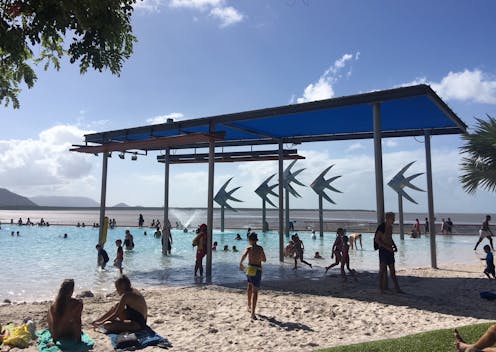
Life in the tropics is often seen as “living in paradise”, a place where everything grows and flourishes. This picture-postcard environment is not the year-round reality. At certain times of year, intense heat, humidity and the wet season affect liveability, making outdoor activity unattractive and thereby reducing social cohesion.
Urban living can already be pretty insular these days. People move from temperature-controlled houses to temperature-controlled cars to temperature-controlled offices, and vice versa. There’s no need to talk to anyone really. And exercise? It’s something you try to fit in if you can – but you probably don’t.
An ideal city life might be one in which you walk or cycle to work easily, say hi to a neighbour, and pick up some fresh produce for lunch along the way. While it is nice to expect that people will do this for a healthier self and planet, the truth is that daily life choices depend on convenience.
Furthermore, the planning and design (or haphazard evolution) of urban spaces largely dictate the way we live. This in turn affects our health in many ways. It can, for instance, encourage or discourage active lifestyles, social cohesion and access to healthy food choices.
Read more: Designing the compassionate city to overcome built-in biases and help us live better
This is where the New Urban Agenda comes into play.
The New Urban Agenda and why it matters
The New Urban Agenda, drafted by UN-Habitat and endorsed in late 2016 by the United Nations General Assembly, aims to help everyone to benefit from urbanisation.
Through Sustainable Development Goal (SDG) 11 (Sustainable cities and communities), the agenda provides a guide for developing safe, inclusive, resilient and sustainable new cities that promote social integration and equity. It can also provide the impetus for conversations about the growth, redesign and redevelopment of existing urban spaces.
Read more: What can the New Urban Agenda and Sustainable Development Goals do for cities?
Making the New Urban Agenda work locally depends on more than overall regulations, or “importing” southern Australian solutions to the tropics. Even within the Australian tropical region, the climate varies. Cairns experiences a tropical monsoon climate (wet tropics), while Townsville is exposed to a tropical savannah climate (dry tropics).
The way public spaces should be designed must, therefore, also vary within the tropical climate zone. We need to listen to locals, understand their behaviour and preferences, then promote these preferred public space qualities through urban planning and design.
Good design can improve the choices we make. But what is good design? And how do we adapt general guidelines to specific places and cultures?
Urban diaries to understand each city
Urban diaries are premised on the importance of local history, values and knowledge. This approach aims to “distinguish underlying organic relationships between people and cities from indiscriminate prescription imposed upon place”. Urban diaries are a powerful tool for personal observation, raising awareness and creating positive urban change.
In our investigation, participants are invited to shoot and caption photographs of their surroundings, noting what makes their lives healthier, happier and stronger, and what does not. These images will be shared through social media and used to capture ideas and start conversations.
These urban diaries will help clarify how Cairns and Townsville function as tropical cities. At the same time this approach will help bring to light ways of improving local lifestyles by implementing the New Urban Agenda principles in this local context.
Place-based urban planning and design
Climate-responsive planning and design are important to make sure people can incorporate incidental exercise into their everyday routine. People will use public spaces if these are designed in a way that mediates the negative impacts of tropical climates.
What type of spaces and features will encourage people to walk even if the temperature outside is 40℃? We are particularly interested in three overarching questions. These concern how existing urban infrastructure and amenities promote or restrict:
- active lifestyles
- social inclusion
- healthy eating.
These questions will be explored through public participation in the upcoming UN-Habitat World Urban Campaign Urban Thinkers Campus events in Cairns on June 8 and Townsville on June 15. Drawing on urban diaries, these events will provide the fundamental basis for understanding these places through a local lens.
Read more: This is why health has to be at the heart of the New Urban Agenda
Authors: Silvia Tavares, Lecturer in Urban Design, James Cook University


 Daily Bulletin


