

What's really driving the future of retail?
- Written by: Jason Pallant, Lecturer of Marketing, Swinburne University of Technology
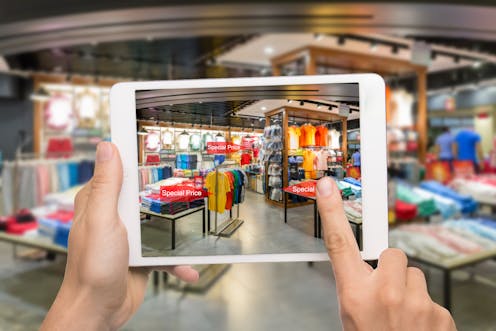
Many predictions about the “future of retailing” have been made. These range from the supposed dominance of certain technologies, to increased use of data and analytics, the rising need for personalisation and customisation, and the transformation of physical spaces.
The challenge with specific predictions is that these are susceptible to becoming obsolete fast. Future technologies are likely to make the current cutting-edge redundant, and the methods by which customers can customise products are likely to look very different in the future.
However, when you take a step back, some common themes emerge from these predictions, such as convenience, customer experience, business intelligence, and personalisation. It’s these themes that will really shape the future of retail.
Many specific predictions about the use of new technologies, for example, link back to the notion of providing convenience to shoppers, or learning more about customers.
Predictions relating to the rising use of data and analytics are about becoming more intelligent in interactions with customers.
While the specifics of each theme may change, their impact is likely to stay. For example, convenience in the future may relate to payment technologies, store opening hours, or other as yet unknown methods. Whatever the case, the drive for convenience is likely to persist.
While some themes are easily identified, others are less obvious; including fragmentation, flexibility, and transparency.
Fragmentation
At a population level, PWC describes fragmentation as the widening gap between the “haves” and the “have nots” and the impact this has had on consumer behaviour. Similar fragmentation is driving the future of the retail industry in a number of ways.
A common prediction is that retail space (including stores and centres) will become smaller. Yet some retailers are opening new flagship stores and some already large centres have been expanded.
Read more: Location and voice technology are the future of retail
Fragmentation is also occurring at the retail level. Mega-retailers like Amazon and Alibaba are holding strong positions in many markets. At the same time small, niche and independent retailers are gaining exposure through outlets such as Etsy and 100 Squared.
The major question arising from this theme is what will happen to the middle? Already department stores like Myer have struggled to find a place. They lack the range and scope of the largest retailers, but don’t have the independence and flexibility of niche operators.
Flexibility
Flexibility is about retailers adapting to changing trends and consumer demands. This is clearly seen in current trends and future predictions related to personalisation and customisation.
Allowing customers to customise products requires flexibility to adapt product or service offerings. At the same time, more flexibility is expected with physical spaces.
Traditional large store footprints are giving way to small and flexible showrooms. A new format of “super-neighbourhood” shopping centre is expected to focus on flexibility for local communities.
This theme has interesting implications for the future. How can stores and shopping centres be designed and managed to provide flexibility? How will the need for flexibility impact the already challenging relationships between retail tenants and landlords?
Finally, how far can flexibility in product and service design really go? Will retailers of the future be able to let consumers design anything they want with no boundaries?
Read more: Westfield's history tracks the rise of the Australian shopping centre and shows what's to come
Transparency
The idea of transparency has gained a lot of attention with discussions about Facebook and Cambridge Analytica. However, a similar theme is impacting retail.
Consumers have unprecedented access to information about stores, brands and products through online channels, mobile devices and consumer-to-consumer sharing.
This challenges retailers to be transparent and honest with product or service offerings, as misrepresentations are easily identified.
How can retailers best manage the need for transparency while still maintaining a competitive advantage? Alternatively, should retailers and shopping centres look to discourage consumer information-gathering? Or can transparency be leveraged to create mutual benefit for consumers and retailers?
What next?
Australian retailers have had a tough time in recent years. Online shopping is growing steadily and major international companies like Costco are also expanding.
This has turned retail into a global competition.
No-one really knows what the future will hold, as confident as some predictions may sound. However, considering the underlying drivers of current trends, as well as future predictions, there are some key factors to consider. The real value comes not from focusing on only one driver, or the latest buzz trend.
It is important to consider how these multiple trends overlap. For example, providing more flexible services might help satisfy the need for greater customer experience, as well as convenience. Alternatively, greater transparency might help cope with the fragmentation of the industry.
The challenge for the retail industry is to develop specific strategies for the future based on these driving forces.
Authors: Jason Pallant, Lecturer of Marketing, Swinburne University of Technology
Read more http://theconversation.com/whats-really-driving-the-future-of-retail-100518


 Daily Bulletin


