

What is a gem? And why painite from Myanmar can fetch US$60,000 per carat
- Written by: Andrew Christy, Senior Curator (Mineralogy) at the Queensland Museum and Lecturer, The University of Queensland
My favourite gem is an occasional series where we ask a scientist to share the fascinating geological and social features of a beautiful rock.
Humans have adorned themselves and their belongings with attractive stones since prehistoric times. We’ve used fossil materials such as jet and amber, colourful rocks such as lapis lazuli, and water-clear single crystals of minerals such as amethyst and golden citrine.
The “precious stones” diamond, ruby, sapphire and emerald are distinguished from the remaining “semiprecious stones” largely on the basis of perceived rarity in classical times.
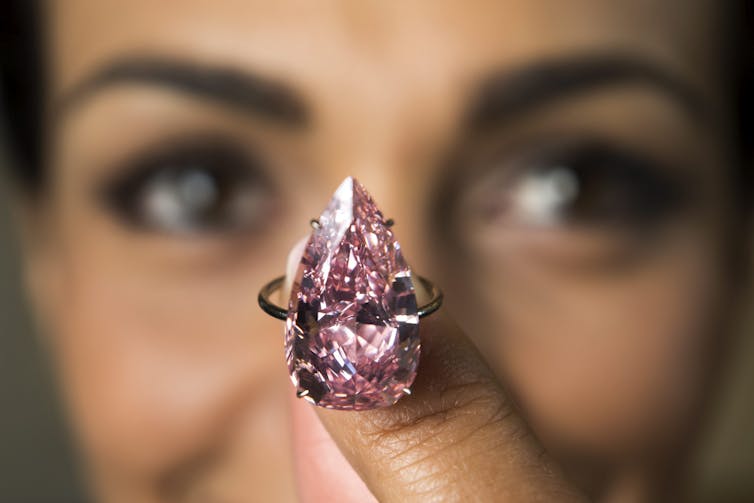 This is a natural diamond – it’s called Unique Pink, and sold for for A$42.8 million in 2016.
LAURENT GILLIERON/AAP
This is a natural diamond – it’s called Unique Pink, and sold for for A$42.8 million in 2016.
LAURENT GILLIERON/AAP
But what makes a stone a gem? It boils down to a few key qualities – beauty and durability. And rarity makes a gem even more special, as is the case for my favourite: painite.
Read more: Why we value diamond rings and other Valentine's Day gifts
Tough beauty
Any stone may become a gem if it has beauty (in the eyes of enough beholders) and is durable enough to retain that beauty through everyday wear.
Durability usually implies that the stone is hard enough to resist abrasion from airborne sand and dust. Also, that it does not easily fracture or “cleave” on flat planes of weakness (determined by its atomic arrangement).
Diamond, the hardest known material, certainly satisfies the abrasion criterion. A diamond crystal does have four orientations of cleavage plane on which it can be split easily. But for diamonds, this apparent liability can be turned into an asset.
The cleavage is used as a short cut in the early stages of shaping, cutting and polishing this extraordinarily hard material, which is otherwise a slow and painstaking business.
How to cleave a diamond.The four Cs
Demand drives the value of gemstones as commercial items, and this in turn is a function of fashion and name recognition.
However, the main valuation criteria for gems such as diamonds are often summarised as “the four Cs”: carats, colour, clarity and cut.
One carat (0.2 g) is the traditional unit of weight for a gemstone – but larger stones are disproportionately rare, and worth more per weight than smaller ones.
While pure diamonds are colourless, and the same is true of many other gem minerals, striking and rare colours almost always increase their value.
Small amounts of impurities or defects of the crystal structure are needed to produce the prized pink diamonds for which the Argyle mine of northwestern Australia is famous.
Impurities also turn the common mineral corundum into its red form (ruby) and other coloured varieties familiar as sapphires. Such colours are appreciated best through the depths of a transparent, intact single crystal, with the passage of light unimpeded by fractures, inclusions or rough surfaces. Hence the value of clarity.
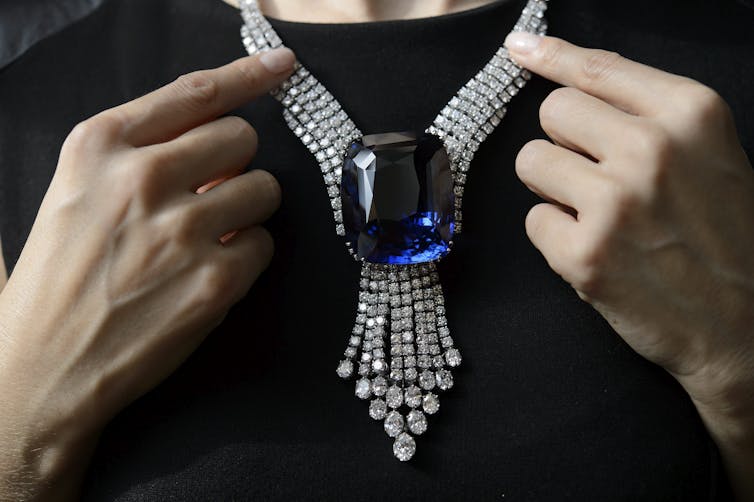 The Blue Belle of Asia is a 392,52 carat sapphire, and was discovered in 1926 in Ceylon.
MARTIAL TREZZINI/AAP
The Blue Belle of Asia is a 392,52 carat sapphire, and was discovered in 1926 in Ceylon.
MARTIAL TREZZINI/AAP
The rare gem painite
Although diamonds are still the popular epitome of preciousness, they are far from the rarest minerals to have been used as gems.
As a mineralogist, my favourite amongst these ultra-rare stones comes from the gem gravels of the Mogok region in Myanmar. There, sapphires, rubies, spinels and other gemstones accumulate in river beds after washing down from the surrounding forested hills. These have been mined since ancient times.
In 1957, two deep red stones from a batch donated to the Natural History Museum in London – as shown in the lead image for this story – turned out to be completely new to science. A tiny slice from one crystal was used for research, and the new mineral was named “painite” after the original donor, the gem dealer Arthur Pain.
Read more: De Beers to sell synthetic diamonds: here’s how they’re made
A third painite was identified in 1979, but it was not until 2001 that a fourth was found in Myanmar. Efforts to find more intensified, working uphill along creeks and locating progressively less water-worn material.
By 2005, a source outcrop for painite was finally discovered, nearly half a century after the original identification. Several thousand stones have now been recovered, but the small number of cut gems remains the preserve of specialist collectors.
Painite’s extreme rarity is due to it containing the chemical elements zirconium and boron, which do not normally associate with each other in nature and don’t occur together in any other mineral. Ironically, some painite crystals are partly altered to a crust of small pink crystals of the more common ruby.
The increase in supply means that you can now get small crystals of painite pretty easily online for tens of dollars, and poor-quality cut stones for about A$100. However, the tiny proportion of gem-quality stones still fetch US$60,000 per carat.
Opal, the odd one out
The national gemstone of Australia, precious opal, is an anomaly. It is soft enough to scratch easily, prone to cracking, most attractive when nearly opaque, and does not occur as crystals.
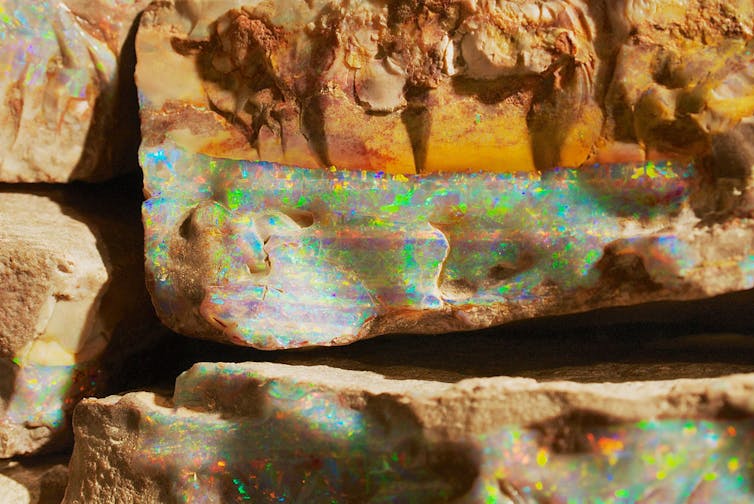 A rare example of boulder opal.
from www.shutterstock.com
A rare example of boulder opal.
from www.shutterstock.com
Opal is made from microscopic spheres of non-crystalline silica in a very regular array. This natural “photonic crystal” diffracts light to produce the play of rainbow colours whose beauty overcomes all other considerations.
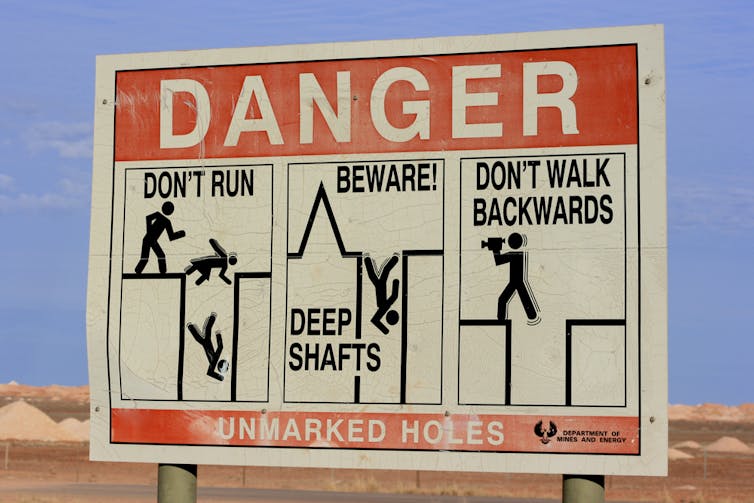 Opal mining creates health hazards in Coober Pedy, South Australia.
from www.shutterstock.com
Opal mining creates health hazards in Coober Pedy, South Australia.
from www.shutterstock.com
Read more: From mine to wine: creative uses for old holes in the ground
Where science comes in
The polishing and carving of semiprecious stones originated in prehistory.
But the cutting of diamonds in particular has become a sophisticated craft well grounded in the science of optics. One rough stone may ultimately produce several finished stones of different sizes, the pattern of cuts being chosen to minimise waste.
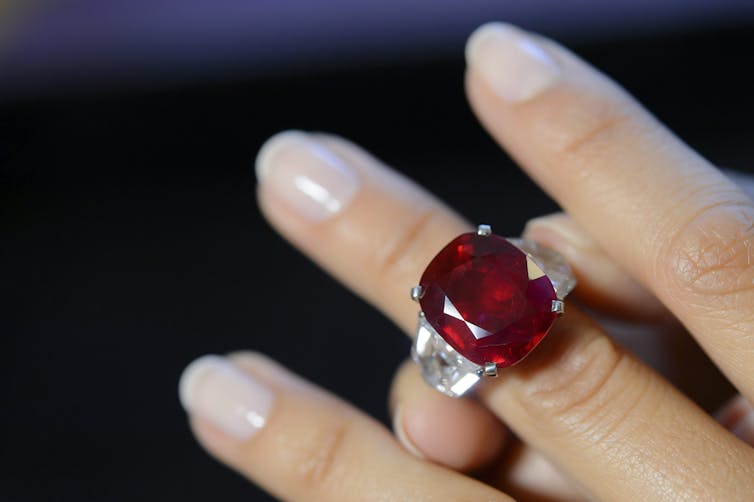 A ruby and diamond ring by Cartier, with a Burmese ruby weighing 25.59 carats.
MARTIAL TREZZINI/AAP
A ruby and diamond ring by Cartier, with a Burmese ruby weighing 25.59 carats.
MARTIAL TREZZINI/AAP
Diamond cutters angle the facets on each stone precisely, so as to maximise the internal reflection of light and the dispersion of white light into rainbow sparkles. They also aim to produce an overall shape which appeals best to the market.
Similar considerations have led to standard cuts being developed for other gems, to show them at their best.
Authors: Andrew Christy, Senior Curator (Mineralogy) at the Queensland Museum and Lecturer, The University of Queensland


 Daily Bulletin


