

Disabled teens suffering the mental health effects of bullying
- Written by: Tania King, Research Fellow, University of Melbourne
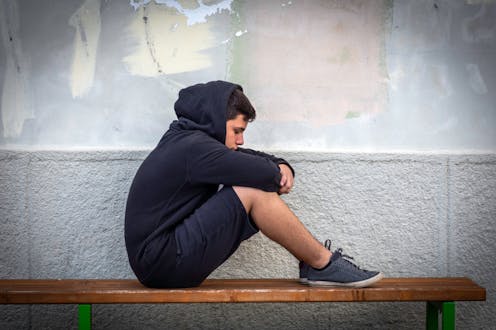
Almost half of the poorer mental health we see in teenagers with a disability is due to bullying, our new research shows.
If we could stop the high levels of bullying that adolescents with a disability experience, we could make a big difference to their health, learning and wellbeing.
So school anti-bullying programs need to acknowledge the link between having a disability, being bullied and poorer mental health.
Read more: School is not always a safe place for students with disability – this has to change
Poorer mental health
Adolescents with a disability are more likely to have poor mental health than other adolescents.
But for a long time, it’s been unclear why. Could it be related to adverse experiences such as bullying?
Read more: Teenagers who are both bully and victim are more likely to have suicidal thoughts
We know that adolescence is a difficult time for many young people, and they are highly sensitive to their social and cultural environment. Their health and wellbeing are also tied to the social circumstances in which they grow up.
For the estimated 9% of Australian adolescents with a disability, this period can be particularly stressful.
What is bullying?
Bullying is a common and harmful experience of childhood and adolescence. Bullying can be physical (pushing, hitting), verbal (such as teasing and name-calling), or relational (excluding and spreading rumours). Cyber-bullying is also a type of bullying.
Read more: What should I do if my child is a cyberbully?
There is clear evidence that being a victim of bullying in adolescence is associated with poor mental health.
Internationally, about one-third of children and adolescents report that they have been bullied, and between 10–14% report that this occurred repeatedly over a period of months.
Internationally, population-based studies have shown adolescents with a disability are up to two times as likely to be bullied compared with other adolescents.
The same is true in Australia. Our research has shown that children with a disability and from disadvantaged families are more commonly bullied.
What we did
We already know that disability is associated with poor mental health, bullying is associated with poor mental health, and disability is associated with more experiences of bullying.
So we wanted to estimate how much of the poor mental health seen in adolescents with a disability is due to the fact that they are more likely to be bullied.
Knowing this, we wanted to work out how much we could improve the mental health of adolescents with a disability by preventing their experiences of bullying.
We used data from a cohort of 3500 adolescents from the Longitudinal Study of Australian Children, where information is collected on disability, bullying and mental health.
Because the study is longitudinal, we could measure disability, bullying and mental health at different time points.
We used a new method called causal mediation analysis to look at the data. This allowed us to separate the “total effect” of having a disability on mental health into two parts.
First, we estimated the effect that is due to bullying (the mediated effect) and second, we measured the effect of disability on mental health that is not due to bullying.
Parents reported their children’s disability at 12-13 years old. Disability included a range of different conditions such as “difficulty learning”, and “speech problems” that had lasted for at least six months.
Parents and adolescents were asked about bullying when the adolescents were 14-15 years old. Parents, teachers and adolescents also reported on the mental health of adolescents at this age.
What did we find?
Our results showed that bullying mediates (or explains) 46% of the total effect of disability on mental health. In other words, almost half of the poorer mental health that we see in adolescents with a disability is due to bullying.
We don’t know what the other 54% is related to. But it could be due to other stresses associated with having a disability, such as schools and the community not providing enough support or assistance, dealing with health problems, or the disadvantaged circumstances in which adolescents with a disability sometimes live.
There may be other factors that could explain the results. For example, some adolescents might be more likely to report both bullying and mental health problems because of certain personality characteristics. It is also true that because the data on disability, bullying and mental health are self-reported, rather than objectively measured, they may not be accurate.
However, as information came from parents, adolescents and teachers, rather than one source, we could test our results using different combinations of respondents. We found similar results across these, and this gave us confidence in our findings.
What does all this mean?
Our results show that the poor mental health of adolescents with a disability is not inevitable. If we could stop the high levels of bullying that adolescents with a disability experience, we could make a big difference to their health.
Bullying is likely to have lifelong consequences for young people with a disability. It affects their learning and social engagement as well as their health and wellbeing as adults.
Anti-bullying programs need to address disability too
Anti-bullying programs have rightly focused on groups vulnerable to bullying such as Indigenous and ethnic minorities, as well as LGBTI+ adolescents – but they should also focus on children and adolescents with a disability.
Interventions that reduce bullying of adolescents with a disability would reduce the inequalities in mental health associated with disability.
Interventions should take a whole-school approach, including teacher training, promoting an inclusive school culture through clearly defined rules, individual counselling and policies, and plans for conflict-resolution.
It is a sad reflection on our current school system that children and adolescents with a disability experience such poor treatment from their peers.
If we are serious about increasing participation and improving outcomes for adolescents with a disability in mainstream education, we need to act now to prevent their experiences of bullying.
Authors: Tania King, Research Fellow, University of Melbourne
Read more http://theconversation.com/disabled-teens-suffering-the-mental-health-effects-of-bullying-101186


 Daily Bulletin


