

The problem isn't dockless share bikes. It's the lack of bike parking
- Written by: Glen Fuller, Associate Professor Communications and Media, University of Canberra
It’s a local government truism that Australian city dwellers care about only three things – rates, rubbish and parking. They want lower rates, the freedom to turf out as much trash as they like, and convenient free car parking. The arrival of dockless share bikes set these attitudes towards parking and rubbish on a collision course.
Dockless bike sharing was quickly embraced as a neat solution to a complex urban transport problem and then just as quickly condemned as a blight on the landscape. Its key advantage over its docked competitor turned out to be its key weakness in the Australian market.
Read more: Oh no, oBikes are leaving Melbourne! But this doesn't mean bike sharing schemes are dead
Our ongoing research project looks at the future of cycling in Australia. Dockless bikes are the most prominent recent re-imagining of how cycling functions in our cities. Our research indicates that culture isn’t the problem so much as infrastructure – namely, a lack of bike parking.
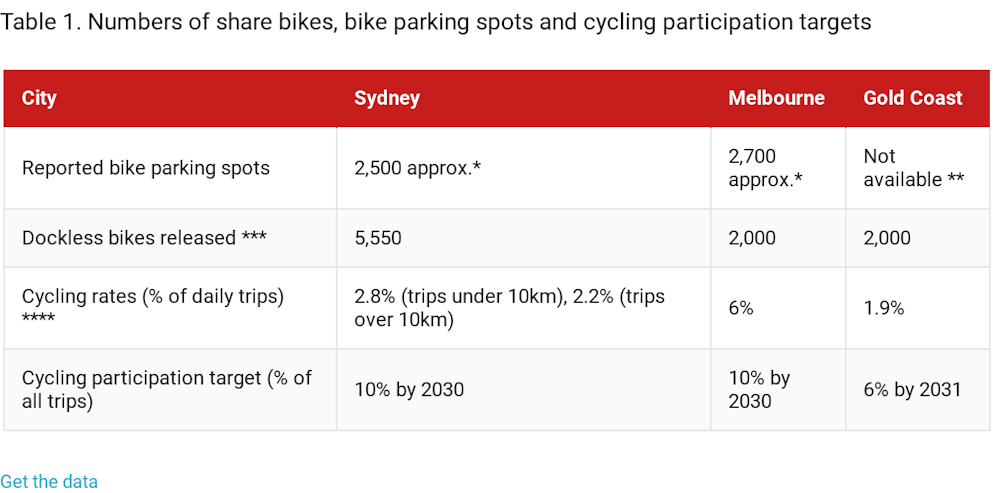 * Excludes pay-for-access Parkiteer stations or private parking.
** Light rail network has six ‘bike sheds’ with multiple parking hoops
*** Numbers based on news reports at time of introduction to each city and middle-of-the-road estimates where projected numbers may not have been met
**** Estimates of rates of cycling can be problematic as there is no standard or nationally applied method for determining these, and cycling is a shared concern between portfolios like transport, public health and sport/recreation
Author provided
* Excludes pay-for-access Parkiteer stations or private parking.
** Light rail network has six ‘bike sheds’ with multiple parking hoops
*** Numbers based on news reports at time of introduction to each city and middle-of-the-road estimates where projected numbers may not have been met
**** Estimates of rates of cycling can be problematic as there is no standard or nationally applied method for determining these, and cycling is a shared concern between portfolios like transport, public health and sport/recreation
Author provided
From go to whoa in a year
Singaporean company oBike launched the first commercial dockless bike venture in Australia in June 2017. Mobike, Reddy Go and Ofo soon followed. At A$2-$2.50 for 30 minutes, the bikes offered an affordable alternative to carbon-based transport for short trips within cities.
Yet, by July 2018, oBike, Ofo and ReddyGo, after placing upwards of 10,000 bikes on Australia’s streets, had announced they were leaving. The dream of enhanced city mobility was reduced to a luminous pile of unwanted bikes.
For the moment it looks like the experiment failed. The obvious reason, rarely mentioned, is the lack of bike parking in Australian cities. Dockless bikes exist in limbo between disposable and valuable, which makes them a target for abuse and abandonment.
The key attraction of dockless bikes is convenience – they can be left anywhere. However, this can be enraging for non-users who see parked bikes as rubbish, and not a standing reserve of cheap transport. They see bikes left in parks, against shop windows, in front gardens, hanging from fences and in building entrances as an unwelcome disordering of a highly ordered space.
Read more: To end share-bike dumping, focus on how to change people's behaviour
More dockless bicycles were introduced to Sydney and Melbourne than there were parking spaces. But councils in both cities introduced guidelines that made operators responsible for bike parking and placement, requiring them to liaise with municipal authorities and public landholders to provide solutions.
In late 2017, six Sydney councils introduced guidelines on dockless bikes. Other jurisdictions followed. The Environmental Protection Authority (EPA) in Victoria introduced rules that led to oBike withdrawing from Melbourne.
That the EPA, rather than a transport authority, made rules about dockless bikes says a great deal about their status. In the eyes of many Australians the bikes are rubbish first and transport second.
A failure of infrastructure
Secure bike parking is provided in both cities, generally around public transport networks. However, Sydney has fewer than 100 individual secure spaces while greater Melbourne has around 70 secure “Parkiteer” sites.
These facilities require users to pay a bond – $50 for Parkiteer – so serve a particular kind of bicycle commuter rather than the public at large. Sydney’s main train stations, Central and Redfern, have fewer than 100 public bicycles spaces between them. It’s common to see bikes chained to fences and railings around these stations.
The failure to find a dockless bike parking solution demonstrates the naivety of the operators. It also indicates that if Sydney and Melbourne were to miraculously achieve their mode-share goals, the failures of their infrastructure’s capacity would be made painfully apparent.
Read more: Cycling and walking are short-changed when it comes to transport funding in Australia
If dockless bikes failed because they were always “matter out of place”, as Mary Douglas famously put it, then who is responsible for providing places for dockless bikes? Blame has largely been placed on users, who are deemed irresponsible. Thus, it must be a social problem.
But Australian cities don’t provide enough bike parking. The City of Sydney says it has 2,500 spaces, but these are spread out over 25 square kilometres (inner-city Copenhagen is 8.8 square kilometres).
Our cities did little to lay the groundwork for dockless bike ventures. At first glance it might seem that the bike companies should have to provide parking spaces for their bikes. By that logic car rental companies ought to provide parking spaces for their cars.
Councils provide parking spaces for cars, regardless of who owns them, so why not for dockless bikes?
Back active transport goals with investment
All major cities in Australia aim to increase active transport such as cycling and walking. Bike parking should be seen as a necessary cost of achieving that goal.
Councils once welcomed dockless bikes as a cheap private solution to a public problem. Yet they now frame regulations to contain the unwanted problem of bike parking rather than promoting the highly desirable solution of fewer cars in the city.
The Active Travel Office of Transport Canberra announced a trial of the city’s first dockless bike share program concurrently with new guidelines. The first item on the list is bike parking. The guidelines insist on a collaborative response to “enable the ACT Government to determine and mark appropriate locations where dockless share bikes may be parked”.
Underlying these guidelines is the anxiety that dockless bikes are only ever a hair’s breadth away from ceasing to be convenient forms of transport and becoming inconvenient forms of rubbish. Maintaining an orderly streetscape has clear priority over cheap, non-carbon-based public transport. Dockless bikes are to be contained as litter rather than upscaled as convenient transport.
As we’ve argued previously, Australia’s bike infrastructure won’t cope with even the smallest increase in bike trips. Policy on bike infrastructure is framed as demand-driven, but the infrastructure is already overwhelmed.
The only way we’ll see a step change in bikes replacing cars is if investment in bike infrastructure is greatly increased.
Read more: Here's what bike-sharing programs need to succeed
The City of Sydney’s goal is for 10% of all trips in the city to be made by bicycle. On 2013 numbers this equates to 1.6 million trips a day. The City of Melbourne’s target is 8%, or 68,305 weekday bicycle trips. It has only about 2,700 bicycle parking hoops.
In both these cities, trips already made by bicycle greatly outnumber parking spaces. Despite their active transport ambitions, through lack of foresight Australian cities have laid bare the failures of their bicycle infrastructure.
What is the price of this failure? Hundreds of needless car trips every day that could easily be done by bike if adequate parking and lockers were available.
Authors: Glen Fuller, Associate Professor Communications and Media, University of Canberra
Read more http://theconversation.com/the-problem-isnt-dockless-share-bikes-its-the-lack-of-bike-parking-102985


 Daily Bulletin


