

Can your actions really save the planet? 'Planetary accounting' has the answer
- Written by: Peter Newman, Professor of Sustainability, Curtin University
The climate is changing before our eyes. News articles about imminent species extinctions have become the norm. Images of oceans full of plastic are littering social media. These issues are made even more daunting by the fact that they are literally global in scale.
In the face of these global environmental crises it can be hard to know where to start to help change the state of our planet. But in a paper published in the journal Sustainable Earth, we set out how to translate many of our global environmental issues into action at a more manageable level.
Our approach aims to chop global problems into digestible chunks that you – as an individual, a chief executive, a city councillor, or a national committee member – can tackle.
We call it “planetary accounting”, because it is about creating a series of environmental “budgets” that will stop us overshooting the planet’s natural boundaries. From that, we can then calculate everyone’s fair share, and hopefully in the process make it easier to visualise which individual, corporate or community actions will have a real environmental impact.
Read more: Is it possible for everyone to live a good life within our planet’s limits?
The planetary boundaries, developed in 2009, are a set of non-negotiable global limits for factors such as temperature, water use, species extinctions and other environmental variables. These aim to quantify how far we can push the planet before threatening our very survival.
The nine planetary boundaries are listed below; exceeding any of these limits puts us at risk of irreversible global damage. We are currently exceeding four, so it’s fair to say the situation is urgent.
 Summary of the planetary boundaries.
Adapted from Steffen et al. 2015, Author provided
Summary of the planetary boundaries.
Adapted from Steffen et al. 2015, Author provided
Despite providing important information about the health of our planet, the planetary boundaries fail to answer one very important question: what can we do about it?
The problem with the planetary boundaries is that they are limits for the environment, not for people. They cannot be easily related to human activities, nor do they make sense at smaller scales.
A national government would be hard-pressed to determine what a fair share of the world’s species extinctions might be. A commuter deciding whether to take the bus or drive to work doesn’t really know how her decision will affect the amount of carbon dioxide in the atmosphere. The planetary boundaries measure outcomes; they do not prescribe actions.
The ecological footprint – which estimates how many Earths would be required for a given level of human activity – has long been used as a tool for environmental policy and action. But many experts think this measure is too simplistic. How can a single statistic possibly capture the range and complexity of human impacts on our planet?
This is where planetary accounting comes in. It offers a new approach to understanding the global impacts of any scale of human activity. It takes the “safe operating space” defined by the planetary boundaries, and then uses these limits to derive a set of quotas that we can act on.
Using this approach, we have drawn up a set of ten global budgets for environmental factors, including carbon dioxide emissions, release of nitrogen to the environment, water consumption, reforestation, and so on.
These budgets can then be divided among the world’s population in easily quantifiable units. That way, nations, cities, businesses and even individuals can begin to understand what their fair share actually looks like.
If the planetary boundaries are a health check for planet Earth, then you can think of these quotas as the prescription for a healthy global environment.
 The Planetary Quotas are global budgets for environmental pressures that can be divided and managed at different levels and areas of society.
Peter Newman/Kate Meyer, Author provided
The Planetary Quotas are global budgets for environmental pressures that can be divided and managed at different levels and areas of society.
Peter Newman/Kate Meyer, Author provided
To extend the health analogy, it’s rather like having a general checkup with a doctor, who might measure a range of variables such as your blood pressure, heart rate, weight and liver function. If any of these are outside the healthy range, the doctor might recommend a healthier diet, more exercise, or avoiding smoking or drinking too much.
Read more: Our food system is at risk of crossing 'environmental limits' – here's how to ease the pressure
Similarly, if we find we are exceeding our environmental fair share – say, by taking too much carbon-intensive transport, or eating too much nitrogen-intensive food – then we can begin to take action.
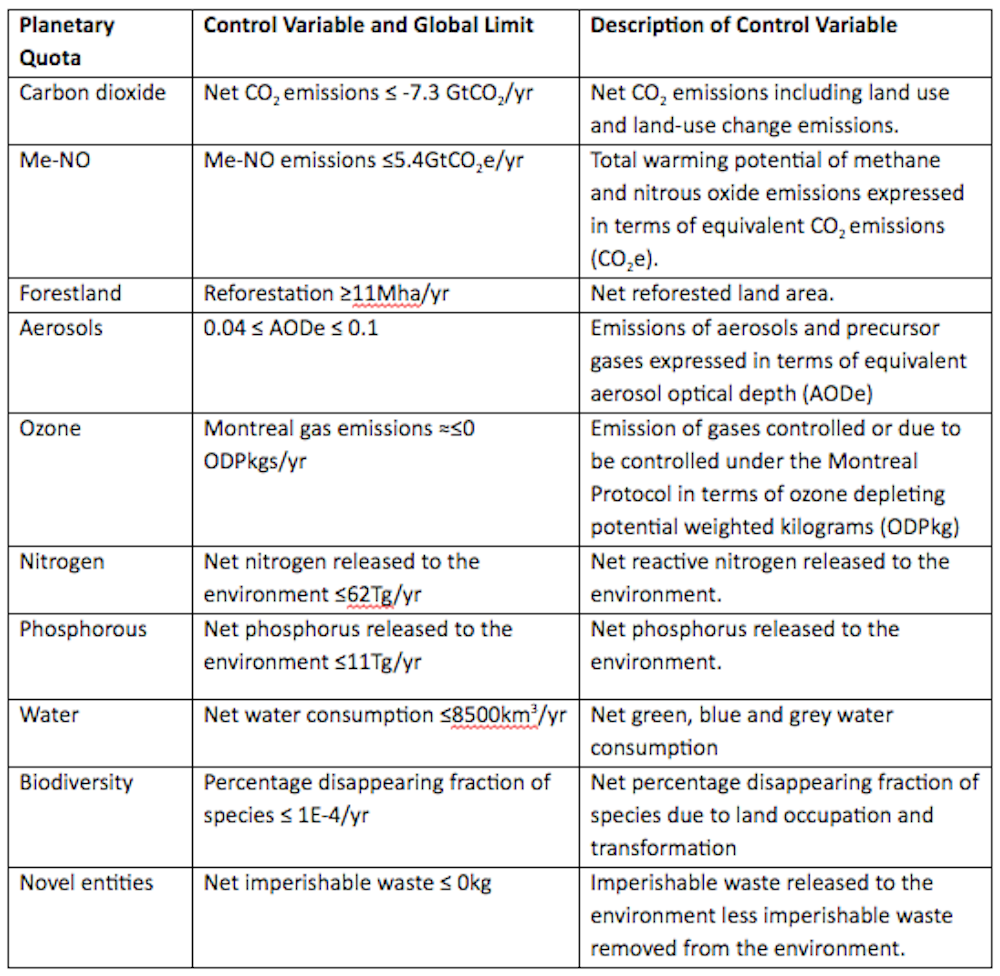 The planetary quotas.
Peter Newman/Kate Meyer, Author provided
The planetary quotas.
Peter Newman/Kate Meyer, Author provided
Planetary accounting is designed to work at a range of scales. We could use it to inform anything from individual actions, to city planning targets, to corporate sustainability goals, to global environmental negotiations.
It could even be “gamified”, perhaps in the form of apps that let players compete with one another to live within their share of global environmental budgets. Or it could be used to draw up “planetary labels” similar to the nutritional information labels that help keep food companies honest and the public informed.
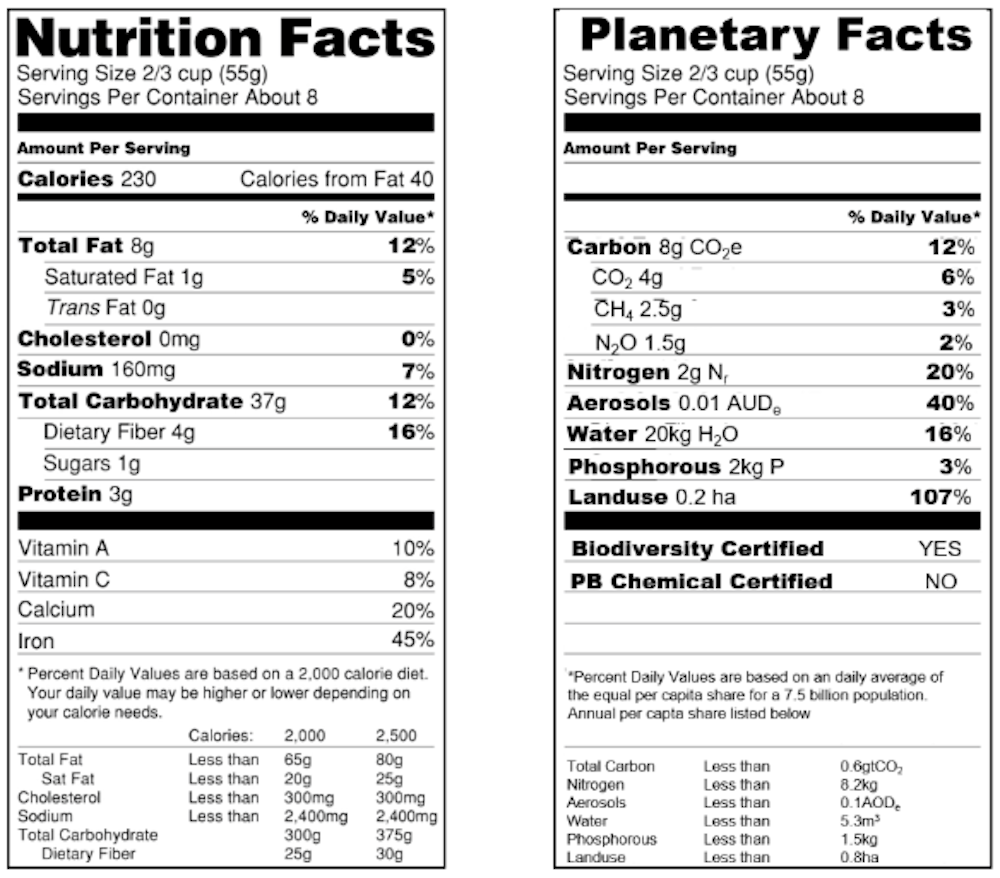 Planetary Facts labels could be used to disclose the critical environmental impacts of goods and services.
Peter Newman/Kate Meyer, Author provided
Planetary Facts labels could be used to disclose the critical environmental impacts of goods and services.
Peter Newman/Kate Meyer, Author provided
Planetary accounting won’t solve all the complex problems our planet faces. But it could make it easier to answer that all-important question: “What can I do to help?”
Authors: Peter Newman, Professor of Sustainability, Curtin University


 Daily Bulletin


