

We have so many ways to pursue a healthy climate – it's insane to wait any longer
- Written by: Peter C. Doherty, Laureate Professor, The Peter Doherty Institute for Infection and Immunity
As a broadly trained life scientist, my concern about climate change isn’t the health of the planet. The rocks will be just fine! What worries me is a whole spectrum of “wicked” challenges, from sustaining food production, to providing clean water, to maintaining wildlife diversity and the green environments that ensure the survival of complex life on Earth.
What’s more, as a disease and death researcher, I think of climate change as equivalent to lead poisoning: slow, cumulative, progressive and initially silent but, if not treated in time, causing irreversible, catastrophic damage.
The link between climate change and human health is obvious. The likely success of Dr Kerryn Phelps in the Wentworth byelection also suggests the informed public gets it. More broadly, Doctors for the Environment Australia has campaigned vigorously against Adani’s proposed Queensland coal mine, and has very strong student chapters. Young people are energised and, as they mature and take power, the political and legal situation regarding energy generation could change very quickly.
Read more: Infographic: here's exactly what Adani's Carmichael mine means for Queensland
The world’s oldest medical journal, The Lancet, has a high-profile commission that will report every two years until 2030 on the broad-ranging issue of climate and human health. The journal has just published a letter from just about every leading Australian medical scientist working in a relevant area that protests the federal government’s contemptuous dismissal of the latest report from the Intergovernmental Panel on Climate Change.
Read more: The UN's 1.5°C special climate report at a glance
Astronauts have shown us how incredibly fragile the atmosphere looks from space. The idea that we should wait for things to get worse before taking action to protect it seems insane.
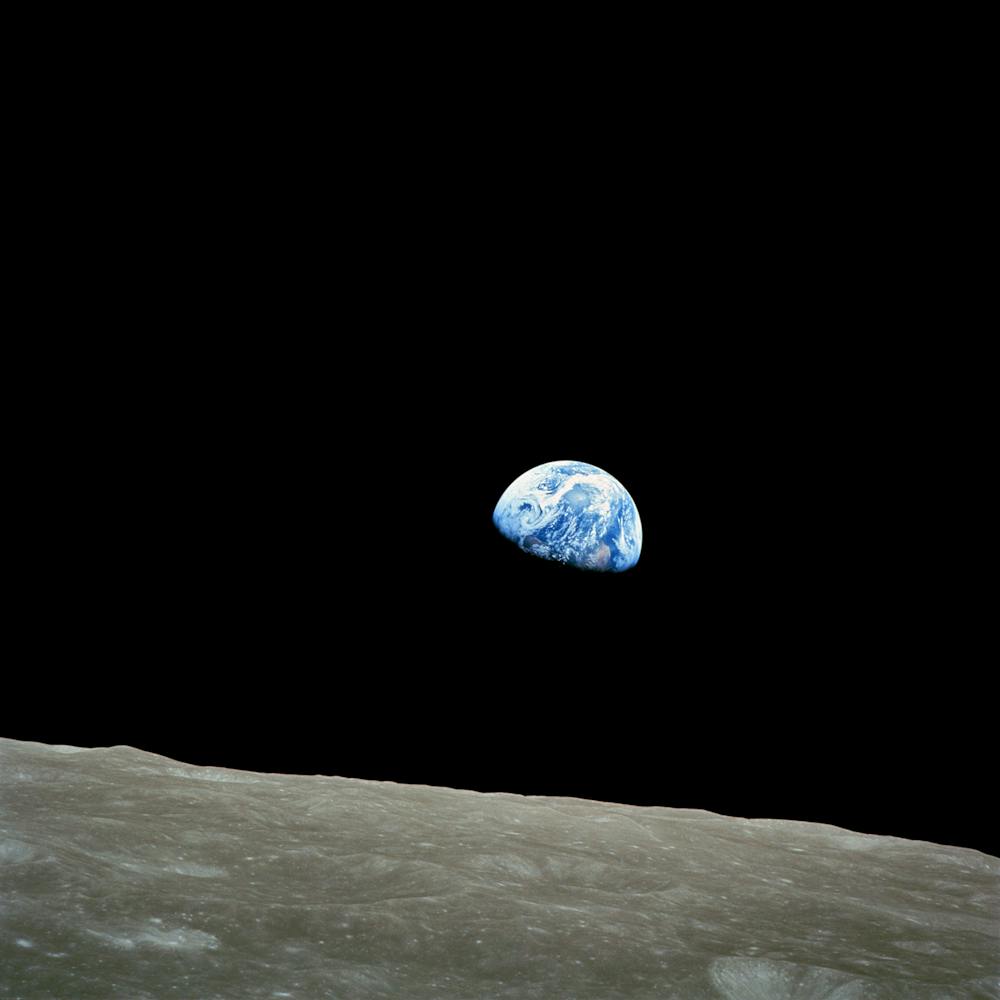 Apollo 8 gave us a valuable perspective on our planet.
NASA
Apollo 8 gave us a valuable perspective on our planet.
NASA
We need legislators who can think and act for the long term. This issue is simply too big for individuals or volunteer groups. Unless politicians are prepared to put a substantial price on greenhouse emissions, it’s difficult to see how a capitalist economic system can move us forward. Clean coal? The US 45Q tax reform, which offers credits for carbon capture and storage projects, suggests we would need a carbon price of at least US$50 a tonne to make this technology economically feasible.
Australia’s governments at every level could be acting now to promote the planting of vegetation, including less readily combustible tree species. We could be embracing, and funding, energy efficiency while constructing all new buildings – especially hospitals and large apartment complexes – in ways that protect their inhabitants. A realistic carbon tax could pay for some of that, while also stimulating jobs and growth and providing investment certainty.
Some moves are already being made in the right direction. The Gorgon gas project is planning to extend its strategy to inject carbon dioxide into the ground rather than releasing it to the atmosphere. CSIRO’s new hydrogen economy roadmap shows how (with the endorsement of Chief Scientist Alan Finkel) we can develop gas exports based on hydrogen rather than natural gas, to supply emerging markets in countries such as Japan.
Read more: The science is clear: we have to start creating our low-carbon future today
A more familiar export product is wood. Planting and harvesting trees mimics nature’s mechanism for storing carbon. Perhaps it’s time for CSIRO and the universities to reinvest in developing wood technologies that displace concrete for at least some forms of construction. Modular wooden houses could also easily be moved away from low-lying areas hit by river flooding and sea level rise.
My wife Penny and I recently joined a small organised tour that took us more than 5,000km around Western Australia. That made us very aware of competing realities. On one hand, we have the human constructs of community, politics and economy. On the other is the reality of nature, imposed by the laws of physics and the fact that all life systems have evolved to live within defined environmental “envelopes”.
Apart from the glorious WA wildflowers and extensive wheat fields, the prominence of mining was very clear. Metals are essential for just about any renewable energy strategy, although the massive amounts of diesel burned in the extraction process are clearly an issue. Could that transition to carbon-neutral biodiesel?
WA also has extensive coastal salt pans: might they be used, perhaps with pumped seawater, to cultivate algae for biofuel production? And, in the face of a global obesity pandemic, the best thing we could do with sugar cane is to convert it to biofuels.
If ethanol is bad for internal combustion engines, perhaps we should revisit external combustion? In WA, we went to the HMAS Sydney memorial in Geraldton. Like all big ships of her time, the Sydney was powered by steam turbines. Turbine power generation could be part of a mix driving electric/wind ships of the future.
Our WA trip also made us very conscious of the complex ecosystems that, in the end analysis, sustain all life. Plants use chemical signals (plant pheromones) to “talk” among themselves, to other species, and to the insects they attract for pollination. Some plants rely for reproduction on a single insect species. If the insects die, they die. We’re currently in the sixth mass extinction – this one caused by humans. As temperatures ramp up, rainfall patterns change, and firestorms grow stronger and more frequent, the effects will be terminal for many species.
Read more: Earth's sixth mass extinction has begun, new study confirms
With much of our land unsuited to agriculture, Australia is the biggest solar collector on Earth. Visiting WA also made us very aware of the enormous, untapped wind potential on the west coast. Apart from battery storage, making hydrogen from seawater offers an obvious strategy for dealing with both the remoteness of generation sites and the variability of supply from renewables, while also returning oxygen to the atmosphere. We could be the clean energy giants!
None of this will happen without the help of major corporations that have the wealth and power to influence governments, along with the globalised structure that facilitates the development and implementation of solutions. What’s very encouraging is that many of the multinationals are now moving forward to develop strategies for supplying global energy needs while minimising greenhouse gas emissions. There’s no way they want to be the “tobacco villains” of the 21st century!
This is an adapted version of a speech given in Melbourne on October 24 at the international ghgt-14 meeting.
Authors: Peter C. Doherty, Laureate Professor, The Peter Doherty Institute for Infection and Immunity


 Daily Bulletin


