

New detections of gravitational waves brings the number to 11 – so far
- Written by: David Blair, Emeritus Professor, ARC Centre of Excellence for Gravitational Wave Discovery, OzGrav, University of Western Australia
Four new detections of gravitational waves have been announced at the Gravitational Waves Physics and Astronomy Workshop, at the University of Maryland in the United States.
This brings the total number of detections to 11, since the first back in 2015.
Ten are from binary black hole mergers and one from the merger of two neutron stars, which are the dense remains of stellar explosions. One black hole merger was extraordinarily distant, and the most powerful explosion ever observed in astronomy.
Read more: The search for the source of a mysterious fast radio burst comes relatively close to home
The latest news comes just a month after doubts were raised about the initial detection. In late October an article in New Scientist, headlined Exclusive: Grave doubts over LIGO’s discovery of gravitational waves, raised the idea that it “might have been an illusion”.
So how confident are we that we are detecting gravitational waves, and not seeing an illusion?
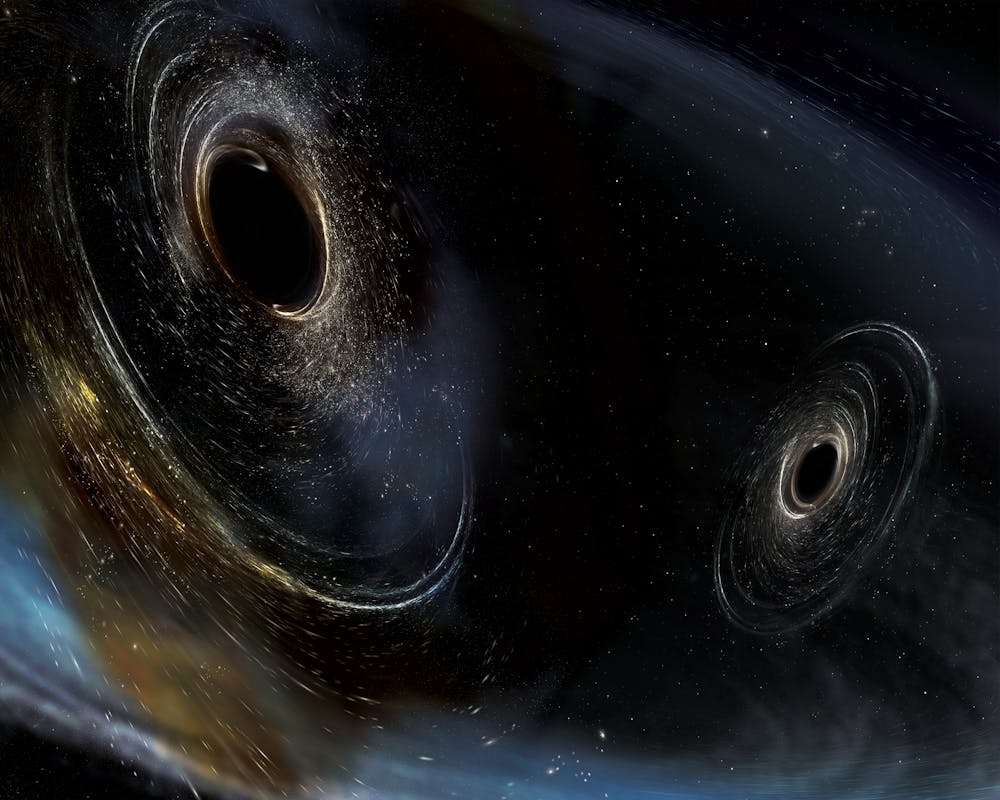 Artist’s conception shows two merging black holes.
LIGO/Caltech/MIT/Sonoma State (Aurore Simonnet)
Open to scrutiny
All good scientists understand that scrutiny and scepticism is the power of science. All theories and all knowledge are provisional, as science slowly homes in on our best understanding of the truth. There is no certainty, only probability and statistical significance.
Years ago the team searching for gravitational waves with the Laser Interferometer Gravitational-Wave Observatory (LIGO), determined the levels of statistical significance needed to make a claim of detection.
For each signal we determine the false alarm rate. This tells you how many years you would need to wait before you have an even chance of a random signal mimicking your real signal.
The weakest signal detected so far has a false alarm rate of one every five years, so still there is a chance that it could have been accidental.
Other signals are much stronger. For the three strongest signals detected so far you would have to wait from 1,000 times to 10 billion billion times the age of the universe for the signals to occur by chance.
Knowing what to listen out for
The detection of gravitational waves is a bit like acoustic ornithology.
Imagine you study birds and want to determine the population of birds in a forest. You know the calls of the various bird species.
When a bird call matches your predetermined call, you jump with excitement. Its loudness tells you how far away it is. If it was very faint against the background noise, you may be uncertain.
But you need to consider the lyre birds that mimic other species. How do you know that sound of a kookaburra isn’t actually made by a lyre bird? You have to be very rigorous before you can claim there is a kookaburra in the forest. Even then you will only be able to be confident if you make further detections.
In gravitational waves we use memorised sounds called templates. There is one unique sound for the merger of each possible combination of black hole masses and spins. Each template is worked out using Einstein’s theory of gravitational wave emission.
In the hunt for gravitational waves, we are searching for these rare sounds using two LIGO detectors in the US and a third detector, Virgo, in Italy.
To avoid missing signals or claiming false positives, the utmost rigour is needed to analyse the data. Huge teams look over the data, search for flaws, criticise each other, review computer codes and finally review proposed publications for accuracy. Separate teams use different methods of analysis, and finally compare results.
Next comes reproducibility – the same result recorded again and again. Reproducibility is a critical component of science.
The signals detected
Before LIGO made its first public announcement of gravitational waves, two more signals had been detected, each of them picked up in two detectors. This increased our confidence and told us that there is a population of colliding black holes out there, not just a single event that could be something spurious.
The first detected gravitational wave was astonishingly loud and it matched a pre-determined template. It was so good that LIGO spent many weeks trying to work out if it was possible for it to have been a prank, deliberately injected by a hacker.
While LIGO scientists eventually convinced themselves that the event was real, further discoveries greatly increased our confidence. In August 2017 a signal was detected by the two LIGO detectors and the Virgo detector in Italy.
On August 17 last year a completely different, but long predicted type of signal was observed from a coalescing pair of neutron stars, accompanied by the predicted burst of gamma rays and light.
The black hole mergers
Now the LIGO-Virgo collaboration has completed the analysis of all the data since September 2015.
The ten black hole mergers.For each signal we determine the mass of the two colliding black holes, the mass of the new black hole that they create, and rather roughly, the distance and the direction.
Each signal has been seen in two or three detectors almost simultaneously (they were separated by milliseconds).
Eight of the 20 initial black holes have masses between 30 and 40 Suns, six are in the 20s, three are in the teens and only two are as low as 7 to 8 Suns. Only one is near 50, the biggest pre-collision black hole yet seen.
These are the numbers that will help us work out where all these black holes were made, how they were made, and how many are out there. To answer these big questions we need many more signals.
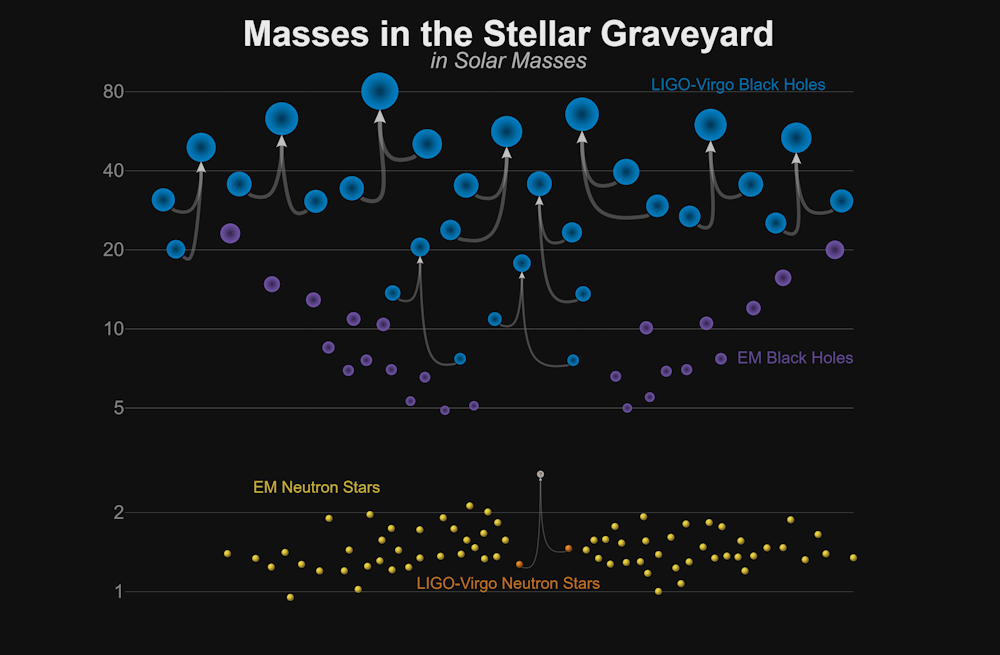 Graphic showing the masses of recently announced gravitational-wave detections and black holes and neutron stars.
LIGO-Virgo / Frank Elavsky / Northwestern
The weakest of the new signals, GW170729, was detected on July 29, 2017. It was the collision of a black hole 50 times the mass of the Sun, with another 34 times the mass of the Sun.
Read more: Explainer: why you can hear gravitational waves when things collide in the universe
This was by far the most distant event, having taken place, most likely, 5 billion years ago – before the birth of Earth and the Solar system 4.6 billion years ago. Despite the weak signal, it was the most powerful gravitational explosion discovered, so far.
But because the signal was weak, this is the detection with the false alarm rate of one every five years.
LIGO and Virgo are improving their sensitivity year by year, and will be finding many more events.
With planned new detectors we anticipate ten times more sensitivity. Then we expect to be detecting new signals about every five minutes.
Authors: David Blair, Emeritus Professor, ARC Centre of Excellence for Gravitational Wave Discovery, OzGrav, University of Western Australia


 Daily Bulletin


