

'Designer' babies won't be common anytime soon – despite recent CRISPR twins
- Written by: Merlin Crossley, Deputy Vice-Chancellor Academic and Professor of Molecular Biology, UNSW
This article is part of our occasional long read series Zoom Out, where authors explore key ideas in science and technology in the broader context of society and humanity.
Despite reports that two genetically modified babies have been born in China I don’t think you’ll be seeing designer babies soon.
This is not just because the laws in many countries, and scientific norms in others, prevent this, but for a much simpler reason: genome editing technology has, and will always have, limits. Limits that are related not to the technology itself but to the intrinsic complexity of the human genome.
In addition, the costs and risks of the procedures will outweigh the benefits for the foreseeable future.
Read more: What is CRISPR gene editing, and how does it work?
Some people may doubt this. But remember, making genetically modified mice became routine back in the 1980s and animals have been cloned (genetic “copies” made) since the 1990s. And yet until the announcement of the CRISPR babies – still yet to be confirmed by a peer-reviewed publication – there were no credible attempts to apply genetic technologies to viable human embryos.
There has been talk of designer babies for years but in my view they will remain (as they are now) very, very rare, for quite a while yet.
Baby 007
Let’s look at a hypothetical case study. Imagine you want to start a family, and would like your child to look like the latest James Bond. You ask a fertility doctor if she can conduct a kind of “genetic surgery” to change the genes of your embryo.
 Same same, but different: six wax versions of James Bond.
from www.shutterstock.com
Same same, but different: six wax versions of James Bond.
from www.shutterstock.com
In simple terms she can’t. You would have to change thousands of genes. Firstly, no one can identify which genes would lead to such an outcome. Secondly, and from a practical point of view, CRISPR only enables researchers to change a handful of genes at a time.
So you think again. Maybe you imagine your baby having the eyes of Jesse Williams, or the hair of Jay-Z? A genetic surgeon still can’t guarantee success. Even just the colour of eyes and hair are the result of complex genetic interactions.
Perhaps you’d rather parent a sporting superstar, like tennis player Karolina Pliskova (1.86m tall). One day it might be possible to “design” a daughter with this height by adjusting genes that control growth hormones. But again, multiple different – background – genes will have an impact, and you can’t be sure of getting the level right.
The risks here are significant. Ethics aside, it would be much simpler to inject hormones to promote growth rather than play with genes and risk your child growing to an unpredictable height (plus other unknown consequences).
 Being tall like Karolina Pliskova offers a distinct advantage in many sports.
from www.shutterstock.com
Being tall like Karolina Pliskova offers a distinct advantage in many sports.
from www.shutterstock.com
Read more: Researcher claims CRISPR-edited twins are born. How will science respond?
Such poor predictability is not due to the limits of genome editing technology – the technology has moved fast to this point, and will no doubt advance further in capability over coming years. Rather, it is due to the interplay between the thousands of genes within our genomes.
On top of that, environmental inputs (the “nurture” part of our development) and epigenetic effects (where subtle chemical modifications, often in response to environmental impacts, influence the expression of certain genes) create further unpredictability.
For these reasons, we simply can’t start ordering physical characteristics off some sort of cosmetic genetic surgeon’s menu – let alone attempt to alter mental traits, like temperament or intelligence.
There is also the problem of trade offs involved in any change. The CRISPR-edited babies reportedly born in China were intended to be resistant to HIV. It is not clear whether they will be – but even if they are, current knowledge suggests that they would also be more susceptible to influenza and West Nile virus. This is due to the many roles that the edited CCR5 gene plays in our immune system.
There are few “free lunches” in human evolution. And few parents would play a game of trial and error with their offspring once they understand the risks.
Preventing genetic disease
Superficial traits aside, even using CRISPR editing to combat serious genetic disease is unlikely to be common.
In many countries genetic counselling is already used to reduce the risk of passing on genetic diseases, like Tay-Sachs (in which the accumulation of fatty substances in nerve cells causes paralysis, dementia, blindness, psychoses, and even death).
Increasingly, in the future, if parents suffering from or carrying genetic mutations, choose to have biological children, they might consider in vitro fertilisation (IVF) and only proceed with unaffected embryos for a pregnancy. In the case of an existing pregnancy, pre-natal diagnosis can give parents information they can use to help them decide whether or not to terminate, or perhaps correct the cells in the embryo as explained below.
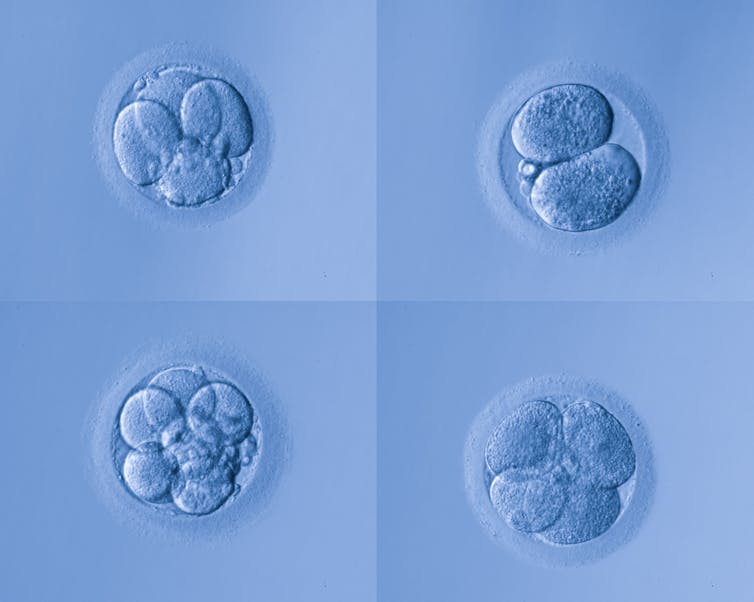 During IVF, a single cell can be safely removed from an embryo for genetic testing.
from www.shutterstock.com'
During IVF, a single cell can be safely removed from an embryo for genetic testing.
from www.shutterstock.com'
It’s possible in the near future that some genetic diseases will be treated at the level of fixing the genes within certain cells in embryos, children or adults, rather than modifying whole embryos. Here, the relevant cells could be taken out of the body, the genes corrected and then the cells injected back in. Blood diseases in which vital oxygen-carrying haemoglobin is defective, such as sickle cell disease and thalassemia, will likely be cured in this way.
In the cases of liver and muscle diseases it may be possible to inject harmless viruses carrying the genome editing agents into these organs.
It’s only in exceptionally rare instances that parents might ask for their embryo to be changed. Sickle cell disease (which leads to anaemia), or cystic fibrosis (that affects the respiratory, digestive and reproductive systems) are examples. Each disease results from two affected copies of the relevant gene coming together: one copy from each parent. If both parents were affected by one of these disorders – which, given these conditions are so rare, is improbable but possible – their only option for having an unaffected biological child would be gene editing.
But one still wouldn’t jump into editing the genome of an embryo, because we have to weigh up not only the benefits but also the risks. The risks are important – because if an unintended genetic change is made, and an unanticipated consequence follows, it could affect not only that child but future generations as well.
At present scientists have generally agreed not to consider modifying human embryos until we know enough about the technology to evaluate the risks, and unless society is on board.
Read more: Tension as scientist at centre of CRISPR outrage speaks at genome editing summit
Society must decide
But it seems this consensus was recently broken. There is concern that in terms of Jiankui He’s work with CRIPSR in human embryos we cannot be sure of either the efficacy of the editing or the consequences of any unintended changes made to the genomes. (Jiankui He has apparently gone missing since his recent appearance at a genome editing summit).
I don’t expect many other scientists to follow his path for now.
In the future there may be rare cases where parents who both carry genes for serious genetic diseases do seek to have an unaffected child via gene editing, and perhaps society would sanction this choice. Where we would draw the line for editing less serious but also well-known genetic variations remains to be determined. In the more distant future actual genetic enhancements may well be contemplated but I think the reactions to Jiankui He’s work make this less rather than more likely.
Read more: Is your genome really your own? The public and forensic value of DNA
For now, CRISPR genome editing remains a revolutionary technology that is transforming biological research and will have many medical and agricultural applications. It’s also clear that different advances associated with genome sequencing, genetic privacy, and discrimination, will present us with many regulatory and ethical challenges in coming years.
But I don’t expect to be debating these issues with designer babies who have grown to adulthood. For the most part, that will remain science fiction.
Authors: Merlin Crossley, Deputy Vice-Chancellor Academic and Professor of Molecular Biology, UNSW


 Daily Bulletin


