

We can't know the future cost of climate change. Let's focus on the cost of avoiding it instead
- Written by: Jack Pezzey, Senior Fellow, Fenner School of Environment and Society, Australian National University
As delegates at the UN climate summit in Katowice, Poland, discuss the possibility of restraining global warming to 1.5℃, it might sound like a reasonable question to ask how much money it will cost if they fail.
Economists have spent the past 25 years trying – and largely failing – to agree on the “right” answer to this question. It’s an important consideration, because governments are understandably keen to balance the benefits of limiting long-term climate damage with the more immediate costs of reducing greenhouse emissions.
In simple economics terms, we can ask what price would be worth paying today to avoid emitting a tonne of carbon dioxide, given the future damage costs that would avoid.
This mythical figure has been called the “social cost of carbon”, and it could serve as a valuable guide rail for policies such as carbon taxes or fuel efficiency standards. But my recent research suggests this figure is simply too complicated to calculate with confidence, and we should stop waiting for an answer and just get on with it.
Read more: Paul Romer and William Nordhaus – why they won the 2018 'economics Nobel'
While some climate economists have put the social cost of carbon at hundreds or even thousands of dollars per tonne of CO₂, one of the most influential analyses, by Yale University economist William Nordhaus, offers a much more modest figure of just over US$30.
Nordhaus won this year’s Nobel Prize in Economics, but his analysis has some uncomfortable conclusions for those familiar with the science.
At this level, it will be economically “optimal” for the world to reduce its CO₂ emissions quite slowly, so that global warming peaks at about 4℃ some time next century. But this certainly doesn’t sound optimal from a scientific perspective.
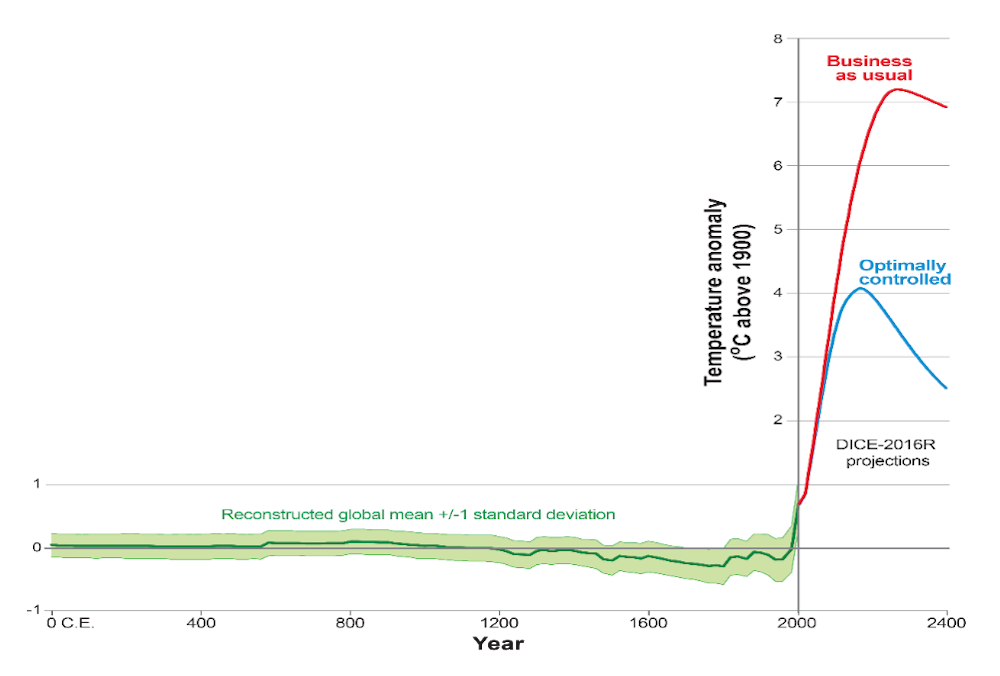 Reconstructed global mean temperature anomalies for 0–2000 CE, and DICE-2016R projections for 2015–2400.
CREDIT, Author provided
Reconstructed global mean temperature anomalies for 0–2000 CE, and DICE-2016R projections for 2015–2400.
CREDIT, Author provided
The impossibility of knowing the social cost of carbon
Calculating this magical economic balancing point is the holy grail of climate economics, and sadly it also seems to be an impossible task, because the question is so complex as to be unanswerable.
Why so? Normally, we gain knowledge via three main methods. The first option is to design an experiment. If that’s impossible, we can look for a similar case to observe and compare. And if that too is impossible, we can design a model that might hopefully answer our questions.
Generally, the laws of physics fall into the first category. It’s pretty straightforward to design an experiment to demonstrate the heat-trapping properties of CO₂ in a lab, for instance.
But we can’t do a simple experiment to assess the global effects of CO₂ emissions, so instead climatologists have to fall back on the second or third options. They can compare today’s conditions with previous fluctuations in atmospheric CO₂ to gauge the likely effects. They also design models to forecast future conditions on the basis of known physical principles.
By contrast, economists trying to put a dollar value on future climate damage face an impossible task. Like scientists, they cannot usefully test or make comparisons, but the economic effects of future climate change on an unprecedented 10 billion people are too fiendishly complex to model with confidence.
Unlike the immutable laws of physics, the laws of economics depend on markets, which in turn rely on trust. This trust could break down in some catastrophic future drought or deluge. So economists’ various rival calculations for the social costs of carbon are all based on unavoidable guesswork about the value of damage from unprecedented future warming.
This view is understandably unpopular with most climate economists. Many new studies claim that recent statistical techniques are steadily improving our estimates of the value of climate damage, based mainly on the local economic effects of short-run temperature and other weather changes in recent decades.
But so far, the world has experienced only about 1℃ of global warming, with at most 0.3℃ from one year to the next. That gives us almost no way of knowing the damage from warming of 3℃ or so; it may turn out to be many times worse than projected from past damage, as various tipping points are breached.
Focus on emission reduction, not damage cost
One reason why economists keep trying to value climate damage is a 1993 US Presidential Executive Order that requires cost-of-carbon estimates for use in US regulations. But my findings support what many other climate economists have been doing anyway. That is to build models that ignore the future dollar cost of climate damage, and instead look at feasible, low-cost ways to cut emissions enough to hit physical targets, such as limiting global warming to 1.5℃ or 2℃, or reaching zero net emissions by 2100.
Once we know these pathways, we don’t need to worry about the future cost of climate damage – all we need to ask is the cost of reducing emissions by a given amount, by a given deadline.
Of course, these costs are still deeply uncertain, because they depend on future developments in renewable energy technologies, and all sorts of other economic factors. But they are not as fiendishly uncertain as trying to pin a dollar value on future climate damage.
Read more: Fresh thinking: the carbon tax that would leave households better off
Focusing on the cost of emissions-reduction pathways allows researchers to put their effort into practical issues, such as how far and fast countries can shift to zero-emission electricity generation. Countries such as Sweden and the UK have already begun implementing this kind of action-oriented climate policies. While far from ideal, they are among the best-ranked major economies in the Climate Change Performance Index. Australia, by contrast, is ranked third worst.
But aren’t trillion-dollar estimates of future warming damage, as featured in the recent US Fourth National Climate Assessment, necessary ammunition for advocates of climate action? Maybe, but it is still important to appreciate that these estimates are founded on a large chunk of guesswork.
Setting climate targets will always be a political question as well as a scientific one. But it’s an undeniably sensible aim to keep climate within the narrow window that has sustained human civilisation for the past 11,000 years. With that window rapidly closing, it makes sense for policymakers just to focus on getting the best bang for their buck in cutting emissions.
Authors: Jack Pezzey, Senior Fellow, Fenner School of Environment and Society, Australian National University


 Daily Bulletin


