

Earthrise, a photo that changed the world
- Written by: Dr Simon Torok, Honorary Fellow, School of Earth Sciences, University of Melbourne
December 24 is the 50th anniversary of Earthrise, arguably one of the most profound images in the history of human culture. When astronaut William Anders photographed a fragile blue sphere set in dark space peeking over the Moon, it changed our perception of our place in space and fuelled environmental awareness around the world.
The photo let us see our planet from a great distance for the first time. The living Earth, surrounded by the darkness of space, appears fragile and vulnerable, with finite resources.
Read more: 50 years ago: Australia and the Apollo 8 mission that sent a Christmas message from the Moon
Viewing a small blue Earth against the black backdrop of space, with the barren moonscape in the foreground, evokes feelings of vastness: we are a small planet, orbiting an ordinary star, in an unremarkable galaxy among the billions we can observe. The image prompts emotions of insignificance – Earth is only special because it’s the planet we live on.
As astronaut Jim Lovell said during the live broadcast from Apollo 8, “The vast loneliness is awe-inspiring, and it makes you realise just what you have back there on Earth.”
The Apollo 8 Christmas Eve broadcast.Earthrise is a testament to the extraordinary capacity of human perception. Although, in 1968, the photograph seemed revelatory and unexpected, it belongs to an extraordinary history of representing the Earth from above. Anders may have produced an image that radically shifted our view of ourselves, but we were ready to see it.
People have always dreamed of flying. As we grew from hot-air balloons to space shuttles, the camera has been there for much of the ride.
After WWII, the US military used captured V-2 rockets to launch motion-picture cameras out of the atmosphere, producing the first images of Earth from space.
Russia’s Sputnik spurred the United States to launch a series of satellites — watching the enemy and the weather — and then NASA turned its attention to the Moon, launching a series of exploratory probes. One (Lunar Orbiter I, 1966) turned its camera across a sliver of the Moon’s surface and found the Earth, rising above it.
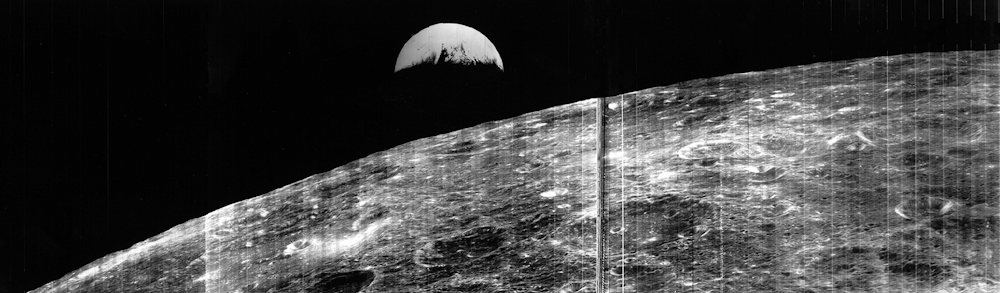 The non-human version of Earthrise from Lunar Orbiter in 1966.
NASA
The non-human version of Earthrise from Lunar Orbiter in 1966.
NASA
Despite not being the “first” image of the Earth from our Moon, Earthrise is special. It was directly witnessed by the astronauts as well as being captured by the camera. It elegantly illustrates how human perception is something that is constantly evolving, often hand in hand with technology.
Earthrise showed us that Earth is a connected system, and any changes made to this system potentially affect the whole of the planet. Although the Apollo missions sought to reveal the Moon, they also powerfully revealed the limits of our own planet. The idea of a Spaceship Earth, with its interdependent ecologies and finite resources, became an icon of a growing environmental movement concerned with the ecological impacts of industrialisation and population growth.
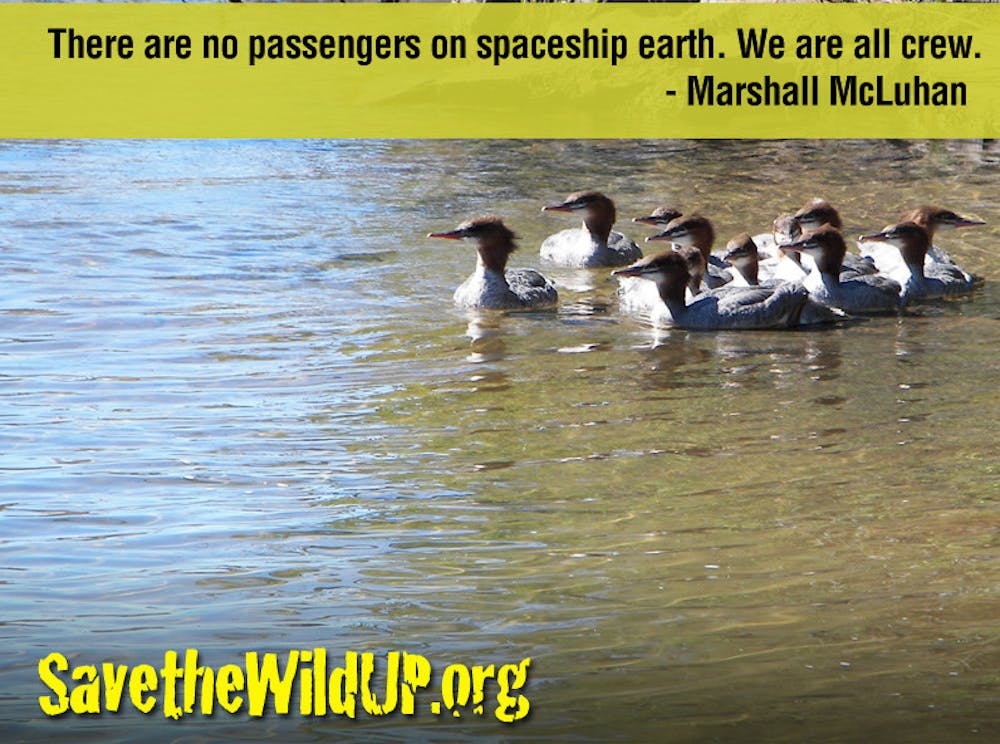 ‘Spaceship Earth’ became a powerful rallying cry for environmental groups.
Flickr, CC BY-SA
‘Spaceship Earth’ became a powerful rallying cry for environmental groups.
Flickr, CC BY-SA
From space, we observe the thin shield provided by our atmosphere, allowing life to flourish on the surface of our planet. Lifeforms created Earth’s atmosphere by removing carbon dioxide and generating free oxygen. They created an unusual mix of gases compared to other planets – an atmosphere with a protective ozone layer and a mix of gases that trap heat and moderate extremes of temperature. Over millions of years, this special mix has allowed a huge diversity of life forms to evolve, including (relatively recently on this time scale) Homo sapiens.
The field of meteorology has benefited enormously from the technology foreshadowed by the Earthrise photo. Our knowledge is no longer limited to Earth-based weather-observing stations.
Satellites can now bring us an Earthrise-type image every ten minutes, allowing us to observe extremes such as tropical cyclones as they form over the ocean, potentially affecting life and land. Importantly, we now possess a long enough record of satellite information so that in many instances we can begin to examine long-term changes of such events.
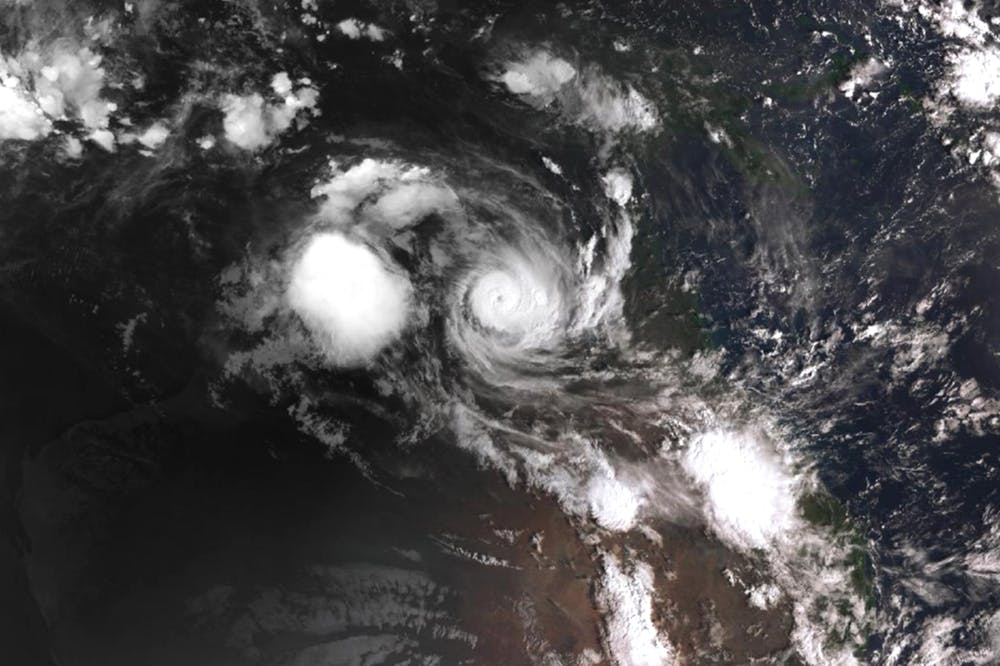 Tropical Cyclone Owen seen from space.
Bureau of Meteorology/AAP
Tropical Cyclone Owen seen from space.
Bureau of Meteorology/AAP
The human population has doubled in the 50 years since the Earthrise image, resulting in habitat destruction, the spread of pest species and wildfires spurred by climate warming. Every year, our actions endanger more species.
Earth’s climate has undergone enormous changes in the five decades since the Earthrise photo was taken. Much of the increase in Australian and global temperatures has happened in the past 50 years. This warming is affecting us now, with an increase in the frequency of extreme events such as heatwaves, and vast changes across the oceans and polar caps.
Read more: Space research pays for itself, but inspires fewer people
With further warming projected, it is important that we take this chance to look back at the Earthrise photo of our little planet, so starkly presented against the vastness of space. The perspective that it offers us can help us choose the path for our planet for the next 50 years.
It reminds us of the wonders of the Earth system, its beauty and its fragility. It encourages us to continue to seek understanding of its weather systems, blue ocean and ice caps through scientific endeavour and sustained monitoring.
The beauty of our planet as seen from afar – and up close – can inspire us to make changes to secure the amazing and diverse animals that share our Earth.
Zoos become conservation organisations, holding, breeding and releasing critically endangered animals. Scientists teach us about the capacities of animals and the threats to their survival.
Communities rise to the challenge and people in their thousands take actions to help wildlife, from buying toilet paper made from recycled paper to not releasing balloons outdoors. If we stand together we can secure a future for all nature on this remarkable planet.
Read more: In defence of zoos: how captivity helps conservation
But is a 50-year-old photo enough to reignite the environmental awareness and action required to tackle today’s threats to nature? What will be this generation’s Earthrise moment?
The authors would like to acknowledge the significant contribution of Alicia Sometimes to this article.
Authors: Dr Simon Torok, Honorary Fellow, School of Earth Sciences, University of Melbourne
Read more http://theconversation.com/earthrise-a-photo-that-changed-the-world-109009


 Daily Bulletin


