

Making friends in primary school can be tricky. Here's how parents and teachers can help
- Written by: Dr Natasha Wardman, Lecturer, School of Education and Arts, Australian Catholic University
If we think back to our own childhood days, most of us would agree making good friends in primary school was not always an easy task. Sometimes friendship occurred out of convenience or survival when there was a limited number of peers to choose from. Sometimes friendship was a utility to be bought and sold through the transaction of lollies or other interesting lunchbox snacks.
Sometimes friendship developed through shared interests and extra-curricular activities. But the friendships found to stand the test of time are those that work to enhance both lives through a mutual sense of humour, empathy, honesty, loyalty, trust and respect.
Read more: Young people value diversity, humour and honesty in their friendships – new research
From this perspective, the best type of friendship is not based on utility, pleasure or convenience which may dissolve over time, but rather the character or virtues of both people. Such friendship needs to be given freely (rather than forced), reciprocal (rather than one-sided), and recognise the virtues both people contribute in getting to know each other and themselves more deeply.
What is developmentally normal?
From a psychological perspective, there are five stages of social competence that influence the formation of friendships:
- stage one (three to seven years) involves momentary friendship with whoever is in close proximity
- stage two (four to nine years) involves one-way friendship with someone who can help us achieve our own goals
- stage three (six to 12 years) involves reciprocal friendship, but only under specific conditions
- stage four (11-15 years) involves mutually close and supportive friendship
- stage five (12 to adulthood) involves friendship which respects the autonomy of each individual even though they may share similar interests and deeper feelings.
From a sociological perspective, friendship is not a series of biologically determined hoops children are expected to jump through in sequential order. Children draw on social strategies to resist or create their own peer culture in ways that may differ from adult expectations. They don’t simply mimic adult socialisation.
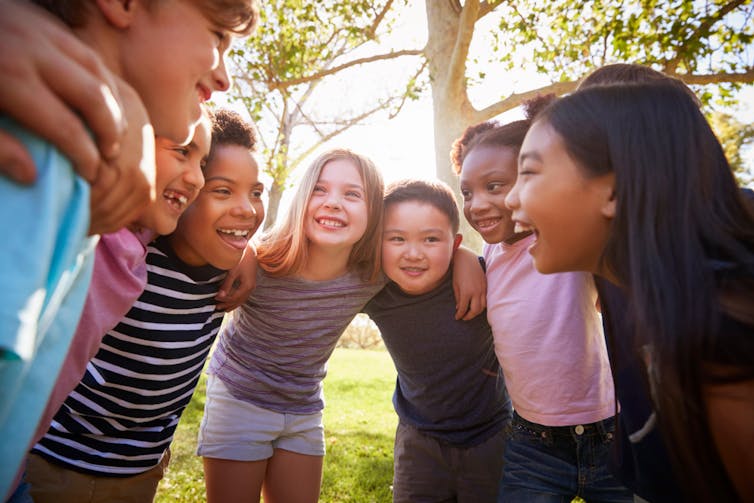 Making friends in schools with more cultural diversity can minimise the risk of peer victimisation.
from www.shutterstock.com
Making friends in schools with more cultural diversity can minimise the risk of peer victimisation.
from www.shutterstock.com
Yet, the members of select cliques still define what’s considered normal or acceptable within this peer culture. In fact, being chosen as friends by those of equal or higher peer status can decrease the risk of peer victimisation.
Given such complexity in friendship formation, it’s not surprising many parents are concerned with how their children can make quality friendships in primary school. Particularly as research has found a positive link between high-quality friendships and better academic results. They also experience less stress from peer exclusion.
So, if high-quality friendships are important for student academic results and stress reduction, what can parents and teachers do to facilitate this?
What parents can do
A magic formula doesn’t exist, but there are some general evidence-based strategies that have proven to assist in friendship formation without the risk of “bonsai parenting” (where parents over-nurture their children) or “bubble-wrapping” children. These include:
- sending your child to a more culturally diverse school where no ethnic group represents the majority of the population and there is a lower risk of visibility and peer victimisation
- encouraging your child to participate in school-based extra-curricular activities such as sport, creative arts or youth groups where they have the opportunity to broaden their social networks
- organising play dates with peers who are socially competent and have similar interests to your child
- supporting your child’s own strategies for making friends at school such as observing peers, making or accepting requests to play, initiating or participating in clubs or teams and intervening to include others.
 Sometimes we’re lucky enough to maintain friendships all the way through adulthood.
from www.shutterstock.com
Sometimes we’re lucky enough to maintain friendships all the way through adulthood.
from www.shutterstock.com
What teachers can do
Given the large amount of time students spend at school, teachers also have a role to play in supporting students to make and maintain positive friendships through:
- explicitly teaching interpersonal skills such as expressing opinions in constructive ways, respecting difference, and caring about the feelings of others
- providing time, space and opportunities for students to work or play with others, identify new friends and maintain their own existing friendships
- being aware of peer culture and attuned to changes, tensions and exclusions in student friendship groups in the classroom or on the playground
- creating a safe space where children can discuss friendship issues such as regular “circle time”.
Read more: Nice guys finish first: empathetic boys attract more close female friends
How to work through ending friendships in primary school
Sometimes we’re lucky enough to maintain friendships as we transition from primary to secondary school (and beyond). Research has shown this may have a positive effect on academic performance and mental health.
But sometimes we grow out of friendships as we evolve in different directions and our values and interests change. There may be times when friendships need to be dissolved if they breach our trust and/or damage our well-being. Children as well as adults, need to know when and how to dissolve such friendships and how to work through any sense of loss that may result.
Authors: Dr Natasha Wardman, Lecturer, School of Education and Arts, Australian Catholic University


 Daily Bulletin


