

why the physical environment is important too
- Written by: Brendon Hyndman, Senior Lecturer and Course Director of Postgraduate Studies in Education, Charles Sturt University
School is back, so students new to secondary school will be beginning to adapt to their new school environments. This adaption commonly involves suddenly having multiple classes with different teachers and locations, many more students, different peer groups, becoming the youngest again and even managing a timetable.
For most commencing, their biggest concern is finding new friends and feeling a sense of social belonging. Yet, the majority are emotionally and socially settled much quicker and better than expected.
Read more: How much physical activity should teenagers do, and how can they get enough?
Another challenge for students entering secondary schools is the physical environment. This can influence students’ health behaviours. Students spend more time sitting or standing in secondary school, and less time being active because they have reduced access to spaces that support physical activity.
Primary and secondary school environments
Australian research found the change from primary into secondary schooling can make students less active and more sedentary, compared to a primary-secondary combined setting.
In Australian secondary schools, there are often high proportions of seats, lounges, empty spaces and picnic tables. In comparison, primary schools have wide varieties of facilities for students to use, such as climbing frames and surface markings.
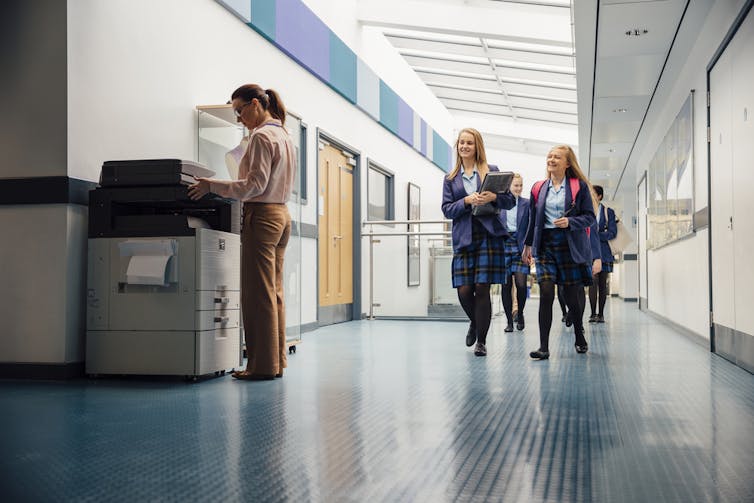 Secondary school environments are less conducive to physical activity than primary schools.
from www.shutterstock.com
Secondary school environments are less conducive to physical activity than primary schools.
from www.shutterstock.com
A large review of multiple types of studies revealed links between providing high quality, well maintained facilities in secondary schools and meeting students’ physical activity needs. For example, it was important to be able to access and play soccer on a field, rather than in a confined space.
An outdoor audit of Australian secondary schools found many have low maintenance, litter or graffiti, few coloured markings/murals or vegetable gardens and spaces not suitable for informal games. Other concerns include areas for smoking, poor facilities to get changed in, little bike storage and not enough space.
What do secondary school students need?
In primary school, students develop fundamental skills, like catching or kicking a ball. In secondary school, students seek facilities with more adventure-type focuses (such as climbing walls or rope swings/courses) and advanced opportunities to test their physical skills (such as gymnastics, skating, sporting and fitness facilities).
But funding for these facilities can be limited. Secondary school students have also suggested walking programs and regular community excursions to places such as swimming pools or baseball fields.
Many suggestions from secondary school students for facilities are very different to their existing school places. Some simply hang around canteens and locker bays.
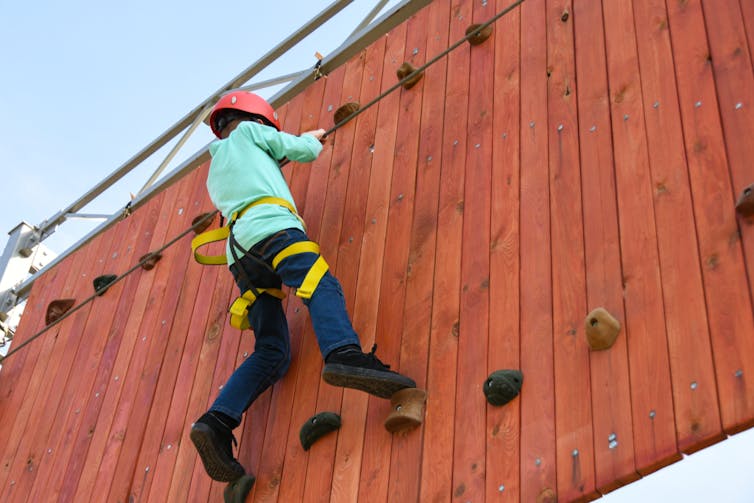 If you ask secondary school students, they want access to more adventurous types of exercise.
from www.shutterstock.com
If you ask secondary school students, they want access to more adventurous types of exercise.
from www.shutterstock.com
Why is this important?
Students are often presented with more opportunities to sit and stand around in secondary schools than in primary schools. This can have an impact on students’ physical health.
International and national reports point to many increased physical health risks when students enter secondary school. Sedentary behaviour can increase in secondary school. More students exceed daily sedentary behaviour screen time guidelines (just two hours for recreation/entertainment) and use more electronic devices.
Secondary school-aged students are also less likely to meet national physical activity recommendations. It’s recommended they complete at least one hour of moderate to vigorous physical activity each day (activity that makes you puff or develop a light sweat). The recommendations are important to maintain good health, develop movement habits and prevent lifestyle diseases (such as type two diabetes).
Additionally, there are fewer secondary school-aged students participating in non-organised (such as kicking a soccer ball around with friends) and organised (such as team sports) physical activity and sport after primary school.
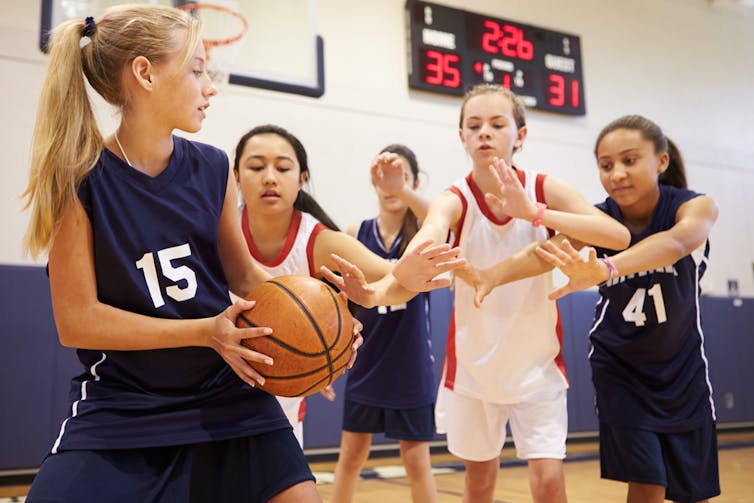 Fewer students play team sports in secondary school.
from www.shutterstock.com
Fewer students play team sports in secondary school.
from www.shutterstock.com
School physical activity participation typically peaks at the end of primary schooling and declines as people age. The primary to secondary transition is a crucial period for maintaining physical activity as a lifelong healthy habit.
What can we do to support new secondary school students?
Consult students on their interests and needs prior to and during the transition into secondary school. What will engage and challenge them? If facilities or programs are unavailable, various excursions to community recreation facilities can help.
Make the amount and variety of physical activities, and the maintenance and access to physical activity facilities a priority. Activity programs can be promoted both within and outside the curriculum. For example, schools can encourage active transport (travelling to/from school by walking or cycling), organised sport, scheduled classes, active lesson breaks or recess periods and before/after school.
Reduce the amount of sitting time in secondary schools to prevent sedentary behaviour, including in the classroom. Encouraging social interaction does not have to involve sitting down.
During unavoidable and prolonged periods of electronics use, provide short breaks for a few minutes with movement tasks, such as moving to music.
Consider multiple strategies that address mental, social and policy factors within physical environments for students. These could help them connect socially (team/group work, involving family or role modelling), mentally (solving problems and goal setting for motivation), academically (connecting to subject areas and reframing negative attitudes) and spiritually (giving them time to reflect) that can be replicated in the community.
Staff need professional development to learn about, accommodate and deliver holistic health approaches in schools and provide inclusive physical activity and sporting settings.
Provide physical activity opportunities that strengthen muscles and bone, such as with resistance bands and providing ideas for bodyweight exercises. This can develop muscles, fitness, prevent injury and meet additional activity guidelines.
Secondary school environments are complex spaces, so we must consider the physical environment to develop adolescent health during the transition from primary schooling.
Read more: How physical activity in Australian schools can help prevent depression in young people
Authors: Brendon Hyndman, Senior Lecturer and Course Director of Postgraduate Studies in Education, Charles Sturt University


 Daily Bulletin


