

do we really need to take 10,000 steps a day?
- Written by: Corneel Vandelanotte, Professorial Research Fellow: Physical Activity and Health, CQUniversity Australia
Regular walking produces many health benefits, including reducing our risk of heart disease, type 2 diabetes and depression.
Best of all, it’s free, we can do it anywhere and, for most of us, it’s relatively easy to fit into our daily routines.
We often hear 10,000 as the golden number of steps to strive for in a day. But do we really need to take 10,000 steps a day?
Not necessarily. This figure was originally popularised as part of a marketing campaign, and has been subject to some criticism. But if it gets you walking more, it might be a good goal to work towards.
Read more: Health Check: in terms of exercise, is walking enough?
Where did 10,000 come from?
The 10,000 steps concept was initially formulated in Japan in the lead-up to the 1964 Tokyo Olympics. There was no real evidence to support this target. Rather, it was a marketing strategy to sell step counters.
There was very little interest in the idea until the turn of the century, when the concept was revisited by Australian health promotion researchers in 2001 to encourage people to be more active.
Based on accumulated evidence, many physical activity guidelines around the world – including the Australian guidelines – recommend a minimum of 150 minutes of moderate intensity physical activity a week. This equates to 30 minutes on most days. A half hour of activity corresponds to about 3,000 to 4,000 dedicated steps at a moderate pace.
In Australia, the average adult accumulates about 7,400 steps a day. So an additional 3,000 to 4,000 steps through dedicated walking will get you to the 10,000 steps target.
Read more: Are you walking your dog enough?
One size doesn’t fit all
Of course, some people accumulate a lot fewer steps per day – for example, older people, those with a chronic disease, and office workers. And others do a lot more: children, runners, and some blue-collar workers. So the 10,000 goal is not suitable for everyone.
Setting a lower individual step goal is fine as long as you try to add about 3,000 to 4,000 steps to your day. This means you will have done your 30 minutes of activity.
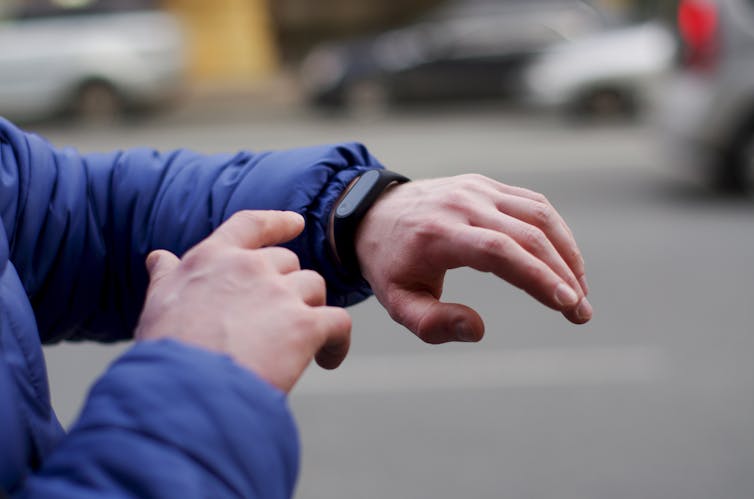 People measure their daily steps using a variety of activity trackers.
From shutterstock.com
People measure their daily steps using a variety of activity trackers.
From shutterstock.com
Studies that examine how the number of daily steps relates to health benefits have mainly been cross-sectional. This means they present a snapshot, and don’t look at how changes in steps affect people’s health over time. Therefore, what we call “reverse causality” may occur. So rather than more steps leading to increased health benefits, being healthier may in fact lead to taking more steps.
Nonetheless, most studies do find taking more steps is associated with better health outcomes.
Several studies have shown improved health outcomes even in participants who take less than 10,000 steps. An Australian study, for example, found people who took more than 5,000 steps a day had a much lower risk of heart disease and stroke than those who took less than 5,000 steps.
Another study found that women who did 5,000 steps a day had a significantly lower risk of being overweight or having high blood pressure than those who did not.
The more the better
Many studies do, however, show a greater number of steps leads to increased health benefits.
An American study from 2010 found a 10% reduction in the occurrence of metabolic syndrome (a collection of conditions that increase your risk of diabetes, heart disease and stroke) for each 1,000-step increase per day.
An Australian study from 2015 demonstrated that each 1,000-step increase per day reduced the risk of dying prematurely of any cause by 6%, with those taking 10,000 or more steps having a 46% lower risk of early death.
Read more: The faster you walk, the better for long term health – especially as you age
Another Australian study from 2017 showed people with increasingly higher step counts spent less time in hospital.
So the bottom line is the more steps, the better.
Step it up
It’s important to recognise that no public health guideline is entirely appropriate for every person; public health messages are aimed at the population at large.
That being said, we shouldn’t underestimate the power of a simple public health message: 10,000 steps is an easily remembered goal and you can readily measure and assess your progress. You can use an activity tracker, or follow your progress through a program such as 10,000 Steps Australia.
Increasing your activity levels, through increasing your daily step count, is worthwhile; even if 10,000 steps is not the right goal for you. The most important thing is being as active as you can. Striving for 10,000 steps is just one way of doing this.
Authors: Corneel Vandelanotte, Professorial Research Fellow: Physical Activity and Health, CQUniversity Australia
Read more http://theconversation.com/health-check-do-we-really-need-to-take-10-000-steps-a-day-109079


 Daily Bulletin


