

What has Australia learned from Black Saturday?
- Written by: Kevin Tolhurst, Senior Lecturer, Fire Ecology and Management, University of Melbourne
Black Saturday was a day like no other; it will be forever remembered in the history of bushfire disasters in Australia. The fires burned about 300,000 hectares in a single day; 173 human lives were lost and more than 2,000 houses were destroyed in one afternoon.
Australia was shocked at the scale of the destruction. Questions were soon being asked about how this could happen in the modern world, what could have been done to reduce the loss of lives and physical destruction, and what can be done to stop this happening again.
Read more: After the firestorm: the health implications of returning to a bushfire zone
The many reports, studies and inquiries in the ten years since Black Saturday have created a new regime for assessing and dealing with fires. While this has meant many improvements in how we communicate and coordinate in the face of bushfires, I believe it has also resulted in an overemphasis on accountability and technology at the expense of effective fire control.
The aftermath
As days passed and the fires were still being fully controlled, attention turned to capturing information about the fires so we could better understand what had happened. Victims and people affected by the fires were interviewed by journalists and social scientists, welfare workers and counsellors, friends and family. Nobody, at the time of the fires, had full knowledge of what had happened, so the collective knowledge pieced the puzzle together.
Fire scientists and meteorologist were also trying to capture as much information as possible about the fires and what drove them. This was a unique opportunity to collect information about fire and weather that could never be reproduced in experiments.
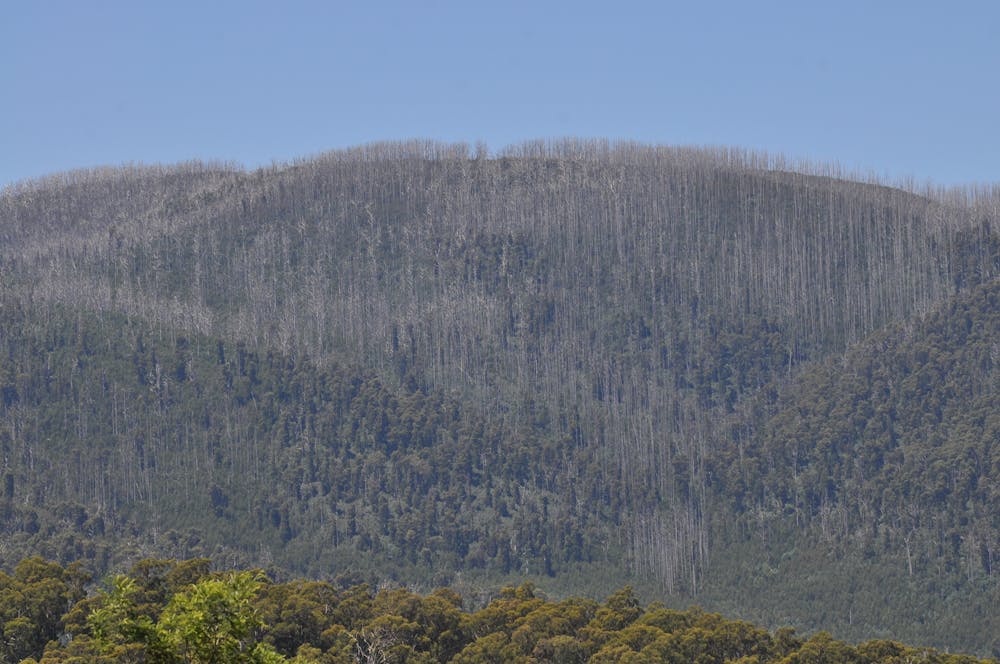 Mountain ash trees killed by the intense heat of the Black Saturday bushfire are still plainly visible on the hills around Marysville ten years on.
AAP Image/Supplied by Jamie Duncan
Mountain ash trees killed by the intense heat of the Black Saturday bushfire are still plainly visible on the hills around Marysville ten years on.
AAP Image/Supplied by Jamie Duncan
Within a few days of the fire, the Victorian premier had announced a royal commission to investigate the cause of the fires, the factors leading to the unprecedented level of death and destruction, and the institutional response before, during and after the fires. The commission ran for 18 months, heard from 434 witnesses, cost more than A$90 million and produced 67 recommendations.
What has changed?
Research and the royal commission significantly increased our understanding of what occurred on Black Saturday. Research using these fires still continues ten years after the event. The knowledge gained has resulted in better weather forecasting, better communication about fires and weather to the public, better coordination and cooperation between emergency response agencies and public land managers, and better building and planning regulations for fire-prone areas.
Unfortunately, the close scrutiny of fire and land management agencies has led to greater emphasis on following standard processes and recording all actions and information used during fire events. This has led to a lot of time and resources being allocated to accountability at the expense of effectiveness in reducing bushfire impacts. This is clearly not a deliberate intention of the various agencies, but is the reality of a highly political and litigious world.
Another unintended development has been the increased reliance on technology for both fighting fires and communication. Many people in the bushfire-prone areas demand reliable access to warnings and fire developments, so there has been a rapid expansion of the mobile phone and internet networks across Victoria. However, just because people have access to such information does not ensure that they will respond in ways that emergency response agencies expect.
Read more: Drought, wind and heat: when fire seasons start earlier and last longer
Other technology such as bigger, stronger fire trucks and the use of aircraft for water bombing has reduced the extent of dry firefighting techniques – that is, controlling fire using firebreaks, hand tools and backburning with little or no water used. This has increased the number of fires growing to damaging sizes and escaping control lines.
This failing has not been fully recognised. Partly, that’s because any “technology” is easily taken by the media, public and politicians as an improvement, when in fact it may not be.
The lessons we’ve yet to learn
Since Black Saturday, use of the concept of “bushfire risk” has been growing. This makes it clear that bushfires in Australia are a constant threat and the risk is never zero.
The “risk concept” allows public agencies, private groups and communities to reduce bushfire risk to a level that they can afford and are willing to accept. However, how bushfire risk is assessed and communicated, and how trade-offs are negotiated, still has a long way to go if bushfire risk is to be a truly “shared responsibility” as the royal commission recommended.
Another complication is that public agencies have a regular turnover of staff. This makes it more difficult to establish trusted relationships between public agencies and private individuals.
Read more: Future bushfires will be worse: we need to adapt now
An event like Black Saturday will occur again. The terrain, vegetation, climate and weather patterns in southeastern Australia ensure that. Climate change will increase this risk.
When it does happen again, the extent of what we learned from Black Saturday will be judged by the impact of that event. We should not expect there will be no loss of lives and property in future massive blazes, but we should expect it will be significantly less than Black Saturday.
Authors: Kevin Tolhurst, Senior Lecturer, Fire Ecology and Management, University of Melbourne
Read more http://theconversation.com/what-has-australia-learned-from-black-saturday-111245


 Daily Bulletin


