

Hydrogen fuels rockets, but what about power for daily life? We're getting closer
- Written by: Zhenguo Huang, Senior lecturer, University of Technology Sydney
To mark the International Year of the Periodic Table of Chemical Elements we’re taking a look at elements and how they’re used in research and the real world.
Hydrogen is the first element on the periodic table. In its pure form hydrogen is a light, colourless gas, but forms a liquid at very low temperatures.
Have you ever watched a space shuttle launch? The fuel used to thrust these enormous structures away from Earth’s gravitational pull is hydrogen.
Hydrogen also holds potential as a source of energy for our daily activities – driving, heating our houses, and maybe more.
Read more: Lightweight of periodic table plays big role in life on Earth
This month the federal coalition government opened public consultation on a national hydrogen strategy. Labor has also pledged to set aside funding to develop clean hydrogen. The COAG Energy Ministers meeting in December 2018 indicated strong support for a hydrogen economy.
But is Australia ready to explore this competitive, low-carbon energy alternative for residential, commercial, industrial and transport sectors?
There are two key aspects to assessing our readiness for a hydrogen economy - technological advancement (can we actually do it?) and societal acceptance (will we use it?).
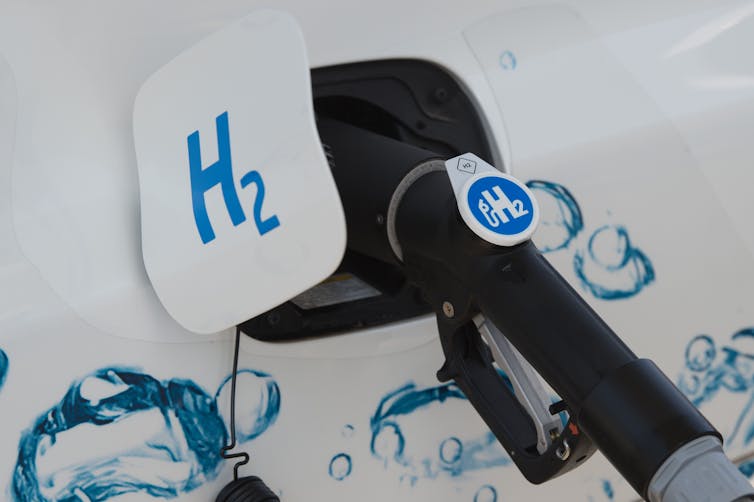 Filling up a hydrogen car in Dresden, Germany in 2018.
Sebastian Kahnert/AAP
Filling up a hydrogen car in Dresden, Germany in 2018.
Sebastian Kahnert/AAP
Is the technology mature enough?
The hydrogen economy cycle consists of three key steps:
- hydrogen production
- hydrogen storage and delivery
- hydrogen consumption – converting the chemical energy of hydrogen into other forms of energy.
Hydrogen production
For hydrogen to become a major future fuel, water electrolysis is likely the best method of production. In this process, electricity is used to split water molecules into hydrogen (H₂) and oxygen (O₂).
This technology becomes commercially feasible when electricity is produced at relatively low costs by renewable sources such as solar and wind. Costs may drop further in the near future as the production technology becomes more efficient.
Read more: How hydrogen power can help us cut emissions, boost exports, and even drive further between refills
How hydrogen is created and used as a power source.Hydrogen storage and delivery
Effective storage and delivery are vital for the safe and efficient handling of large amounts of hydrogen.
Because it is very light, hydrogen has conventionally been compressed at high pressure, or liquefied and stored at an extremely low temperature of -253℃. Taking these steps requires an extra energy investment, so efficiency drops by up to 40%. But current hydrogen storage and delivery still rests on these two technologies – compression and liquefaction – as they are proven and supported by well-established infrastructure and experience.
Another option being explored (but needing further development) is to combine hydrogen with other elements, and then release it when required for use.
Currently, most hydrogen fuel cell cars use carbon-fibre reinforced tanks to store highly compressed hydrogen gas. The cost of tanks will need to lower to make this option more economic (currently over a few thousands of US dollars per unit).
Using hydrogen as a fuel
There are two main ways to convert the chemical energy in hydrogen into usable energy (electrical energy or heat energy). Both of these approaches produce water as the by-product.
A primitive and straightforward way of using hydrogen is to burn it to generate heat – just like you use natural gas for cooking and heating in your home.
A trial planned for South Australia aims to generate hydrogen using renewable electricity, and then inject it into the local gas distribution network. This way of “blending” gases can avoid the cost of building costly delivery infrastructure, but will incur expenditures associated with modifications to existing pipelines. Extensive study and testing of this activity are required.
When used in hydrogen fuel cells, energy is produced when hydrogen reacts with oxygen. This is the technology used by NASA and other operators in space missions, and by car manufacturers in hydrogen fuel cell cars. It’s the most advanced method for hydrogen use at the moment.
Turn up the sound for this hydrogen-fuelled launch.It works, but will we accept it?
Safety considerations
As a fuel, hydrogen has some properties that make it safer to use than the fuels more commonly used today, such as diesel and petrol.
Hydrogen is non-toxic. It is also much lighter than air, allowing for rapid dispersal in case of a leak. This contrasts with the buildup of flammable gases in the case of diesel and petrol leaks, which can cause explosions.
However, hydrogen does burn easily in air, and ignites more readily than gasoline or natural gas. This is why hydrogen cars have such robust carbon fibre tanks – to prevent leakages.
Where hydrogen is used in commercial settings as a fuel, strict regulations and effective measures have been established to prevent and detect leaks, and to vent hydrogen. Household applications of hydrogen fuel would also need to address this issue.
Impact on the environment
From an environmental perspective, the ideal cycle in a hydrogen economy involves:
- hydrogen production through using electrolysis to split water
- hydrogen consumption via reacting it with oxygen in a fuel cell, producing water as a byproduct.
If the electricity for electrolysis is generated from renewable sources, this whole value chain has minimal environment impact and is sustainable.
Read more: The science is clear: we have to start creating our low-carbon future today
Moving closer to a hydrogen economy
Cheap electricity from renewable energy resources is the key in making large-scale hydrogen production via electrolysis a reality in Australia. Internationally it’s already clear – for example, in Germany and Texas – that renewable hydrogen is cost competitive in niche applications, although not yet for industrial-scale supply.
Techniques for storage and delivery need to be improved in terms of cost and efficiency, and manufacturing of hydrogen fuel cells requires advancement.
Hydrogen is a desirable source of energy, since it can be produced in large quantities and stored for a long time without loss of capacity. Because it’s so light, it’s an economical way to transport energy produced by renewables over large distances (including across oceans).
Underpinned by advanced technologies, with strong support by governments, and commitment from many multinational energy and automobile companies, hydrogen fuel links renewable energy with end-users in a clean and sustainable way.
Let’s see if hydrogen takes off.
Authors: Zhenguo Huang, Senior lecturer, University of Technology Sydney


 Daily Bulletin


