

Sexual aggression key to spread of deadly tumours in Tasmanian devils
- Written by: David Hamilton, PhD Candidate in Zoology, University of Tasmania
Tasmanian devils have a reputation as a fearsome animal – most of the time this is undeserved. When it comes to the mating season, however, it’s a fair judgement. Between February and April, mating can be incredibly aggressive, with male and female devils prone to biting one another both during and after the act.
That could be deadly for the devils, according to new research published online in the journal Behavioral Ecology.
Unfortunately, biting drives the spread of devil facial tumour disease (DFTD) a transmissible cancer that has been afflicting the species since the mid-1990s.
Read more: Survival of the fittest? Perhaps not if you're a Tasmanian devil
DFTD is highly unusual for a cancer because it can transfer between individual devils and grow in its new host.
The fact that devils regularly bite one another around the mouth means tumour cells can easily transfer from an infected devil to an open wound on a healthy devil. This makes the buildup of wounds in devils extremely important to our understanding of this disease.
When devils mate
In our study, we examined the accumulation of bite wounds in a population of wild devils in northwest Tasmania.
We found males were much more likely than females to pick up high numbers of bite wounds. But these wounds appear to be related to the amount of time males spent in mating season interactions with females, as opposed to fights with other males (as we had previously thought).
In the mating season, after male devils have mated with females, they spend an extended period either confining the female in a den, or closely following her to make sure other males are unable to mate with her.
During our study we found this behaviour could go on for up to two weeks in the wild. The process is known as “mate guarding” and is relatively common in the animal kingdom.
We found the longer males spent engaging in mate guarding behaviour, the more bite wounds they received. This would seem to put successful males, who mate with a high number of females, in the firing line when it comes to acquiring DFTD.
But no pattern of sex bias in DFTD prevalence has ever been observed in the wild.
So how does this fit with our study on the increased vulnerability in males?
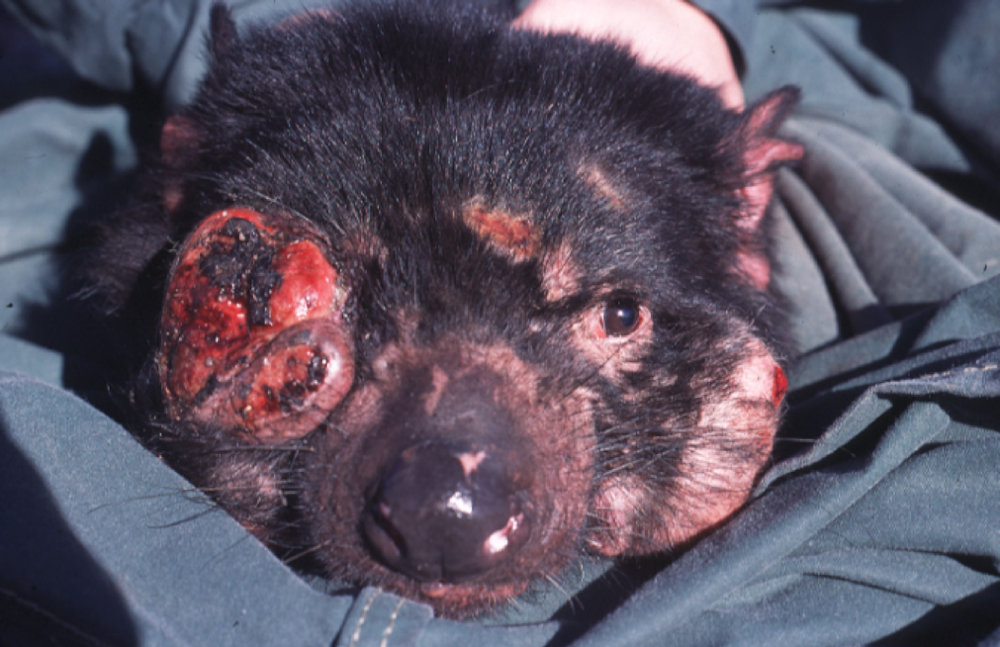 A Tasmanian devil with the Devil Facial Tumour Disease.
Menna Jones/PLOS ONE, CC BY
A Tasmanian devil with the Devil Facial Tumour Disease.
Menna Jones/PLOS ONE, CC BY
Disease transfer
A crucial unknown in the DFTD transmission process involves directionality – which way the deadly disease is passed on by a devil. There are two possibilities:
an infected devil bites an uninfected animal, transferring tumour cells (from its teeth or saliva) directly into the wound it causes
an uninfected devil bites into tumours on an infected animal, and cells transfer into an open wound inside the biter’s mouth.
The reality is likely to involve a combination of the two.
Our results indicate that most disease transmission occurs during extended mating season interactions, when females appear to be causing high numbers of wounds to their mates.
If DFTD can transfer in either direction during these encounters, then both the males receiving the wounds and the females causing them would be equally at risk of acquiring the disease.
Future of the devil
We have highlighted mating season encounters between the sexes as crucial transmission points for the spread of DFTD. The behaviour of male devils appears to be driving patterns that support transmission of the disease.
This information is important for potential disease management options, as it pinpoints males in good condition – who are likely to be reproductively successful – as targets for management interventions, such as vaccinations.
Most importantly, these results add one more piece to the puzzle of rapid evolution in the Tasmanian devil, in response to the strong evolutionary pressure DFTD is placing on this iconic species. With almost 100% mortality once devils reach breeding age, any advantage an individual devil might have to survive a little longer and reproduce should – over time – spread through the population.
The species has already shown remarkably rapid shifts in their life history and genome, while some are able to mount an immune response and recover from the tumours.
DFTD is spread through biting so we can expect strong evolutionary pressure for devils to become less aggressive towards each other over time.
With these new results, we can now pinpoint for the first time who (healthy, successful males) and when (guarding females after mating) the intense selection pressure on aggressive behaviour in devils will operate.
Read more: Could Tassie devils help control feral cats on the mainland? Fossils say yes
Ultimately, devils will solve the DFTD problem themselves by evolving resistance, tolerance and changing their behaviour. One of the best things we can do is let evolution take its course, giving a helping hand along the way via well guided management actions.
Authors: David Hamilton, PhD Candidate in Zoology, University of Tasmania


 Daily Bulletin


