

Hong Kong is one of the most unequal cities in the world. So why aren't the protesters angry at the rich and powerful?
- Written by: Toby Carroll, Associate Professor, City University of Hong Kong
There have been many explanations for the turmoil in Hong Kong, which is now heading toward its 16th weekend. However, the powerful links between the economic and political elites in the city and the grossly inadequate system of governance they preside over are too often ignored.
In explaining the source of Hong Kong’s unrest, many leaders have predictably blamed the teaching of liberal studies in schools. The notion that students should gain a critical understanding of politics and society – not to mention actively participate in these – is simply too much for those who believe they must make the big decisions.
On the other side, the ire of many protesters is overwhelmingly directed toward China and the Hong Kong government, particularly Chief Executive Carrie Lam. Lam’s actions – first disappearing and then reappearing with equal measures of bureaucratic steeliness and obstinacy – have only made matters worse, as have the actions of a police force once revered by many as “Asia’s finest” and the posturing of Chinese forces.
Read more: Hong Kong protesters don't identify as Chinese amid anger at inequality – survey suggests
Indeed, the sum total of these efforts has been a hardening localist identity that has become more apparent among the protesters as the unrest has continued.
Moreover, mutual animosity has grown to such an extent that backing down by either side would seem unlikely. Indeed, for the last few weeks it has been much easier to imagine escalation than the opposite.
Decline without hope
However, the most likely explanation for the unrest lies not in the education curriculum or Beijing’s influence over the city, but rather the nature of Hong Kong government and society itself.
Despite the way the Hong Kong government markets itself to the world – emphasising the rule of law and promoting the city’s high-quality business environment – the city has actually been in decay for decades.
Firstly, Hong Kong has been subject to the “hollowing out” processes that have plagued many former industrial economies – a situation in which industry leaves and nothing replaces it.
Importantly, this has been coupled with an inability of those at the top end of town to recognise the vast inequalities this has contributed towards. According to government statistics, Hong Kong’s wealth gap hit a historic high in 2017, with the wealthiest households earning 44 times the poorest.
For many here, life is experienced in the form of stalling or declining social mobility, sky-high housing prices (the most expensive in the world), dire air quality, crumbling infrastructure (the subway system and airport being the only exceptions), highly uneven education and health services (despite the trumpeted statistics), and lack of decent public spaces.
Read more: New research shows vast majority of Hong Kong protesters support more radical tactics
Long delays to move into public housing are the norm. “Nano apartments” smaller than a parking bay are the only housing option for many, with many flats in the city housing multiple generations of families.
Young Hong Kongers who have been raised on the city’s golden age stories of tycoons like Li Ka Shing (known here affectionately as “Superman”) also face depressing futures in low-paying service jobs.
Moreover, higher education hasn’t helped young people secure higher-paying jobs. One recent survey found that average graduate salaries are significantly lower than they were in 1987.
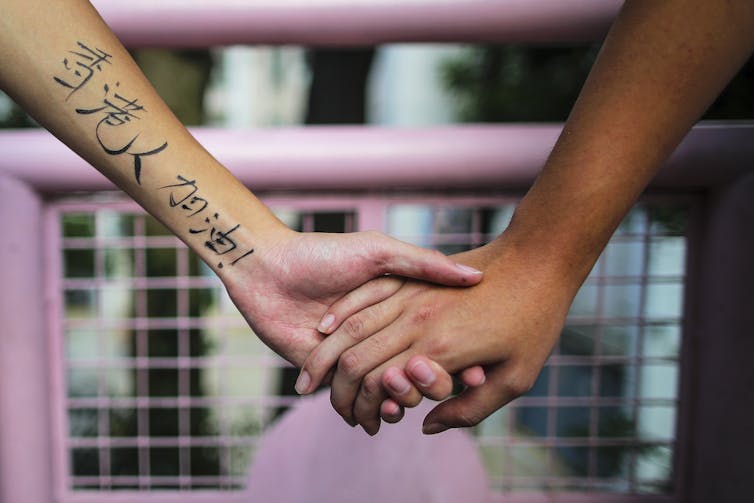 Student protesters taking part in a human chain in Hong Kong this month.
Fazry Ismail/EPA
Student protesters taking part in a human chain in Hong Kong this month.
Fazry Ismail/EPA
While market fundamentalists like Milton Friedman famously heralded the entrepreneurialism of Hong Kong. In reality, it’s laissez-faire for the top end of town, and colonial-era bureaucracy for the rest. Young people contemplating opening a business face oligopolies, rapacious landlords eager to gain from the first signs of success and, in some sectors, rigid government regulations.
Making matters worse, anything vaguely progressive in a redistributive sense is often dismissed by anti-government protesters as too narrowly focused on economic factors at the expense of democratic reforms.
Much like the United States, which has become a positive reference point for many protesters, a pull-yourself-up-by-the-bootstraps individualism prevails in Hong Kong.
Frustratingly, rather than taking aim at the tycoons and conglomerates that dominate the economy, or the property developers and landlords who control the housing market, the main target of the protesters has been the government.
And the protesters don’t condemn the government for protecting the elite’s economic interests to the exclusion of many Hong Kongers, but rather for implementing the will of Beijing.
Why protesters aren’t focusing on economic elites
Indeed, even after some of the richest people in the territory voiced support for the government in recent weeks, very few in the protesting camp have turned their anger towards the city’s economic elites.
This fact speaks to the power of the founding myths of modern Hong Kong and how the city’s rich made good. There’s a certain reverence for the city’s tycoons that persists here, along with a lack of class consciousness and an ingrained ideological hostility towards anything vaguely left-leaning politically.
Moreover, while universal suffrage is a key part of the demands made by protesters, this overwhelmingly relates to the selection of the chief executive, not the structure of the government itself.
For instance, under an anachronistic colonial arrangement known as the “functional constituencies”, a host of economic sectors (such as the financial services, real estate and tourism) gain political representation in the Legislative Council at the expense of citizens.
Crucially, too, little effort has been made to explain why universal suffrage would be so important in Hong Kong beyond thwarting China’s influence. This has limited the formation of lasting coalitions within the protest movement that could rally around the idea of using increased political power to resolve pressing social issues.
Combined with some protesters flying American, British and colonial flags and waving pictures of US President Donald Trump on top of a tank, the movement often appears to be erring closer towards being just another form of reactionary populism.
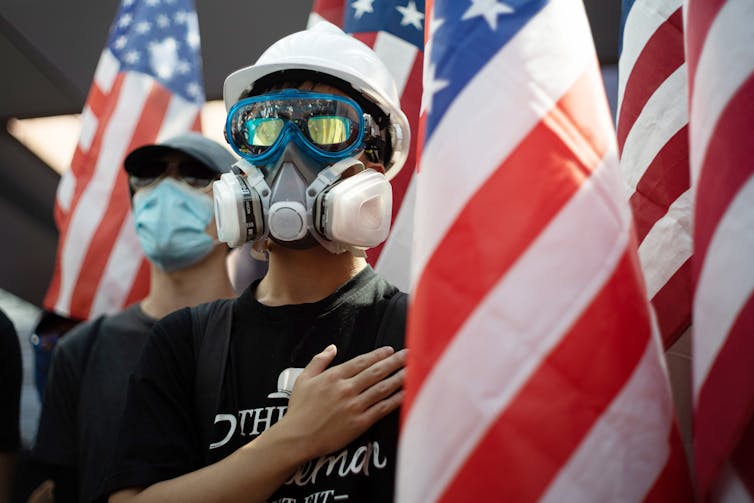 US flags have been a common sight at many protests in Hong Kong.
Jerome Favre/EPA
US flags have been a common sight at many protests in Hong Kong.
Jerome Favre/EPA
Rebuilding hope and the city
The fact that young people are grappling with forging a more positive future is to be admired. However, for Hong Kong to have any reasonable future, the city requires nothing short of large-scale economic and political transformation.
Universal suffrage is one part of this, but in isolation it is insufficient. The question for Hong Kong is whether the protesters and other members of society recognise what needs to be done in a holistic sense and can pull together to make it possible.
In a city characterised by vast inequalities in economic and political power, this challenge is nothing short of revolutionary in the genuine sense of the word.
Authors: Toby Carroll, Associate Professor, City University of Hong Kong


 Daily Bulletin


