

A rare natural phenomenon brings severe drought to Australia. Climate change is making it more common
- Written by: Nicky Wright, Research Fellow, Australian National University
Weather-wise, 2019 was a crazy way to end a decade. Fires spread through much of southeast Australia, fuelled by dry vegetation from the ongoing drought and fanned by hot, windy fire weather.
On the other side of the Indian Ocean, torrential rainfall and flooding devastated parts of eastern Africa. Communities there now face a locust plague and food shortages.
These intense events can partly be blamed on the extreme positive Indian Ocean Dipole, a climate phenomenon that unfolded in the second half of 2019.
Read more: Why drought-busting rain depends on the tropical oceans
The Indian Ocean Dipole refers to the difference in sea surface temperature on either side of the Indian Ocean, which alters rainfall patterns in Australia and other nations in the region. The dipole is a lesser-known relative of the Pacific Ocean’s El Niño.
Climate drivers, such as the Indian Ocean Dipole, are an entirely natural phenomenon, but climate change is modifying the behaviour of these climate modes.
In research published today in Nature, we reconstructed Indian Ocean Dipole variability over the last millennium. We found “extreme positive” Indian Ocean Dipole events like last year’s are historically very rare, but becoming more common due to human-caused climate change. This is big news for a planet already struggling to contain global warming.
So what does this new side-effect of climate change mean for the future?
The Indian Ocean brings drought and flooding rain
First, let’s explore what a “positive” and “negative” Indian Ocean Dipole means.
During a “positive” Indian Ocean Dipole event, waters in the eastern Indian Ocean become cooler than normal, while waters in the western Indian Ocean become warmer than normal.
Warmer water causes rising warm, moist air, bringing intense rainfall and flooding to east Africa. At the same time, atmospheric moisture is reduced over the cool waters of the eastern Indian Ocean. This turns off one of Australia’s important rainfall sources.
Read more: Dipole: the 'Indian Niño' that has brought devastating drought to East Africa
In fact, over the past century, positive Indian Ocean Dipoles have led to the worst droughts and bushfires in southeast Australia.
The Indian Ocean Dipole also has a negative phase, which is important to bring drought-breaking rain to Australia. But the positive phase is much stronger and has more intense climate impacts.
We’ve experienced extreme positive Indian Ocean Dipole events before. Reliable instrumental records of the phenomenon began in 1958, and since then a string of very strong positive Indian Ocean Dipoles have occurred in 1961, 1994, 1997 and now 2019.
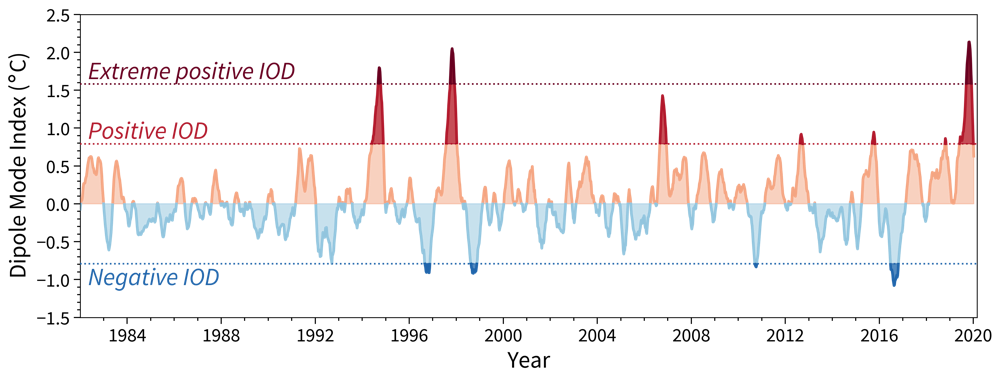 The Dipole Mode Index is used to track variability of the Indian Ocean Dipole.
Author provided
The Dipole Mode Index is used to track variability of the Indian Ocean Dipole.
Author provided
But this instrumental record is very short, and it’s tainted by the external influence of climate change.
This means it’s impossible to tell from instrumental records alone how extreme Indian Ocean Dipoles can be, and whether human-caused climate change is influencing the phenomenon.
Diving into the past with corals
To uncover just how the Indian Ocean Dipole has changed, we looked back through the last millennium using natural records: “cores” taken from nine coral skeletons (one modern, eight fossilised).
These coral samples were collected just off of Sumatra, Indonesia, so they’re perfectly located for us to reconstruct the distinct ocean cooling that characterises positive Indian Ocean Dipole events.
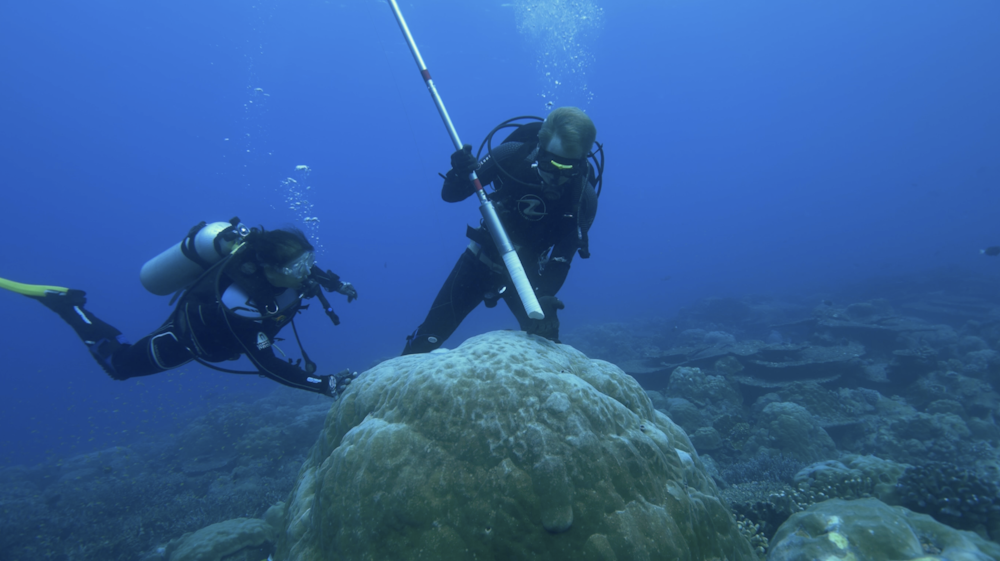 Scientists drilling into corals to study past climate. Corals are like trees, and grow a band for every year they live.
Jason Turl, Author provided
Scientists drilling into corals to study past climate. Corals are like trees, and grow a band for every year they live.
Jason Turl, Author provided
Corals grow a lot like trees. For every year they live they produce a growth band, and individual corals can live for more than 100 years. Measuring the oxygen in these growth bands gives us a detailed history of the water temperature the coral grew in, and the amount of rainfall over the reef.
In other words, the signature of extreme events like past positive Indian Ocean Dipoles is written in the coral skeleton.
Altogether, our coral-based reconstruction of the Indian Ocean Dipole spans 500 years between 1240 and 2019. There are gaps in the timeline, but we have the best picture so far of how exactly the Indian Ocean Dipole has varied in the past.
How unusual was the 2019 Indian Ocean Dipole event?
Extreme events like the 2019 Indian Ocean Dipole have historically been very rare.
We found only ten extreme positive Indian Ocean Dipole events in the entire record. Four occurred in the past 60 years, but only six occurred in the remaining 440 years before then. This adds more weight to evidence that positive Indian Ocean Dipole events have been occurring more often in recent decades, and becoming more intense.
Read more: Is Australia's current drought caused by climate change? It's complicated
But another finding from the reconstruction surprised – and worried – us. Events like 2019 aren’t the worst of what the Indian Ocean Dipole can throw at us.
Of the extreme events we found in our reconstruction, one of them, in 1675, was much stronger than anything we’ve seen in observations from the last 60 years.
The 1675 event was around 30–40% stronger than what we saw in 1997 (around the same magnitude as 2019). Historical accounts from Asia show this event was disastrous, and the severe drought it caused led to crop failures, widespread famine and mortality, and incited war.
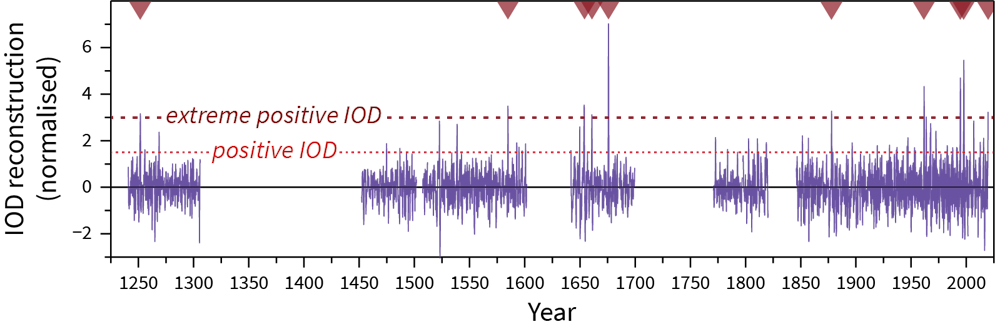 The wiggles that make up 500 years of reconstructed Indian Ocean Dipole variability. The red triangles show when extreme positive events occurred.
Author provided
The wiggles that make up 500 years of reconstructed Indian Ocean Dipole variability. The red triangles show when extreme positive events occurred.
Author provided
As far as we can tell, this event shows just how extreme Indian Ocean Dipole variability can be, even without any additional prompting from external forces like human-caused climate change.
Why should we care?
Indian Ocean Dipole variability will continue to episodically bring extreme climate conditions to our region.
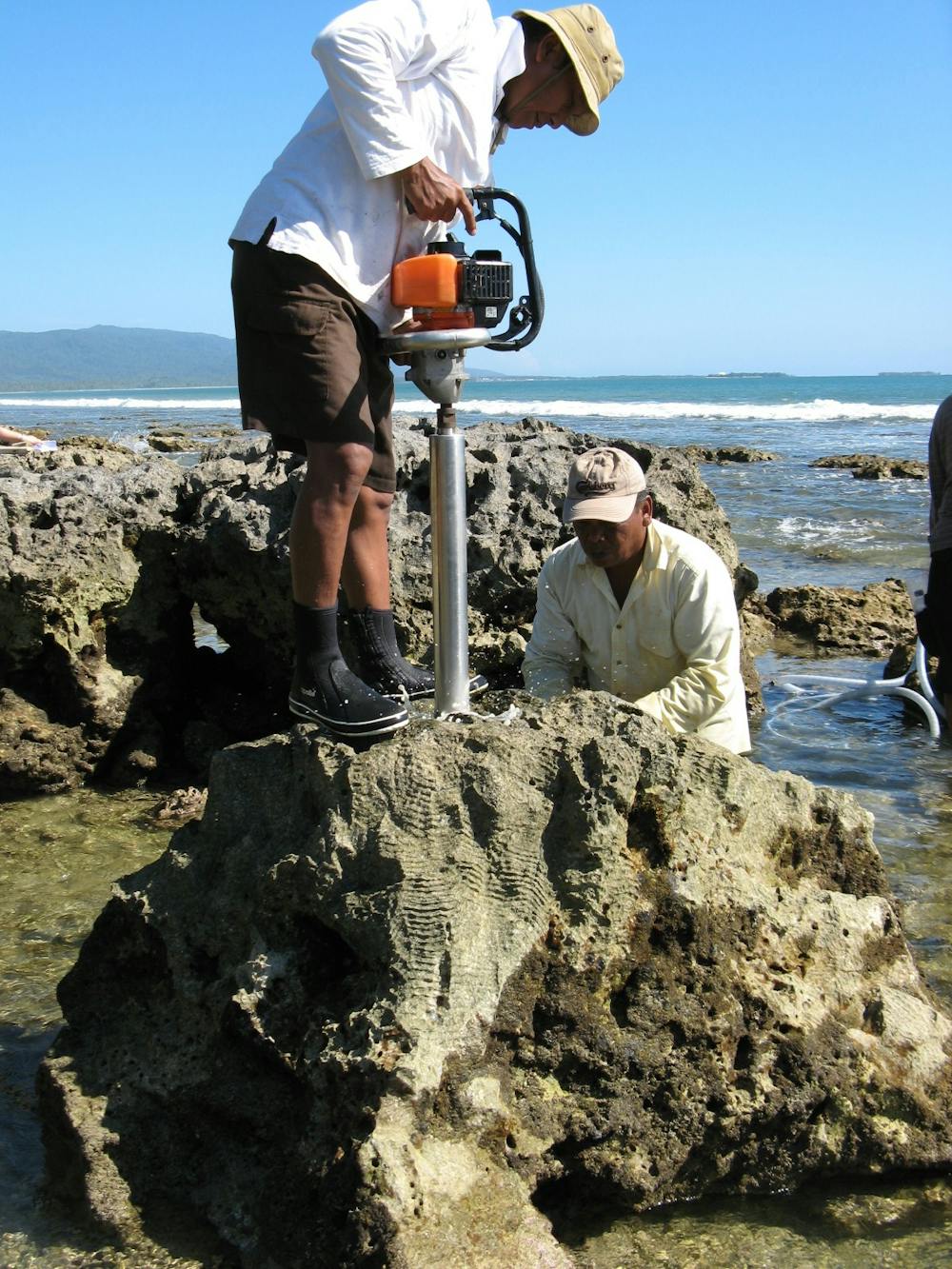 Drilling through fossilised coral layers to look into the past.
Nerilie Abram, Author provided
Drilling through fossilised coral layers to look into the past.
Nerilie Abram, Author provided
But previous studies, as well as ours, have shown human-caused climate change has shortened the gaps between these episodes, and this trend will continue. This is because climate change is causing the western side of the Indian Ocean to warm faster than in the east, making it easier for positive Indian Ocean Dipole events to establish.
In other words, drought-causing positive Indian Ocean Dipole events will become more frequent as our climate continues to warm.
In fact, climate model projections indicate extreme positive Indian Ocean Dipole events will occur three times more often this century than last, if high greenhouse gas emissions continue.
Read more: The world may lose half its sandy beaches by 2100. It’s not too late to save most of them
This means events like last year will almost certainly unfold again soon, and we’re upping the odds of even worse events that, through the fossil coral data, we now know are possible.
Knowing we haven’t yet seen the worst of the Indian Ocean Dipole is important in planning for future climate risks. Future extremes from the Indian Ocean will act on top of long-term warming, giving a double-whammy effect to their impacts in Australia, like the record-breaking heat and drought of 2019.
But perhaps most importantly, rapidly cutting greenhouse gas emissions will limit how often positive Indian Ocean Dipole events occur in future.
Authors: Nicky Wright, Research Fellow, Australian National University


 Daily Bulletin


