

The times suited him, then passed him by: the Alan Jones radio era comes to an end
- Written by: Denis Muller, Senior Research Fellow, Centre for Advancing Journalism, University of Melbourne
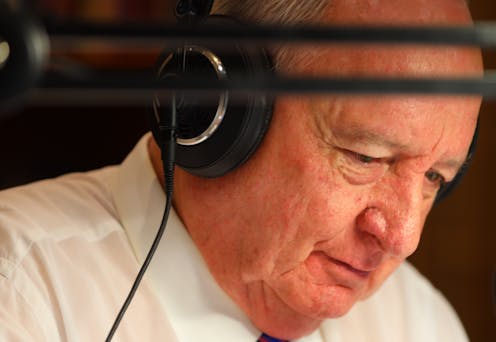
Time has finally caught up with Alan Jones. Time as measured in years, but not time as measured by social and attitudinal change.
It is remarkable that his recipe of nostalgia, bullying and reactionary politics, all delivered in a ranting, hectoring style, is as successful today as it has been for the whole 35 years of his career in radio broadcasting.
Two hundred and twenty-six ratings wins in the highly competitive Sydney breakfast radio market is testament to that.
And power. Former Prime Minister John Howard, said in a tribute that Jones had been the most influential radio broadcaster during his time in politics, a period of 33 years.
In the early 2000s, Jones was for a time a de facto member of the NSW state cabinet. In 2001, when Premier Bob Carr was about to appoint Michael Costa as the new police minister, he told Costa to go and see Jones at his home and talk about policing policy with him.
Read more: It will be money, not morality, that finally turns the tide on Alan Jones
Only a year earlier, Jones had come out badly from what was called the cash-for-comment inquiry. The inquiry found he and other talkback hosts had taken money from big companies to spruik their virtues, while making it look as if it was their own honestly held opinion.
Yet within weeks, Jones was hosting an event for Howard, who was then prime minister and had become a fixture on the broadcaster’s program.
It invites the question, why?
There are many answers, but one is overwhelmingly more important than the others: the climate of fear and resentment created in certain sections of society by economic dislocation and the threat to security represented by the rise of Islamic fundamentalism.
In 2006, the Australia Institute produced a webpaper by Clive Hamilton that described the characteristics of Jones’s audience based on extensive demographic and attitudinal data from Roy Morgan Research.
It showed Jones draws his audience largely from an older generation in lower to middle income brackets. His listeners are more religious than other Australians, more socially conservative, more likely to believe that the fundamental values of Australian life are under threat and more likely to favour heterosexual families in which children are disciplined and taught respect for authority. They were also reported to feel less safe than they used to.
If we reflect on the tectonic shifts in society since Jones embarked on his radio career in 1985, it is possible to see how an audience like this might find the Jones recipe appealing.
The late 1980s were years in which the Hawke-Keating governments opened the Australian economy to global competition. Many manufacturing jobs were lost overseas. Blue-collar workers, many trained for one job only, were suddenly on the economic scrapheap.
The Australian Bureau of Statistics reported that long-term unemployment in Australia reached an unprecedented peak of 366,000 persons in March 1993, representing 38% of the unemployed. The previous peak (31% of total unemployment) occurred in February 1984. Older men had been particularly affected by this trend.
Nobody had asked them whether they thought this was good policy. They felt disenfranchised and their resentment was to surface in a variety of ways: dislike of Asians, contempt for Aboriginal people and more lately, fear of Islam and asylum-seekers.
These attitudes were discovered in much social research during the ensuing decades. An example was a report for the Melbourne University Social Equity Institute on attitudes to asylum-seekers in 2016.
It noted that many of the fears and resentments underpinning attitudes to asylum-seekers were similar to those behind the rise of Pauline Hanson’s One Nation party in the mid-1990s.
The promise by Howard in 1996 to make Australians feel “relaxed and comfortable” turned out to be a successful election strategy, and for the 11 years of his prime ministership, Howard was a fixture on the Jones program.
It was symbiotic. The people Jones referred to as living in “Struggle Street” became “Howard’s battlers”.
The election of Kevin Rudd in 2007, with its focus on climate change, was calculated to make Australians feel anything but relaxed and comfortable.
Jones read this unerringly and became a relentless climate denier, offering his own version of comfort to an audience confronting an existential threat for which the science was both irrefutable and incomprehensible.
It was over climate change that in August 2019 Jones uttered his infamous entreaty to Scott Morrison that he should shove a sock down the throat of New Zealand Prime Minister Jacinda Ardern.
Read more: Shoving a sock in it is not the answer. Have advertisers called time on Alan Jones?
Powerful women were often his target. His proposal in 2011 that Julia Gillard, then prime minister, should be taken out to sea and dumped in a chaff bag, was also provoked by his anger at her government’s climate-change policies.
This may or may not have resonated with his ageing audience, but at any rate they stayed loyal to him.
He has been accused of racism, particularly in respect of Middle Eastern people and Muslims generally.
In 2009, the New South Wales Administrative Decisions Tribunal found Jones “incited hatred, serious contempt and severe ridicule of Lebanese Muslims” during on-air comments in April 2005.
He had described them as “vermin” who “rape and pillage a nation that’s taken them in”.
These insults were unleashed at a time of racial tension in Sydney that culminated in the Cronulla riots, when a confrontation between men of Middle Eastern appearance and Anglo-Australian lifesavers provoked a violent retaliatory response a week later.
Multiculturalism and feminism have been two of the most enduring forces for social change in Australia over the past five decades. Jones has been a vocal campaigner against both. Coupled with economic dislocation and the threat of terrorism, they have reshaped the contours of Australian society.
The times have suited him, but in many fundamental respects time has also passed him by.
His outbursts have generated social and commercial backlashes recently that were unthinkable just a few years ago, powered by the new force of social media.
For his latter-day employer, Nine Entertainment, he was high-risk. The withdrawal of 19 big advertisers from his program after the attack on Ardern came only a few months after he had cost 2GB $3.75 million in defamation damages, plus costs, for a baseless and relentless campaign in which he blamed a family of quarry owners for the deaths of 12 people in the 2011 Grantham floods.
It may be no coincidence that his retirement comes as his contract with Nine approaches its end.
Authors: Denis Muller, Senior Research Fellow, Centre for Advancing Journalism, University of Melbourne


 Daily Bulletin


