

Mask or no mask? This simple ethical approach can help with your pandemic etiquette
- Written by: Elspeth Tilley, Associate Professor of English (Expressive Arts), Massey University
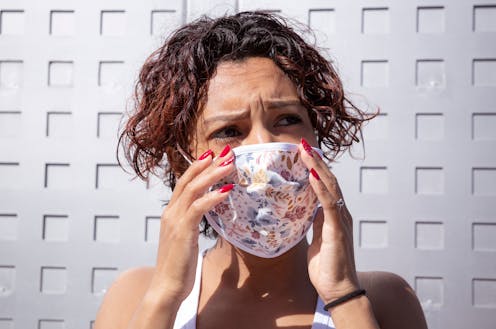
Feeling torn about wearing a mask? Me too. I don’t want to look like I’m virtue signalling or get funny looks. But I also want to be responsible about public health. I’ve ended up conflicted, wearing a mask one day but not the next.
The statistics suggest this isn’t my dilemma alone. While mask sales have skyrocketed in New Zealand since COVID-19 reemerged, public mask wearing (even in Auckland) is still the exception.
This is where understanding ethical decision making can be useful. Ethics breaks down values-based decisions, helping us see when our ego is ruling us, and when our rationality is in control.
Ethical analysis can’t make the decision for us, but it can make dealing with ethical decisions clearer and more conscious.
What kind of person do I want to be?
Scholars divide the study of ethics into three main branches: virtue, deontological and consequential. All three can us help think about wearing a mask.
Virtue ethics is about developing good character. Our virtues come from our upbringing, experiences and education. We can change them by redefining what sort of person we want to be.
Read more: 3 moral virtues necessary for an ethical pandemic response and reopening
Simple virtue checks include:
(There are several recently disgraced politicians who probably wish they’d run the front page and significant other checks before acting.)
However, virtue ethics are individualistic: values differ by gender, age, culture and other factors. Our ego can help us moderate our behaviour, but it can also convince us we are right just because we sincerely hold a strong moral belief.
The “no win” debates we see on social media often reach a stalemate because people are relying on personal values as their only moral compass.
Also, prioritising reasonableness can result in apathy. While Aristotle praised the “reasonable man” as virtuous, George Bernard Shaw pointed out that “all progress depends on the unreasonable man”.
Currently mask wearers are the exception rather than the rule, and some have even been mocked. Shaw’s approach would suggest the courage to show ethical leadership deserves praise rather than mockery. But we can only make a robust ethical judgement if duties and outcomes are also considered.
Read more: Why New Zealand needs to focus on genome sequencing to trace the source of its new COVID-19 outbreak
What are my duties?
Deontologists try to identify rules for good behaviour that will hold true in every situation. They advise us to obey the law and any codes of conduct or standards that apply to our job or other group membership.
There is currently no law in New Zealand mandating mass masking, so that can’t guide us. But many workplaces have conduct or health and safety codes, which can simplify decision making, and there are clear public health recommendations.
Deontology gives clarity – rules define what can be done without penalty – and is less muddy or personal than virtue-based ethics. It can also provide accountability. If we breach the rules of a group, often we can be removed from that group.
On the other hand, deontological ethics is inflexible. Codes and rules can’t cover every situation, can date rapidly, and are usually made reactively. They mostly punish breaches rather than guiding good behaviour.
Nonetheless, considering laws and rules is an important ethical step, alongside thinking about our values and the impact of our actions.
What kind of world do I want to live in?
Consequentialists judge actions by their outcomes: who is affected and how. They aim to maximise benefit and minimise harm.
When weighing consequences, it is useful to ask:
Would you be happy for your action to affect you in the same way it does others (reversibility)?
Would the outcome be acceptable if everyone behaved this way (universalisability)?
What don’t we know today that might be true tomorrow (unknowability)?
Consequentialists try to act ethically towards all groups of people, not just the group they currently occupy, because they know circumstances can change. If a friend was diagnosed with an unexpected respiratory condition tomorrow, for example, would we be happy with how we behaved today?
But, on their own, consequentialist approaches can be vague and complex. Most usefully, consequentialism adds depth to other approaches.
Ask yourself these questions
So, I run all three ethics checks: what values are important to me, what are my duties, and what are the potential impacts of my choice? To help, I can ask other questions:
What would mum say? (Be compassionate.)
What does my workplace code of conduct say? (It prioritises manaakitanga or care for others.)
What does the reversability test imply? (That I can show solidarity with, and reduce anxiety for, people at risk, even if I am at less risk.)
If someone I’m in contact with got sick tomorrow, how would I feel about my behaviour today? (I’d rather not be sorry in hindsight.)
Asking a range of questions from all three ethical angles helps me arrive at an ethically measured decision: that I should be consistently wearing a mask when I go out. And a careful decision is much easier to stick to, even if it means I still get the odd funny look.
Authors: Elspeth Tilley, Associate Professor of English (Expressive Arts), Massey University


 Daily Bulletin


