

How China is remaking the world in its vision
- Written by: Natasha Kassam, Fellow, ANU National Security College’s Futures Council, Australian National University
This is an edited extract of an essay in the latest issue of Australian Foreign Affairs, The March of Autocracy, published today.
It is the year 2049. China is celebrating having reached its second centenary goal – to become a “prosperous, powerful, democratic, civilised and harmonious socialist modernised country” by the 100th anniversary of the people’s republic.
Its economy is three times the size of the United States’, as the International Monetary Fund predicted back in the 2010s. The US remains wealthy and powerful – it has functioning alliances in Europe – but its pacts with Asian allies have fallen into disrepair.
For decades, Hong Kong has been accepted as just another province of China. Few dare to criticise the ongoing human rights abuses there, or in Xinjiang and elsewhere, because of the extraterritorial application of China’s national security laws. Taiwan, if not annexed, is isolated, with no diplomatic partners.
The legacy of Xi Jinping, who led China for more than 30 years, monopolises ideological discourse in China. His successors rule under his shadow.
Outside China, many of the third-wave democracies that transitioned in the second half of the 20th century have become far less liberal. Elections are held, but increasingly authoritarian governments have adopted many of Beijing’s technological and legal tools to manage markets and control politics. The internet is heavily censored.
Mistrust permeates every aspect of China’s relations with the West. International co-operation on climate change and the strong carbon-reduction commitments of the early 2020s have long been abandoned. The focus is on individual adaptation.
Australia remains a liberal democracy and a staunch defender of free markets and human rights. But these are no longer the default standards of global governance – they are minority positions associated mostly with Western traditions. No longer a top-20 economic or military power, Australia’s opportunities to make its mark internationally are few and far between.
An unsettling but plausible vision
This vision of a fragmented and decidedly less liberal international order is highly speculative, but also dispiritingly plausible.
It is unsettling to an Australian reader, not just because Australian foreign policy has been centred on a global set of rules and institutions since 1945, but because Australian identity is so enmeshed with the values of liberal democracy.
The 2017 Foreign Policy White Paper states that Canberra is “a determined advocate of liberal institutions, universal values and human rights”, in stark contrast to Beijing.
Read more: Xi Jinping's grip on power is absolute, but there are new threats to his 'Chinese dream'
All nation states, especially rising powers, desire a favourable global environment in which they can acquire power, prosperity and prestige. The postwar system greatly aided China, and it would be incorrect to claim Beijing wants to dismantle it entirely.
Similarly, it would be disingenuous to overlook the many instances where the US and other liberal democracies have behaved inconsistently.
But the Chinese Communist Party, which leads an authoritarian state, sees the liberal values embedded in the present order as a threat to its rule. Unlike the US, which at times ignores or violates these principles, China needs many of them to be suppressed, even eliminated.
As China seeks to remake the international order, the challenge is to understand where and how Beijing’s efforts will undercut its liberal character, and to identify where it is possible to resist.
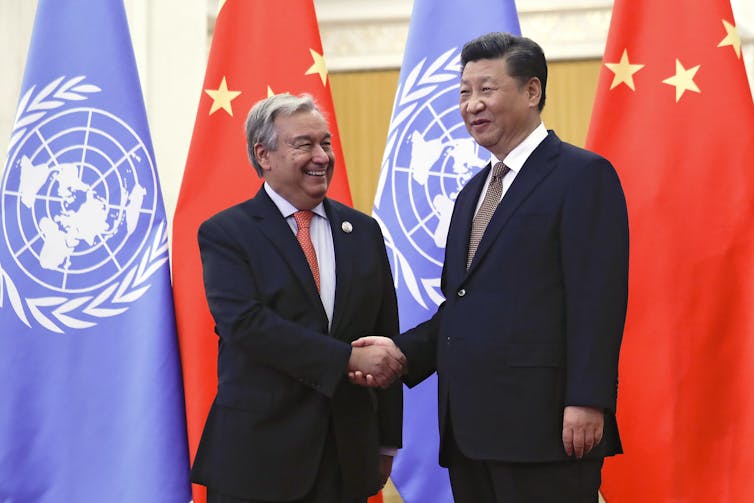 Chinese state media lauded Xi Jinping as a ‘champion of the UN ethos’ ahead of the UN General Assembly last year.
Andy Wong/AP
Chinese state media lauded Xi Jinping as a ‘champion of the UN ethos’ ahead of the UN General Assembly last year.
Andy Wong/AP
How China is changing the world
Rather than upend the existing international system, Beijing’s approach today is to co-opt, ignore and selectively exploit institutions.
Xi has said:
reforming and improving the current international system do not mean completely replacing it, but rather advancing it in a direction that is more just and reasonable.
In late 2019, for instance, the World Trade Organisation’s appellate body ceased to function after the US – complaining about the organisation’s soft stance on China – blocked the appointment of replacement judges.
In many ways, the WTO’s structure is the epitome of a liberal rules-based system: countries relinquish some sovereignty and are bound by judicial decisions in the interests of resolving trade disputes.
In response, China joined with the European Union, Australia and other governments to set up a parallel stop-gap legal mechanism.
This was a reflection of the CCP’s nuanced relationship with the liberal international order. China needs a stable trading system and will agree to binding rules to preserve it. The odd trade dispute does not substantially threaten China’s ideological security.
In the future, Beijing should be expected to exert its influence on the current order. The challenge for states such as Australia is to identify when Beijing’s behaviour exceeds influence and begins to erode the system’s liberal foundations.
China is already skilfully manoeuvring within international institutions to guide their operations, press for reforms and promote the China model.
Chinese nationals run four of the 15 United Nations specialised agencies, including the Food and Agricultural Organisation and the International Civil Aviation Organisation.
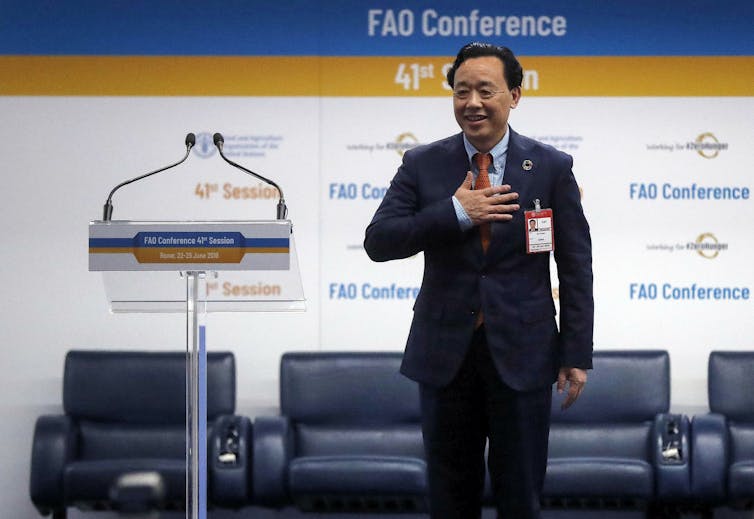 Qu Dongyu, the new director general of the Food and Agricultural Organisation.
Riccardo Antimiani/AP
Qu Dongyu, the new director general of the Food and Agricultural Organisation.
Riccardo Antimiani/AP
Ironically, the democratic nature of international institutions benefits Beijing. Chinese representatives in a variety of forums, such as the World Health Assembly and committees of the UN General Assembly, muster coalitions of the Global South to ensure favourable votes on issues such as Taiwan’s (non)participation or to counter criticism of its repressive policies in Xinjiang.
China also elevates its government-organised NGOs, presenting an image of independence while drowning out the voices of independent civil society.
The China Society for Human Rights Studies, for example, has official consultative status at the United Nations as an NGO, but is co-located with Chinese government offices and staffed by Chinese government officials. It has vigorously prosecuted China’s human rights agenda.
Read more: The China-US rivalry is not a new Cold War. It is way more complex and could last much longer
The use of deft diplomacy and inducements to generate voting blocs is unsurprising. But China also seeks to change the system, diluting the liberal elements that threaten the China model and thus the CCP’s rule.
For instance, China has already succeeded in weakening the liberal character of international human rights. In 2017, it proposed its first-ever resolution to the UN Human Rights Council, headed: “The contribution of development to the enjoyment of all human rights”.
It prioritised economic development above civil and political rights, and put the primacy of the state above the rights of the individual. Despite objections and nay votes from Western members, the resolution passed. The subsequent report by the council’s advisory committee, a body of 18 experts supposed to maintain independence, referred mainly to Chinese party-state documents.
Chinese diplomats also block human rights resolutions at the UN Security Council, such as a February 2020 resolution on the plight of Myanmar’s ethnic Rohingya.
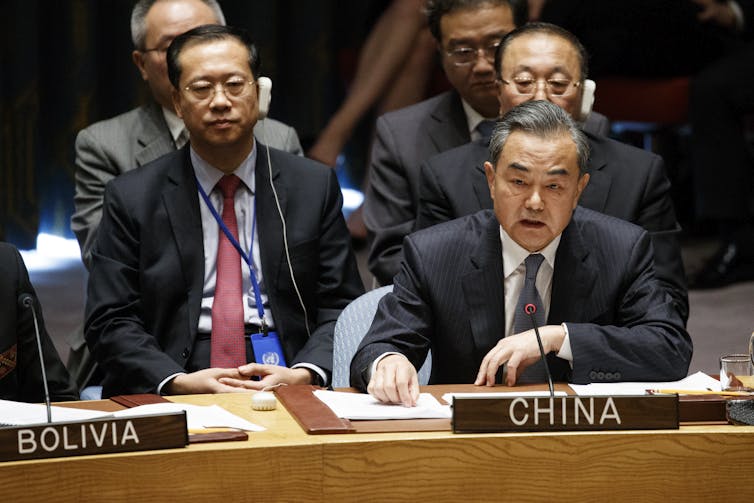 Chinese Foreign Minister Wang Yi speaks during a UN Security Council briefing in 2018.
Evan Vucci/AP
Chinese Foreign Minister Wang Yi speaks during a UN Security Council briefing in 2018.
Evan Vucci/AP
While the US has arguably been similarly obstructive on resolutions about Palestine, it is for the narrow purpose of protecting an ally, rather than the broader project of weakening the rights themselves.
China has even been able to marshal the international system to defend and commend its behaviour in Xinjiang and Hong Kong.
In 2020, at the 44th session of the UN Human Rights Council, a joint statement signed by 27 countries, including Australia, expressed concern at arbitrary detention, widespread surveillance and restrictions in Xinjiang and the national security legislation in Hong Kong.
A competing statement supporting the Hong Kong legislation received support from 53 states, only three of which are considered “free” by the non-governmental organisation Freedom House.
By working within the system to rally a voting bloc, Beijing was able to compromise the world’s peak human rights body. Tactics that have been successful in watering down human rights are now being employed in areas where norms are still being established, such as internet governance.
Preparing for the new world disorder
The history of liberal internationalism is replete with contradictions. Some say that in recent decades it is Washington, not Beijing, that has damaged the order most.
So can China really do more damage to an order already on life support? Liberalism is not just facing an external challenge, but one from within.
The answer requires optimism about liberalism’s capacity to self-correct across the arc of history, and scepticism that illiberalism can do likewise. As much as Donald Trump belittled, criticised and attacked America’s institutions, he also created the conditions for a course correction – Joe Biden’s victory.
Read more: China enters 2021 a stronger, more influential power — and Australia may feel the squeeze even more
The CCP is a well-resourced and well-organised political force. It has the potential to be far more effective than any iconoclastic but capricious populist in permanently weakening the liberal foundations of the global order. Much of China’s influence abroad is unavoidable. A rising power with the economic and military strength that China wields is unlikely to be deterred.
On this logic, optimism has no place. But it would also be mistaken to adopt a fatalistic approach. Instead, Australia and its partners must focus their efforts on those elements of the liberal order most worth preserving and most under threat.
The centenary of the people’s republic is still 28 years away.
Authors: Natasha Kassam, Fellow, ANU National Security College’s Futures Council, Australian National University
Read more https://theconversation.com/how-china-is-remaking-the-world-in-its-vision-155377


 Daily Bulletin


