

Four seismic climate wins show Big Oil, Gas and Coal are running out of places to hide
- Written by: Jacqueline Peel, Professor of Environmental and Climate Law, The University of Melbourne
Three global fossil fuel giants have just suffered embarrassing rebukes over their inadequate action on climate change. Collectively, the developments show how courts, and frustrated investors, are increasingly willing to force companies to reduce their carbon dioxide pollution quickly.
A Dutch court ordered Royal Dutch Shell to slash its greenhouse emissions, and 61% of Chevron shareholders backed a resolution to force that company to do the same. And in an upset at Exxon Mobil, an activist hedge fund won two seats on the company’s board.
The string of wins was followed in Australia on Thursday by a court ruling that the federal environment minister, when deciding whether or not to approve a new coal mine, owes a duty of care to young people to avoid causing them personal injury from climate change.
The court rulings are particularly significant. Courts have often been reluctant to interfere in what is viewed as an issue best left to policymakers. These recent judgements, and others, suggest courts are more prepared to scrutinise emissions reduction by businesses and - in the case of the Dutch court - order them to do more.
 The wins for climate action put big polluters on notice.
AP
The wins for climate action put big polluters on notice.
AP
Court warns of ‘irreversible consequences’
In a world-first ruling, a Hague court ordered oil and gas giant Shell to reduce CO₂ emissions by 45% by 2030, relative to 2019 levels. The court noted Shell had no emissions-reduction targets to 2030, and its policies to 2050 were “rather intangible, undefined and non-binding”.
The case was brought by climate activist and human rights groups. The court found climate change due to CO₂ emissions “has serious and irreversible consequences” and threatened the human “right to life”. It also found Shell was responsible for so-called “Scope 3” emissions generated by its customers and suppliers.
The Chevron upset involved an investor revolt. Some 61% of shareholders supported a resolution calling for Chevron to substantially reduce Scope 3 emissions generated by the use of its oil and gas.
And last week, shareholders of ExxonMobil, one of the world’s biggest corporate greenhouse gas emitters, forced a dramatic management shakeup. An activist hedge fund, Engine No. 1, won two, and potentially three, places on the company’s 12-person board.
Engine No. 1 explicitly links Exxon’s patchy economic performance to a failure to invest in low-carbon technologies.
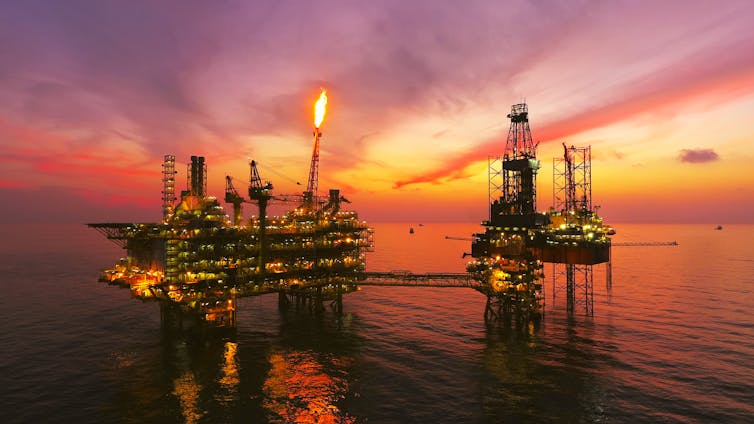 The court said Shell’s emissions reduction efforts were ‘rather intangible’.
Shutterstock
The court said Shell’s emissions reduction efforts were ‘rather intangible’.
Shutterstock
Climate-savvy shareholders unite
As human activity causes Earth’s atmosphere to warm, large fossil fuel companies are under increasing pressure to act.
A mere 20 companies have contributed 493 billion tonnes of CO₂ and methane to the atmosphere, primarily from the burning of their oil, coal and gas. This equates to 35% of all global greenhouse gas emissions since 1965.
Shareholders – many concerned by the financial risks of climate change – are leading the corporate accountability push. The Climate Action 100+ initiative is a leading example.
It involves more than 400 investors with more than A$35 trillion in assets under management, who work with companies to reduce emissions, and improve governance and climate-related financial disclosures. Similar movements are emerging worldwide.
Shareholders in Australia are also stepping up engagement with companies over climate change.
Last year, shareholder resolutions on climate change were put to Santos and Woodside. While neither resolution achieved the 75% support needed to pass, both received unprecedented levels of support – 43.39% and 50.16% of the vote, respectively.
And in May 2021, Rio Tinto became the first Australian board to publicly back shareholder resolutions on climate change, which subsequently passed with 99% support.
Read more: Wondering if your energy company takes climate change seriously? A new report reveals the answer
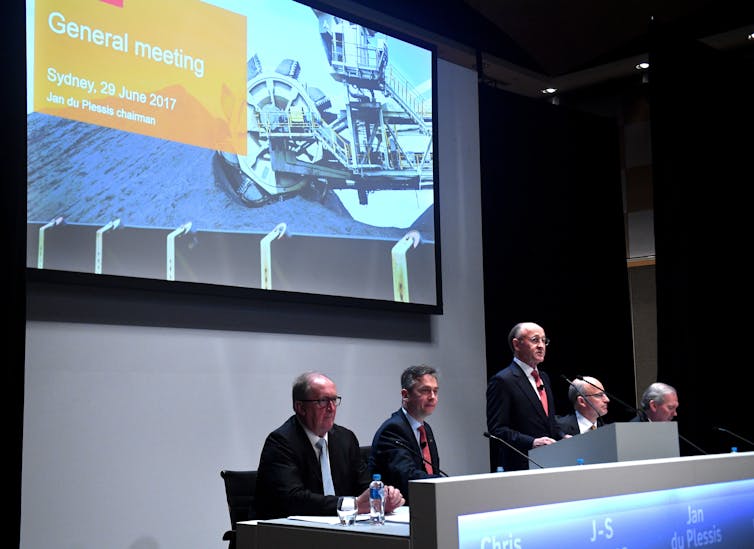 The Rio Tinto board backed a shareholder resolution on climate change.
Brendan Esposito/AAP
The Rio Tinto board backed a shareholder resolution on climate change.
Brendan Esposito/AAP
The litigation trend
To date, the question of whether corporate polluters can be legally forced to reduce greenhouse emissions has remained unanswered. While fossil fuel companies have faced a string of climate lawsuits in the United States and Europe, courts have often dismissed the claims on procedural grounds.
Cases brought against governments have been more successful. In 2019, for example, the Dutch Supreme Court affirmed the government has a legal duty to prevent dangerous climate change.
The decision against Shell is significant, and sends a clear signal that corporations can be held legally responsible for greenhouse pollution.
Shell has previously argued it can only reduce its absolute emissions by shrinking its business. The recent case highlights how such companies may have to quickly find new forms of revenue, or face legal liability.
It’s unlikely we’ll see identical litigation in Australia, because our laws are different to those in the Netherlands. But the Shell case is emblematic of a broader trend of climate litigation being brought to challenge corporate polluters.
This includes the case decided on Thursday involving young people opposed to a company’s coal mine expansion, and Australian cases arguing for greater disclosure of climate risk by corporations, banks and super funds.
Read more: Climate change will cost a young Australian up to $245,000 over their lifetime, court case reveals
 The case brought against the Australian government by a group of teenagers is part of a growing trend towards climate litigation.
Supplied
The case brought against the Australian government by a group of teenagers is part of a growing trend towards climate litigation.
Supplied
Change is nigh
Oil and gas companies often argue Scope 3 emissions are not their responsibility, because they don’t control how customers use their products. The Shell finding and shareholder action against Chevron suggest this claim may hold little sway with courts or shareholders in future.
The Shell case may also set off a global avalanche of copycat litigation. In Australia, legal experts have noted the turning tide, and warned is it’s only a matter of time before directors who fail to act on climate change face litigation.
Clearly, a seismic shift is looming, in which corporations will be forced to take greater responsibility for climate harms. These recent developments should act as a wake-up call for oil, gas and coal companies, in Australia and around the world.
Authors: Jacqueline Peel, Professor of Environmental and Climate Law, The University of Melbourne


 Daily Bulletin


