

Is an electric bike right for you? Here’s what to consider before you buy
- Written by: Muhammad Rizwan Azhar, Lecturer of Chemical Engineering, Sustainable Energy and Resources, Edith Cowan University
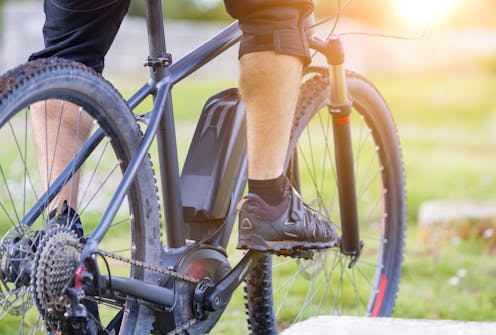
More Australians than ever are riding electric bikes – a fact you may have noticed on the streets of our cities and towns.
Electric bikes, or e-bikes, are typically equipped with an electric motor and a battery, providing power to help you pedal. Some allow you to boost and lower the amount of pedalling assistance you get.
Globally, the transport sector produces about one-quarter of greenhouse gas emissions. Finding cleaner ways to get around is vital to combating the climate crisis. E-bikes also offer solutions to the problems of traffic congestion, fuel costs and sedentary lifestyles.
But is an electric bike right for you? Below, we discuss the pros and cons, to help you decide.
The pros
– Reduce carbon emissions
In developed countries, transport can be one of the largest proportions of an individual’s carbon footprint. But you can reduce your travel emissions by 75% if you replace car use with an e-bike for short trips such as the work commute.
Research has found e-bikes, if used to replace cars, could cut carbon dioxide (CO₂) emissions by up to 50% in England – or about 30 million tonnes a year. Other analysis showed the potential was greatest in rural areas.
– Connect with your community
The “car-rification” of our cities changed community dynamics. Retail became concentrated in out-of-town shopping centres, leading to a decline in smaller town centres. This provided fewer opportunities to meet our neighbours and has contributed to high rates of loneliness and social isolation.
Similar to regular cycling, riding e-bikes helps create community bonds. It makes us more likely to engage with our surroundings and interact with people around us. You can even join an e-bike group or community ride.
– Save money
E-bikes offer substantial long-term financial benefits to owners.
In Australia, an e-bike costs from about A$1,000 to more than $5,000. An annual e-bike service will set you back between $100 and $300. And retailers currently put the cost of a full battery charge at 10–15 cents, translating to roughly $20 per year for an average commuter.
Cars, of course, cost far more to run. For example, Victorian motoring body RACV last year found the state’s cheapest car to own and operate was the MG3 Core light Hatch, with monthly costs of $734.84. Even taking into account charging costs and maintenance, you can see how quickly an e-bike would pay for itself.
– Get active
E-bikes are clearly better for your health than riding in a car.
A 2019 study investigated e‐bike commuting for inactive, overweight people living in regional Australia. It found e-bike users increased their physical activity by an average 90 minutes a week.
A literature review in 2022 found e-biking was a moderately intense physical activity on measures such as energy expenditure, heart rate and oxygen consumption. The benefits were lower than conventional cycling, but generally greater than walking.
Women, in particular, have reported benefits from e-bike use. A New Zealand study showed e-bikes provided less fit women with “more empowering physical activity experiences” and increased their cycling confidence.
The cons
– Safety challenges
Like any form of mobility, e-bikes must be used safely. Concerns around e-bikes include speeding, accidents and people riding without helmets.
In May this year, Sydney’s Northern Beaches Council launched a public awareness campaign on e-bike safety. The advice includes:
- slow to walking pace when others are on the path
- ring your bell to signal your approach
- be ready for sudden changes.
Government regulation on e-bikes is also important for public safety. For example in Germany, high-speed e-bikes are classed as mopeds and cannot be ridden on bike paths.
Separately, e-bikes usually contain lithium-ion batteries which can explode and start fires – particularly in e-bikes bought from overseas retailers that don’t meet Australian standards. Before buying, check advice from fire authorities.
– Lack of cycling and charging infrastructure
Well-designed cycling infrastructure encourages e-bike use. In Australia, governments are slowly accepting the need for infrastructure such as dedicated bike lanes and charging stations, but more money is needed.
In the Netherlands, a surge in e-bike sales has driven investments in cycling paths, improvements in bicycle parking at train stations, and other efforts to promote cycling and e-bike use.
– Higher upfront cost than a regular bike
The cost of buying an e-bike can be a barrier for some. For example, NZ-based research found the purchase cost meant the benefits were less likely to be available to lower-income women.
So how can the cost barrier be overcome? In Australia, some companies offer e-bike rentals, via a weekly subscription service. And overseas, share schemes mean people can access e-bikes without having to buy one.
In 2023, Tasmania became the first Australian state to offer a subsidy for e-bike purchases, and the uptake was rapid. However, the scheme has now closed.
– Environmental impacts
Almost everything we buy has an environmental impact, and electric bikes are no exception. However, they are obviously a better alternative to conventional cars – and also have less impact than electric vehicles.
Over the total lifecycle of the product, including manufacturing, an e-bike emits about 10% of the CO₂ emissions associated with producing an electric car, according to the European Cyclists Federation. And e-bikes consume about 15 watt-hours per kilometre, compared to electric cars which consume around 150 to 200 watt-hours per kilometre.
E-bike battery systems also typically require fewer raw materials and simpler design than an electric vehicle, which simplifies the battery recycling process.
Cleaner, cheaper, better
Electric cars are crucial for replacing traditional vehicles on longer routes and for family travel. However, e-bikes offer a more affordable and lower-impact solution for commuting and short-distance travel – and if you buy a cargo e-bike, you can even take your family.
Mass adoption of e-bikes in Australia requires better cycling infrastructure, new government regulation and price incentives. But in the meantime, thousands of Australians are already enjoying the benefits of e-bikes. Perhaps you could too?
Authors: Muhammad Rizwan Azhar, Lecturer of Chemical Engineering, Sustainable Energy and Resources, Edith Cowan University


 Daily Bulletin


