

Read The Times Australia

Daily Bulletin

Households are burning plastic waste as fuel for cooking and heating in slums the world over

  • Written by: Bishal Bharadwaj, Adjunct Research Fellow, Curtin Institute for Energy Transition, Curtin University
Households are burning plastic waste as fuel for cooking and heating in slums the world over

Poor people in vast city slums across the Global South are burning plastic to cook their food, warm their homes and boil water for hot showers.

Waste plastic is plentiful and highly flammable. So it’s not surprising people in developing countries, mainly in Africa, Asia and Latin America, are putting it to use – especially as wood is increasingly scarce.

But burning plastic is hazardous, as it releases toxins into the surrounding air – and possibly into the food on the stove.

We wanted to draw attention to this growing problem, which has received little attention to date despite the many potential harms.

In our new “perspective” paper, published in Nature Cities, we explain why so many communities are using plastic as an energy source.

We then explore further research needed and recommend ways for policymakers to tackle the issue.

Mountains of plastic waste

The world has produced more plastic in the past 20 years than the total previously produced since commercial production began in 1950. Roughly half a billion tonnes of plastic is now produced every year.

Plastic production is still accelerating. Global plastic use is predicted to almost triple by 2060 due to soaring demand from a growing population with rising incomes.

Unfortunately, most plastic is not recycled. Instead, it is discarded and ultimately ends up polluting marginal land such as flooded areas and open dumping grounds before making its way into the ocean.

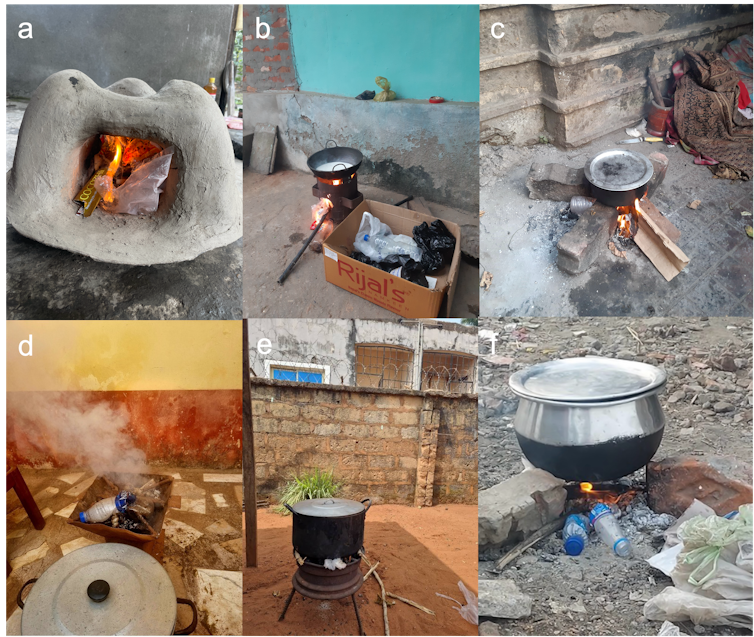
A composite image showing examples of how people are using plastic to cook and heat their homes.
Burning plastic waste for cooking and heating is becoming increasingly common in city slums. a–f, Photographs showing the use of plastic to start a fire in Koshi Province in Nepal (a), a household heating milk by burning plastic in Madhesh province of Nepal (b) and the burning of plastic in Guwahati, India (c), in Enugu, Nigeria (d,e) and in the slums of Lahore, Pakistan (f). Credits for photographs: a, Srijana Baniya; b, Pramesh Dhungana; c, Monjit Borthakur; d,e, Chizoba Obianuju Oranu; f, Sobia Rose. Bharadwaj, B., Gates, T., Borthakur, M. et al. The use of plastic as a household fuel among the urban poor in the Global South. Nat Cities (2025).

A product of energy poverty in city slums

Increasing urbanisation is reducing access to traditional fuels such as wood and crop residue from farmland.

But plastic is readily available. Low-income households with little or no access to gas or electricity often find themselves living alongside mountains of rubbish.

This plastic, made from fossil fuels, represents a cheap and convenient fuel. It’s lightweight, easy to transport, and a nuisance material that people want to be rid of. Plastic is also relatively easy to dry and store, but can burn even when wet. It’s also flexible and pliable, so it can be used easily in traditional cooking arrangements such as basic stoves.

Burning plastic releases toxins such as dioxins, furans and heavy metals into the air. These chemicals are known to cause cancer, heart disease and lung diseases.

The more vulnerable people in the household – including women and children and those who spend more time indoors – tend to be most exposed to the fumes. But the problem also affects people in the neighbourhood and the wider community.

Burning plastic is likely to also contaminate food. For example, eggs from farms near plastic waste incinerators in Indonesia contained hazardous chemicals from burned plastic. However, more evidence is needed around food contamination.

Furthermore, when households burn plastic bottles and other containers, some of the original contents also burn. Given chemicals are poorly regulated, the consequences of burning plastic could be greater still.

Overcoming the problem

A first step to overcoming the problem is understanding the reality of those living in slums. Policy-makers need to recognise these people’s needs and the challenges they face.

Extensive research is needed to design the most effective and inclusive policy interventions. This needs to be addressed if we are to reduce the associated health and environmental impacts on such large populations across the world.

We have gathered a collaborative, multidisciplinary team of researchers from around 35 countries – mostly in the Global South – to better understand the problem. We recently completed a survey of people exposed to the issue such as local government employees, teachers and community workers in more than 100 cities in 26 countries.

We are also examining the emissions from waste plastic during food preparation to determine the extent of contamination in variety of stoves.

Nobody wants to burn plastic waste to cook food, so policies like ban on burning plastic with out contextual intervention will not work. There is a need to design inclusive policy interventions that provide equitable benefits to the wider community. For example, encouraging people to:

  • wash any plastic before it is burned, to remove chemical residues
  • use improved cookstoves that vent the fumes outside
  • expand basic urban amenities like waste management to low income settlements
  • provide support to help lift households out of poverty.

Each approach will depend on the specific requirements of the slum settlement. But by implementing multiple approaches in parallel, we can tackle the problem more effectively.

Authors: Bishal Bharadwaj, Adjunct Research Fellow, Curtin Institute for Energy Transition, Curtin University

Read more https://theconversation.com/households-are-burning-plastic-waste-as-fuel-for-cooking-and-heating-in-slums-the-world-over-250265

Business News

How Industrial Drying Equipment Supports Efficient Processing

Many industrial processes require moisture to be removed from compressed air, products or process materials before they move to the next stage. Excess moisture can affect equipment performance, produc...

Daily Bulletin - avatar Daily Bulletin

Practical Ways a Whiteboard Can Improve Workplace Communication

Effective communication helps teams stay organised, share ideas and keep track of important information. While digital tools are now common in many workplaces, a whiteboard continues to provide a simp...

Daily Bulletin - avatar Daily Bulletin

Designing Eco-Friendly Custom Water Bottles for Your Next Event

The Evolution of Sustainable Event Merchandise Event planning has undergone a massive transformation over the last decade. Gone are the days when organizers could hand out cheap, single use plastic...

Daily Bulletin - avatar Daily Bulletin

Why Choosing a Professional Florist Melbourne Makes Flower Delivery Impactful

Flowers have a great power to speak when humans cannot express their feelings with right words. Flowers are the best gifts when you are celebrating a birthday or welcoming a newborn child into your fa...

Daily Bulletin - avatar Daily Bulletin

The Business Case for Choosing Australian Fabricators Over Imported Alternatives

For a long time, you might have defaulted to overseas suppliers when sourcing fabricated metal components for a project. The unit price was lower on paper, and the maths seemed straightforward. That...

Daily Bulletin - avatar Daily Bulletin

Australian organisations are relying on business continuity plans built for a far more predictable world

Tariff escalations, supply chain fragility, geopolitical events, and the ongoing threat of cyber disruption have reshaped the risk environment facing Australian organisations. The problem is that ma...

Daily Bulletin - avatar Daily Bulletin

How to Rent a Car for Uber in Melbourne: What Every New Driver Needs to Know

Starting out as an Uber driver in Melbourne is not as complicated as it sounds but getting the vehicle right is where most new drivers get stuck. Uber has strict requirements around vehicle age, condi...

Daily Bulletin - avatar Daily Bulletin

When Should You Speak to a Lawyer About a Legal Issue?

Legal issues can begin with a simple question, then become harder to manage once formal steps are involved. Many people wait until a matter feels urgent before seeking guidance, even though earlier ...

Daily Bulletin - avatar Daily Bulletin

The strategic rise of Bali as Australia’s next essential healthcare support hub

As Australian healthcare providers grapple with unprecedented operational bottlenecks, a new nearshore model is quietly transforming patient care delivery. Forward-thinking organisations,  including...

Daily Bulletin - avatar Daily Bulletin

The Daily Magazine

Top Garment Steamers for Busy Professionals in Australia

The gap between garment steamers built for a quick touch-up and ones built to keep pace with a wor...

Correct Sleeping Posture to Minimize Back Strain

Most people don’t pay much attention to how they sleep until they start waking up with a stiff bac...

Why Product Longevity Matters for Sustainable Australian Buildings

Sustainability in building design is often associated with recycled materials, renewable resources a...

NDIS Support Coordination Explained: What Does a Support Coordinator Actually Do?

NDIS support coordination explained means understanding how a professional can help participants n...

When Should You Speak with Divorce Lawyers in Sydney?

Divorce involves more than completing an online application. It can affect parenting arrangements, p...

How to Choose a Reliable Hot Water System Installer on the Gold Coast

Choosing a reliable installer is just as important as choosing the right hot water system. A qualifi...

How Microtask Platforms Support Modern Digital Promotion

Digital promotion has become increasingly complex. Businesses communicate with customers through w...

Cosmetic Dentistry Options From a Brisbane-Based Dental Team

You cover your mouth when you laugh. You skip the group photo. Maybe you edit pictures to soften a...

Essential Steps to Handle Sudden Tooth Pain and Dental Crises

A sudden, throbbing toothache can totally stop your whole day, with no warning. When severe pain, ...