

Microsoft just claimed a quantum breakthrough. A quantum physicist explains what it means
- Written by: Stephan Rachel, Professor, School of Physics, The University of Melbourne
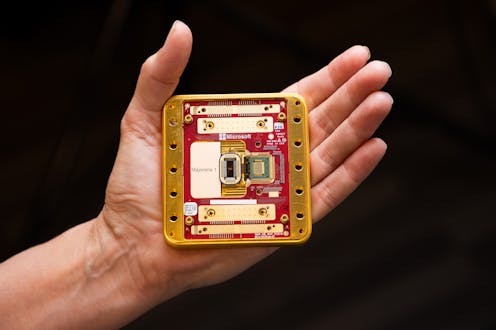
Researchers at Microsoft have announced the creation of the first “topological qubits” in a device that stores information in an exotic state of matter, in what may be a significant breakthrough for quantum computing.
At the same time, the researchers also published a paper in Nature and a “roadmap” for further work. The design of the Majorana 1 processor is supposed to fit up to a million qubits, which may be enough to realise many significant goals of quantum computing – such as cracking cryptographic codes and designing new drugs and materials faster.
If Microsoft’s claims pan out, the company may have leapfrogged competitors such as IBM and Google, who currently appear to be leading the race to build a quantum computer.
However, the peer-reviewed Nature paper only shows part of what the researchers have claimed, and the roadmap still includes many hurdles to be overcome. While the Microsoft press release shows off something that is supposed to be quantum computing hardware, we don’t have any independent confirmation of what it can do. Nevertheless, the news from Microsoft is very promising.
By now you probably have some questions. What’s a topological qubit? What’s a qubit at all, for that matter? And why do people want quantum computers in the first place?
Quantum bits are hard to build
Quantum computers were first dreamed up in the 1980s. Where an ordinary computer stores information in bits, a quantum computer stores information in quantum bits – or qubits.
An ordinary bit can have a value of 0 or 1, but a quantum bit (thanks to the laws of quantum mechanics, which govern very small particles) can have a combination of both. If you imagine an ordinary bit as an arrow that can point either up or down, a qubit is an arrow that can point in any direction (or what is called a “superposition” of up and down).
This means a quantum computer would be much faster than an ordinary computer for certain kinds of calculations – particularly some to do with unpicking codes and simulating natural systems.
So far, so good. But it turns out that building real qubits and getting information in and out of them is extremely difficult, because interactions with the outside world can destroy the delicate quantum states inside.
Researchers have tried a lot of different technologies to make qubits, using things like atoms trapped in electric fields or eddies of current swirling in superconductors.
Tiny wires and exotic particles
Microsoft has taken a very different approach to build its “topological qubits”. They have used what are called Majorana particles, first theorised in 1937 by Italian physicist Ettore Majorana.
Majoranas are not naturally occurring particles like electrons or protons. Instead, they only exist inside a rare kind of material called a topological superconductor (which requires advanced material design and must be cooled down to extremely low temperatures).
Indeed, Majorana particles are so exotic they are usually only studied in universities – not used in practical applications.
The Microsoft team say they have used a pair of tiny wires, each with a Majorana particle trapped at either end, to act as a qubit. They measure the value of the qubit – expressed by means of whether an electron is in one wire or the other – using microwaves.
Braided bits
Why has Microsoft put in all this effort? Because by swapping the positions of Majorana particles (or measuring them in a certain way), they can be “braided” so they can be measured without error and are resistant to outside interference. (This is the “topological” part of “topological qubits”.)
In theory, a quantum computer made using Majorana particles can be completely free of the qubit errors that plague other designs.
This is why Microsoft has chosen such a seemingly laborious approach. Other technologies are more prone to errors, and hundreds of physical qubits may need to be combined together to produce a single reliable “logical qubit”.
Microsoft has instead put its time and resources into developing Majorana-based qubits. While they are late to the big quantum party, they hope they will be able to catch up quickly.
There’s always a catch
As always, if something sounds too good to be true, there is a catch. Even for a Majorana-based quantum computer, such as the one announced by Microsoft, one operation – known as T-gate – won’t be achievable without errors.
So the Majorana-based quantum chip is only “almost error-free”. However, correcting for T-gate errors is much simpler than the general error correction of other quantum platforms.
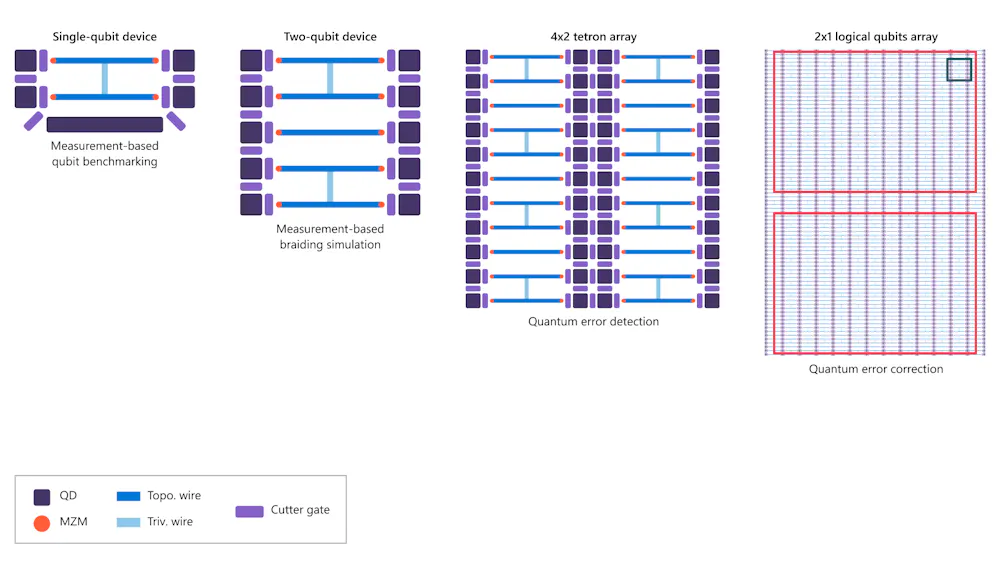
What now? Microsoft will try to move ahead with its roadmap, steadily building larger and larger collections of qubits.
The scientific community will closely watch how Microsoft’s quantum computing processors operate, and how they perform in comparison to the other already established quantum computing processors.
At the same time, research into the exotic and obscure behaviour of Majorana particles will continue at universities around the globe.
Authors: Stephan Rachel, Professor, School of Physics, The University of Melbourne


 Daily Bulletin


