

Getting the temperature just right helps people with dementia stay cool
- Written by: Paul Cooper, Senior Professor and Director of the Sustainable Buildings Research Centre (SBRC), University of Wollongong
Everyone knows how bad it feels when the temperature is uncomfortably hot or cold. For most of us it doesn’t last long as we can take simple steps to get comfortable, such as putting on clothes, opening a window, or switching on a heater.
But what happens when you can’t control the temperature where you live? This problem is faced by many residents of aged care facilities, and can be particularly difficult for those living with dementia. To find out how these residents cope we recently carried out a three-year research project on the effects of indoor environment in aged care facilities in south-eastern NSW. This was part of a broader program of University of Wollongong research on the impact of indoor environment on elderly people.
Read more: Australia's aged care residents are very sick, yet the government doesn't prioritise medical care
Dementia and agitation
Dementia is a collection of symptoms that affect people’s behaviour, thinking, and their ability to communicate and perform everyday tasks. Sometimes people with dementia can become agitated or distressed, which can be disturbing for other people around them. This often happens for no clear reason.
This is a big issue for the aged care sector since approximately half of all residents in aged care facilities have dementia.
While current rules governing the accreditation of aged care facilities in Australia do make reference to the need to provide ‘comfortable internal temperatures and ventilation’ there is no specific reference to what temperature ranges are considered comfortable. We set out to find whether this should be remedied and whether there is a relationship between agitation among residents living with dementia and the indoor temperatures to which they are exposed.
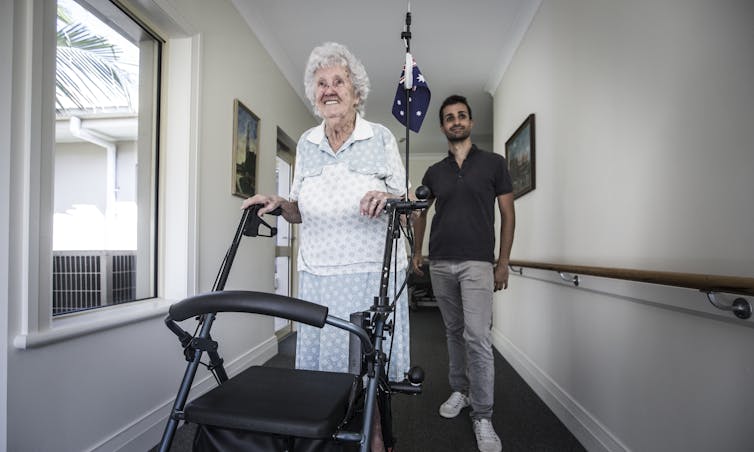 Dr Federico Tartarini (right) led the study that found that indoor temperatures in aged care centres have a dramatic impact on the wellbeing of residents, particularly those living with dementia. Photo: University of Wollongong.
Author supplied, CC BY
Dr Federico Tartarini (right) led the study that found that indoor temperatures in aged care centres have a dramatic impact on the wellbeing of residents, particularly those living with dementia. Photo: University of Wollongong.
Author supplied, CC BY
Tracking the temperature
Firstly we set up a network of sensors in six aged care facilities to monitor indoor environmental conditions, such as air temperature, humidity, air velocity and noise.
In collaboration with the care staff of one particular facility we then assessed the frequency and intensity of a range of agitated behaviours exhibited by residents living with dementia over the course of a year.
The most important finding of this study was that the frequency and intensity of agitated behaviours of residents with dementia significantly increased when they were exposed to uncomfortable air temperatures.
A statistically significant correlation was found between rates of agitation of residents and their cumulative exposure to temperatures outside their comfort zone of between 20°C and 26°C.
More generally, the data collected from the hundreds of temperature sensors across all our case study facilities over a one-year period showed that some facilities were often uncomfortably hot or cold (below 19°C in winter and over 30°C in summer) for significant periods.
Poorly designed buildings
This was attributable to many different factors including poor thermal design of the buildings and poor control of the heating and cooling systems. Interestingly, our analysis showed staff were significantly less tolerant of variations in indoor temperature than residents, probably because they were generally more active than the residents (i.e. moving around and working), and therefore had higher metabolic rates. They may have also had higher thermal comfort expectations than the residents.
Regulations can help
The evidence appears to suggest that maintaining a comfortable temperature will reduce the behavioural and psychological symptoms of dementia.
There is a clear need for new regulations that ensure aged care facilities provide comfortable indoor environmental conditions, particularly for elderly residents, but also for the staff working in these facilities.
The aged care sector needs good indoor environmental rating tools, built on recent research evidence, to guide the design of their facilities and to audit their operations.
This type of approach has already been successfully applied in the commercial building sector, where mandatory disclosure of the real energy consumption of larger offices, for example, is required of owners wishing to sell or lease their property.
Read more: Why is it so cold in here? Setting the office thermostat right – for both sexes
Publicly available ratings of the actual indoor environment provided to aged care residents and staff would alert architects, managers and staff to the importance of thermal comfort and help elderly people, and their families, make a more informed choice as to the best facility in which to live.
Authors: Paul Cooper, Senior Professor and Director of the Sustainable Buildings Research Centre (SBRC), University of Wollongong


 Daily Bulletin


